Key Takeaways
- The Break-Even Formula is simply dividing total fixed costs by the contribution margin per rental (rental price minus variable costs). Example: $15,000 fixed costs ÷ $300 margin = 50 rentals needed for water slide profitability.
- Purchase Timing Matters Significantly. January-March buyers achieve 2.9-4 months payback by capturing the full peak season. Off-season purchases extend commercial water slide investment recovery to 12-15 months—timing affects break-even speed by 300%.
- Premium Pricing Cuts Break-Even in Half $450-$600 daily rates require only 20-30 rentals versus 60-80 at budget pricing. Add-ons like concessions and generators increase margins 15-30% without proportional costs in your inflatable rental business calculator.
- Tax Benefits Reduce Effective Investment 25-40% Section 179 deductions and 60% bonus depreciation return $2,500 on a $10,000 slide at a 25% tax rate. This accelerates how a commercial water slide pays for itself through rental income by lowering the net capital required.
- Track Weekly or Miss Your Timeline Monitor utilization versus 1.5-2 weekly rental targets. Monthly reviews catch problems when minor pricing adjustments close gaps—waiting until season's end turns 6-month water slide break-even analysis projections into 12-18 month realities.
Break-even analysis determines the exact point where your commercial water slide investment starts generating profit. It's the threshold where total revenue from rentals equals all costs—both fixed expenses like insurance and storage, plus variable costs like fuel and labor. This calculation is essential for understanding water slide profitability and planning your inflatable rental business strategy.
The water slide break-even analysis formula is straightforward: divide your total fixed costs by the contribution margin per rental. Contribution margin equals your rental price minus variable costs per booking. For example, if your annual fixed costs total $15,000 and you earn a $300 contribution margin per rental ($350 rental rate minus $50 variable costs), you need 50 rentals per year to break even. Beyond this point, every additional rental generates pure profit. This inflatable rental business calculator approach shows exactly how many bookings transform your commercial water slide investment from an expense into a revenue generator.
Why Water Slides Need Break-Even Calculations
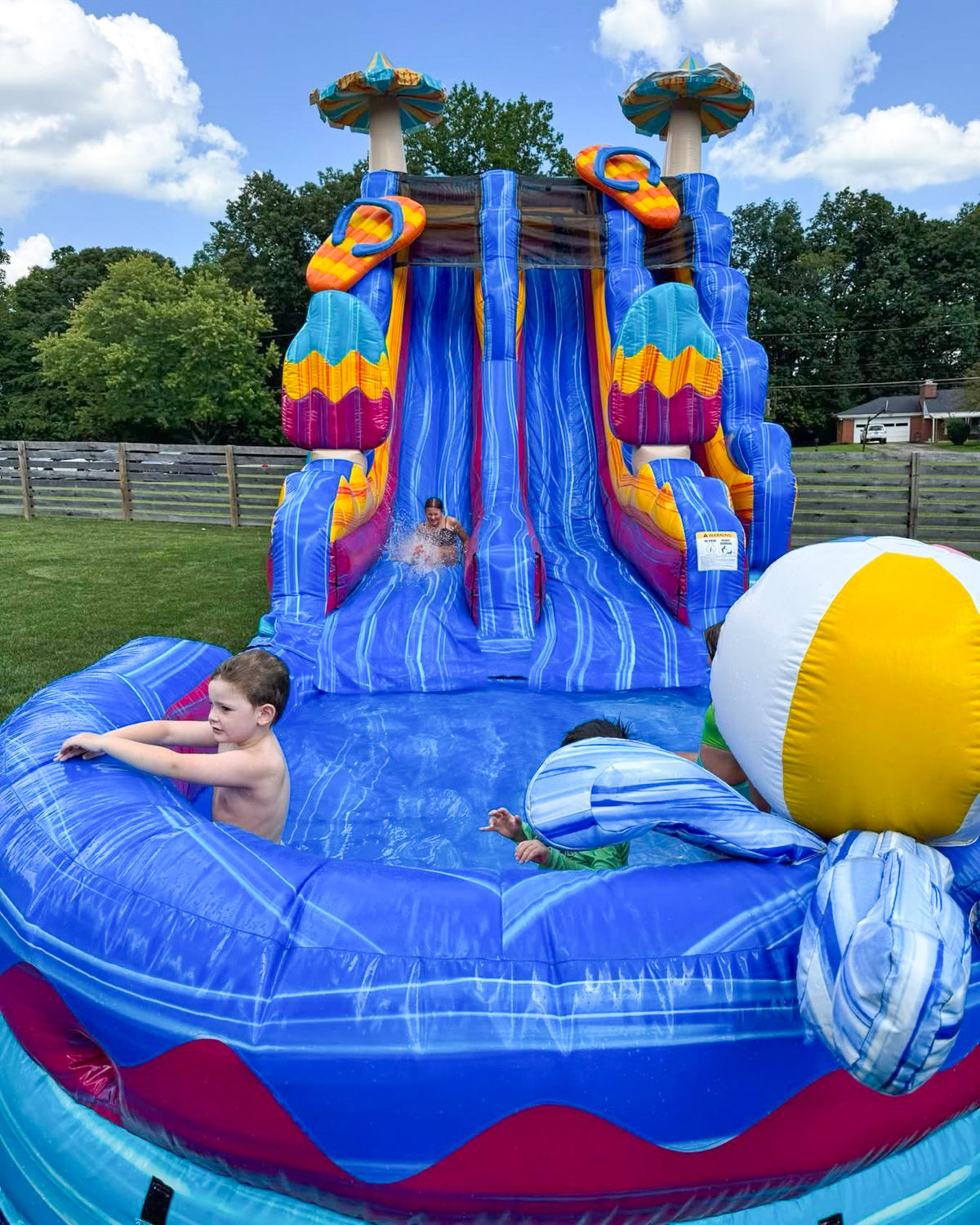
Commercial water slide investments demand precise break-even analysis due to their substantial upfront costs and seasonal revenue patterns. A quality 30-foot inflatable slide ranges from $4,000 to $16,000, while standard commercial units cost $2,000 to $10,000. Unlike smaller inflatables, water slides concentrate roughly 70% of annual revenue into a four-month peak season (May through August), making timing and utilization critical for water slide profitability.
Hidden costs significantly impact your inflatable rental business calculator projections. Beyond equipment purchase, expect $15,000 to $25,000 in annual operational expenses—insurance, storage, maintenance, permits, and marketing. Despite these costs, the industry maintains 30-40% gross margins. Most operators achieve water slide break-even analysis targets within 6-9 months under optimal conditions, though 12-18 months represents the industry average. Understanding these numbers before purchasing ensures your commercial water slide investment generates expected returns rather than tying up capital without adequate payback.
How to Calculate Break-Even for Your Water Slide
The basic payback formula divides equipment cost by monthly net revenue, but a complete water slide break-even analysis requires factoring in both equipment recovery and ongoing fixed costs. Start by calculating your contribution margin per rental: subtract variable costs from your rental price. This margin represents the actual profit available to recover your commercial water slide investment and cover fixed expenses.
Here's a real-world example for water slide profitability calculations. A $4,500 commercial slide renting at $350 per event with $50 variable costs (fuel, labor, cleaning) yields a $300 contribution margin. At 8 rentals per month during peak season, you generate $2,400 monthly contribution, recovering equipment costs in just 1.9 months. However, your inflatable rental business calculator must include allocated fixed costs. With $3,000 in annual fixed expenses allocated to this unit, the total break-even point reaches 23.3 rentals. This comprehensive approach shows how a commercial water slide can pay for itself through rental income: the equipment recovers quickly, but true profitability begins after covering both equipment and operational costs.
What Variable Costs Affect Each Rental?
Variable costs directly impact your water slide profitability by reducing contribution margin on every booking. Labor represents the largest expense at $45-$90 per rental, covering delivery, setup, and takedown time. Fuel costs run $20-$50, depending on distance, while cleaning supplies add $5-$15 per event. Factor in $10-$30 for equipment wear allocation and 2.9% plus $0.30 for payment processing fees.
Distance-based pricing affects your commercial water slide investment returns. Charge $3.50 per mile beyond your standard delivery radius to cover additional fuel and time. Extended rental periods command $75-$100 premiums without proportional cost increases, improving margins. Most operators calculate $50-$80 total variable costs per rental in their inflatable rental business calculator. Accurate variable cost tracking is essential for water slide break-even analysis—underestimating by even $20 per rental means you'll need significantly more bookings before your commercial water slide pays for itself through rental income.
How Seasonal Demand Changes Break-Even Timeline
Seasonal demand patterns dramatically affect water slide profitability and payback speed. Peak season from May through August generates 70% of annual reservations, with July recording the highest booking volume. During these four months, achieving 30-50 rentals per month is realistic, while off-season months (November-February) see 60% booking declines. This concentration means your commercial water slide investment recovers fastest when purchased before peak season begins.
Purchase timing directly impacts your water slide break-even analysis timeline. January-March buyers capture the full peak season, achieving 2.9-4 month payback periods. April-May purchases extend timelines to 4-6 months, while mid-summer buyers (June-August) need 6-9 months. September-December purchases face 12-15 month payback periods because they miss the entire peak season. Booking lead times of 4-6 weeks for peak weekends means your inflatable rental business calculator should account for marketing ramp-up time. Conservative operators calculate break-even based on peak season performance only, ensuring their commercial water slide pays for itself through rental income even without off-season bookings.
What Rental Rates Speed Up Break-Even?
Rental pricing directly determines how quickly your commercial water slide investment reaches profitability. Higher rates dramatically reduce the number of bookings needed for water slide break-even analysis targets. The table below illustrates this impact using a $4,500 slide with $3,000 allocated fixed costs:
|
Pricing Tier |
Daily Rate |
Break-Even Rentals |
Timeline at 2/week |
|
Budget |
$200-$250 |
60-80 rentals |
7.5-10 months |
|
Standard |
$300-$400 |
35-50 rentals |
4.4-6.3 months |
|
Premium |
$450-$600 |
20-30 rentals |
2.5-3.8 months |
While the industry average sits at $200-$300 daily, commercial water slides command $300+ rates due to size and appeal. Premium pricing cuts break-even timelines in half compared to budget rates, significantly improving water slide profitability. Urban markets with 65% penetration support premium pricing, while 73% customer return rates ensure consistent bookings for your inflatable rental business calculator projections.
Add-ons accelerate how a commercial water slide pays for itself through rental income. Concession machines ($45-$55), generators ($50-$100), and extended time ($75-$100) increase margins 15-30% per rental without proportional cost increases. A $350 base rental plus $100 in add-ons reduces your break-even from 35 to 27 rentals—shaving weeks off your commercial water slide investment recovery.
How Different Water Slide Types Compare
Equipment type significantly impacts your water slide break-even analysis and overall commercial water slide investment returns. Standard bounce houses offer the fastest equipment payback at 2.4 months ($2,000 cost, $200-$300 rentals), while combo wet/dry units achieve 2.3-month payback despite higher $2,500-$6,000 costs due to premium rental rates and 484% annual ROI. Commercial water slides ($4,000-$10,000) reach break-even in 2.9 months at $300+ daily rates. Large 40-foot obstacle courses require 6-8 months but deliver 393% first-year ROI, making them strong long-term water slide profitability plays.
Premium slides break even faster despite higher upfront costs because they command $300+ rental rates versus $200-$250 for budget units. Premium 18-ounce vinyl construction extends equipment life 40% with proper maintenance, reducing replacement frequency in your inflatable rental business calculator projections. Lower repair rates minimize revenue-killing downtime during peak season. Quality features justify premium pricing to customers, while superior durability generates steady income streams for several years. This is how a commercial water slide pays for itself through rental income more efficiently—higher rates and longer lifespans compound returns, offsetting the initial commercial water slide investment premium within months while delivering better margins throughout the equipment lifecycle.
What Strategies Reduce Break-Even Timeline 30-50%?
Tax benefits dramatically accelerate water slide profitability by reducing your effective commercial water slide investment. Section 179 allows immediate write-offs up to $1,220,000 in 2024, while bonus depreciation provides 60% first-year deductions (declining to 0% by 2027). Equipment qualifies as 5-year property under MACRS. A $10,000 slide at a 25% tax rate returns $2,500, dropping net investment to $7,500—significantly shortening your water slide break-even analysis timeline. This federal incentive means your commercial water slide pays for itself through rental income 25-40% faster than gross cost calculations suggest.
Strategic purchasing accelerates payback further. Cash purchases avoid 6-12% financing interest that extends timelines, though equipment loans preserve capital for marketing. Multi-slide purchases share fixed costs across units—$15,000 in insurance and storage divided by three slides versus one, dramatically improving per-unit economics in your inflatable rental business calculator. Startup packages range from $10,000-$15,000 (1-2 units) to $25,000-$35,000 (3-4 units), with larger inventories achieving economies of scale. Purchase timing matters most: January-March buyers capture full peak season for 2.9-4 month payback, while mid-year purchases extend timelines 50-100%. Combining tax benefits, cash purchasing, and pre-season timing can reduce break-even by 30-50% compared to financed off-season purchases.
What Break-Even Timeline is Realistic?
Conservative water slide break-even analysis projects 50 rentals annually—achievable even with minimal marketing in most markets. Moderate scenarios target 8-10 monthly rentals (96-120 annually), while aggressive operators achieve 15-20 monthly rentals during May-August peak season. These projections determine realistic commercial water slide investment recovery timelines based on market conditions and operational capacity.
Optimal conditions deliver 6-9 months payback, though the industry average sits at 12-18 months for standard operations. First-year operators realistically achieve 6-9 month timelines with strong pre-season marketing and full peak season capture in their inflatable rental business calculator. The key requirement: maintain 1.5-2 rentals per week utilization rates during the operating season. This is how a commercial water slide pays for itself through rental income within one season—consistent weekly bookings compound quickly. Missing this utilization target extends water slide profitability timelines significantly, while exceeding 2 weekly rentals can push break-even under six months. New operators should plan conservatively for 12-month payback, then optimize toward 6-9 month targets as booking systems and marketing mature.
How to Track Your Break-Even Progress?
Systematic tracking ensures your water slide break-even analysis stays on target throughout the operating season. Monitor weekly utilization against target rental counts—if projections require 2 rentals per week but you're averaging 1.2, you'll miss payback timelines. Track monthly revenue against cumulative costs to identify variance early, while calculating contribution margin per rental confirms consistent water slide profitability. Margins that decline signal rising variable costs or discounting issues that extend your commercial water slide investment recovery.
Customer acquisition costs directly impact break-even speed—control marketing spend under 15% of revenue to maintain projections in your inflatable rental business calculator. Analyze seasonal booking patterns to refine next year's forecasts and identify growth opportunities. Create a simple break-even dashboard tracking rentals completed versus required, making progress visible at a glance. If falling behind projections, adjust pricing strategy immediately rather than waiting until the season's end. This is how a rent grade inflatable obstacle course and commercial water slide pays for itself through rental income on schedule—proactive tracking catches problems when minor pricing adjustments or marketing pushes can close gaps, preventing 6-month targets from stretching to 12-18 months due to unaddressed booking shortfalls.
Is Break-Even Analysis Enough for Investment Decisions?
Water slide break-even analysis reveals minimum viability, but shouldn't drive commercial water slide investment decisions alone. Break-even shows when you stop losing money—not when you start making substantial profits. Evaluate ROI percentages alongside payback periods: the industry averages 200-300% annual returns, with peak performance reaching 500%. A slide that breaks even in 6 months but delivers only 50% annual ROI underperforms one requiring 9 months but generating 400% returns.
Comprehensive evaluation examines market factors your inflatable rental business calculator can't capture—local competition intensity, weather volatility, and storage availability all affect water slide profitability beyond pure numbers. Full analysis requires 3-year profit projections and equipment lifecycle costs, not just first-year break-even. Well-executed operations reach $50,000-$200,000+ revenue within 2-3 years, supported by 7.2% annual industry growth and 25% expansion over five years. Success cases show that 150% booking increases within six months are possible. Factor non-negotiable costs like comprehensive liability insurance into projections. This complete picture shows how a commercial water slide pays for itself through rental income long-term—break-even is your starting point, but combine it with ROI analysis, cash flow projections, and market assessment before committing capital to any commercial water slide investment.
Start Your Water Slide Rental Business with JumpOrange
Ready to turn your water slide break-even analysis into reality? JumpOrange provides commercial-grade inflatable water slides built for rapid ROI and long-term profitability. Our premium 18-ounce vinyl construction delivers the durability that extends equipment life 40%, while our industry expertise helps you optimize your commercial water slide investment from day one.
Whether you're calculating your first inflatable rental business setup or expanding existing inventory, JumpOrange offers the equipment quality and support that accelerates how a commercial water slide pays for itself through rental income. Contact our team today to discuss which water slide models and sports inflatables fit your market, review water slide profitability projections for your area, and access financing options that improve your payback timeline. Let's build your path to that 6-9 month break-even target together.


Leave a comment
This site is protected by hCaptcha and the hCaptcha Privacy Policy and Terms of Service apply.