
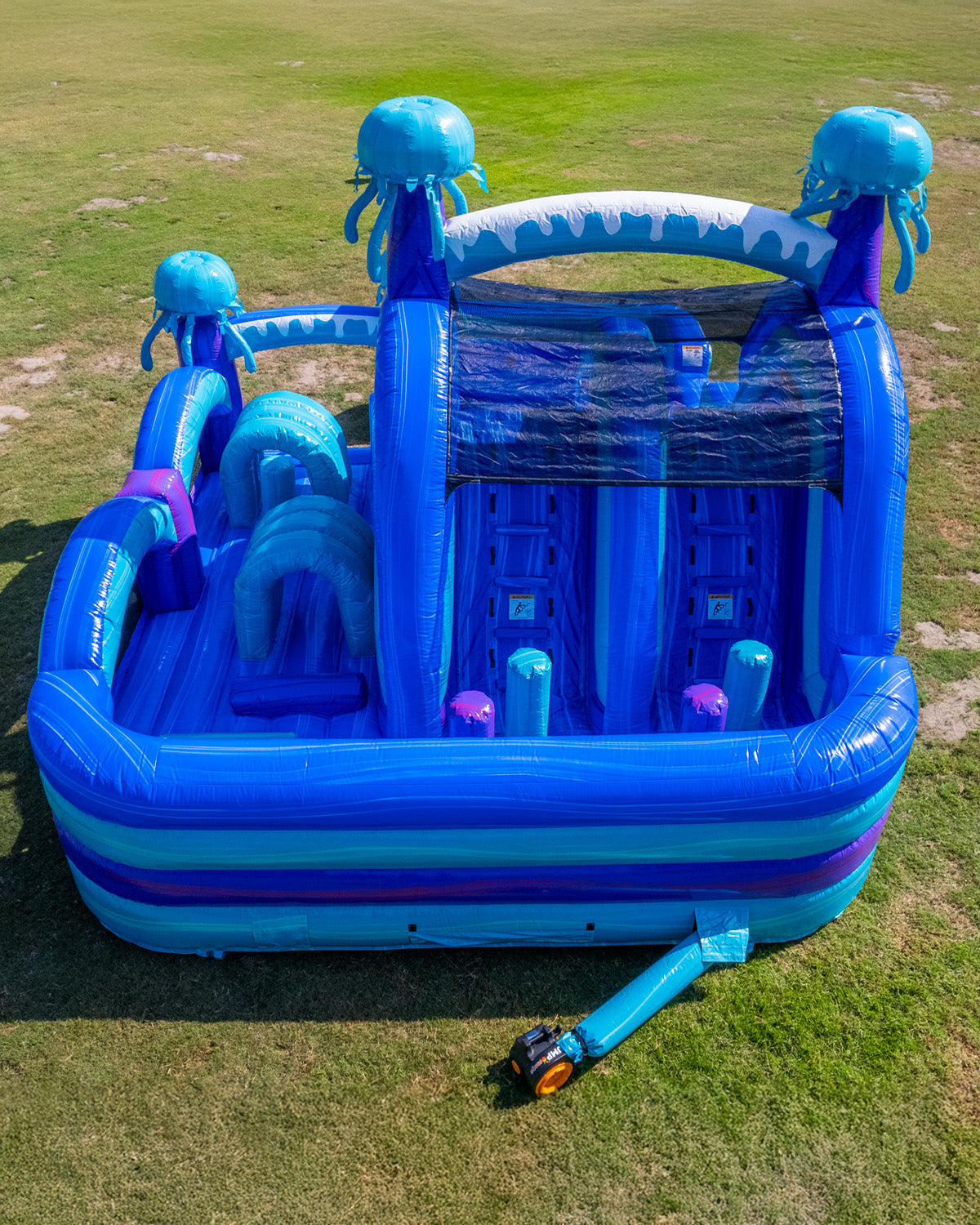
Key Takeaways
- Construction Thickness Determines Lifespan: Premium 18-20oz construction thickness delivers 5-10 year lifespan versus budget 2-3 years when buying inflatable slip and slides—thin materials fail under commercial rental frequency.
- Seam Construction Prevents 80% of Failures: Triple/quadruple-stitching plus heat-welding prevents seam separation—proper construction thickness and seam construction reduce annual maintenance from 20-25% to 10-15%.
- Budget Costs 40% More Long-Term: Premium commercial slip and slide construction generates $25,000-50,000 lifetime revenue versus a budget $8,000-15,000 through superior slip and slide durability.
- ASTM F2374-19 Required for Insurance: Minimum 18oz construction thickness with proper seam construction mandatory—no certification means no coverage when buying inflatable slip and slides.
- Verify Specifications Before Purchase: Confirm exact oz/yd², seam method, ASTM certification, and inspect samples—construction thickness and seam construction documentation protects commercial slip and slide investments.
Construction thickness determines whether your inflatable slip and slide survives one season or ten. Material weight—measured in ounces per yard² (oz/yd²) and millimeter thickness—directly impacts slip and slide durability, puncture resistance, and your bottom line when buying inflatable slip and slides for commercial use.
Material Weight Standards for Commercial Slip and Slide:
Residential 13oz PVC fails immediately under commercial rental frequency. Budget-commercial 15oz (0.45-0.50mm) deteriorates within 12-18 months of regular bookings. The 18oz commercial minimum (0.55mm) represents the industry baseline—anything less isn't truly commercial-grade despite marketing claims.
Premium 18-20oz construction thickness (0.55-0.7mm) withstands 500+ inflation cycles per season. Thickness directly correlates to puncture resistance and tear strength under concentrated user loads during active sliding.
Durability and Cost Impact:
UV degradation reveals the truth about construction thickness and seam construction quality. Thin materials fade and crack within 1-2 seasons. Premium thickness maintains structural integrity and appearance for 4-5+ seasons.
Poor material choices when buying inflatable slip and slides increase operational costs by up to 40%. Budget construction lasts 2-3 years. Premium construction thickness delivers a 5-10 year lifespan—the difference between replacing equipment constantly or maximizing revenue from a single commercial slip and slide investment.
How Do Seam Construction Methods Determine Durability?
Seam construction separates commercial slip and slide equipment that lasts from expensive failures. Construction thickness and seam construction work together—even 20oz material fails if seams separate under stress. Understanding the seam hierarchy protects your investment when buying inflatable slip and slides.
Seam Construction Quality Levels:
Single-stitch residential seams separate within months of commercial rental use. Double-stitch budget construction handles only light commercial frequency. Triple and quadruple-stitching distributes stress across multiple thread lines, preventing separation at connection points.
Heat-welded seams create molecular bonds exceeding stitching strength alone. The optimal combination for commercial slip and slide durability: triple or quadruple-stitching PLUS heat-welding. This dual-method construction withstands continuous water pressure without progressive degradation.
Financial Impact of Seam Quality:
Seam failures dominate equipment problems—80% of budget inflatable slip and slide failures occur at seam connections, not material tears. Repair costs average $200-400 per seam separation, representing 15-20% of the original purchase price.
Proper construction thickness and seam construction reduce annual maintenance from 20-25% to 10-15% of equipment cost. When buying inflatable slip and slides, the seam method determines whether you're constantly repairing equipment or generating revenue. Slip and slide durability depends equally on material thickness and seam construction—compromise on either specification and commercial viability disappears.
What Are the Total Ownership Costs by Construction Quality?
Total ownership costs reveal the true expense of buying inflatable slip and slides. Initial pricing misleads—construction thickness and seam construction determine maintenance burden, lifespan, and revenue potential. Budget commercial slip and slide equipment appears cheaper, but costs significantly more over operational life.
Budget vs Premium Construction Comparison:
|
Factor |
Budget (15oz/Double-Stitch) |
Premium (18-20oz/Heat-Welded Triple-Stitch) |
|
Initial Investment |
$1,500-$2,500 |
$3,500-$7,000 |
|
Annual Maintenance |
20-25% of the purchase price |
10-15% of the purchase price |
|
Expected Lifespan |
2-3 years |
5-10 years |
|
5-Year Maintenance |
$2,000-3,500 |
$1,200-2,100 |
|
Rental Rate per Event |
$200-300 |
$300-500 |
|
Lifetime Revenue |
$8,000-15,000 |
$25,000-50,000 |
|
Break-Even Rentals |
12-20 events |
22-35 events |
Why Does Premium Construction Deliver Superior ROI?
The initial price difference represents only 30-40% of the 5-year total ownership costs when buying inflatable slip and slides. Premium construction thickness and seam construction enable 25-50% higher rental rates—customers recognize quality and pay accordingly.
Slip and slide durability drives booking frequency. Reliable commercial slip and slide equipment generates 30-50 bookings per season versus 20-30 for budget units requiring constant repairs. Hidden budget costs emerge within 6-12 months—seam repairs, material patches, and early replacement.
Cumulative ROI reveals the truth: premium construction delivers 200-300% returns over the lifespan versus budget 100-150%. Superior construction thickness and seam construction transform a commercial slip and slide from an expense into a profit center.
When Does Budget Construction Make Sense?
Budget construction serves three specific scenarios when buying inflatable slip and slides: market testing with under 15 bookings planned, supplementary income without growth intentions, or short-term 1-2 year operation before business exit.
Even these limited scenarios require minimum standards. Never purchase bounce house combos or slip and slides below 18oz construction thickness with at least double-stitching. Slip and slide durability below this threshold creates liability exposure regardless of business model. Inadequate construction thickness and seam construction endanger users and eliminate insurance coverage—no commercial slip and slide operation survives these risks.
How Do Construction Specifications Impact Safety and Insurance?
Construction thickness and seam construction directly determine insurance eligibility and legal liability when buying inflatable slip and slides. Inadequate specifications create safety hazards, void coverage, and expose rental businesses to catastrophic financial risk. Commercial slip and slide operators cannot separate construction quality from liability protection.
What Safety Risks Come from Inadequate Construction?
Material puncture during active use represents the primary safety hazard. Thin PVC tears under concentrated user weight, creating fall hazards mid-slide. Seam separation while inflated causes progressive deflation during operation—users suddenly drop onto hard ground as the commercial slip and slide collapses.
Structural collapse occurs when inadequate construction thickness and seam construction fail under the maximum rated capacity. Multiple users simultaneously exceed poor specifications, causing catastrophic failure. Legal exposure multiplies dramatically when construction defects contribute to injury incidents—slip and slide durability failures transform accidents into negligence claims with substantially higher settlement costs.
How Does Construction Quality Affect Insurance?
ASTM F2374-19 certification mandates a minimum 18oz construction thickness plus proper seam construction methods. Insurance carriers require written documentation proving specifications before issuing coverage for inflatable slip and slide operations. No documentation means no coverage—regardless of marketing claims when buying inflatable slip and slides.
Premium rate variation spans 10-25% based on verified construction specifications. Carriers assess risk differently for equipment meeting versus exceeding minimum standards. Weight capacity requirements protect operators: 1,000+ pounds total capacity with 200-250 pounds per person limits.
Physical setup requirements include 5-6 feet of safety clearance around the entire commercial slip and slide unit. Construction thickness and seam construction supporting proper capacity plus adequate clearance, determine insurability. Slip and slide durability meeting these specifications enables coverage—failing them eliminates protection regardless of business quality otherwise.
What Must You Verify Before Purchase?
Verification protects your investment when buying inflatable slip and slides. Manufacturers misrepresent specifications constantly—"commercial grade" labeling means nothing without documented proof. Construction thickness and seam construction claims require written confirmation before purchase commitment. Proper verification prevents costly mistakes that destroy commercial slip and slide profitability.
Required Documentation for Commercial Equipment
Material specifications require exact numbers: 18-20oz/yd² weight and 0.55-0.7mm construction thickness documented in writing. Verbal claims and marketing materials don't satisfy insurance requirements or prove slip and slide durability specifications.
Seam construction method needs explicit confirmation: double, triple, or quadruple-stitching AND heat-welding specified separately. ASTM F2374-19 certification requires written documentation—this certification proves minimum construction thickness and seam construction standards for commercial slip and slide operations.
Warranty terms reveal the manufacturer's confidence in construction quality. Minimum 3-year coverage for materials AND seams listed as separate protected components. Inspect physical samples before purchase commitment when buying inflatable slip and slides—documentation alone doesn't guarantee actual construction matches specifications.
Red Flags Indicating Substandard Quality
"Commercial grade" marketing without oz/yd² specification indicates residential equipment mislabeled for commercial markets. Vague seam descriptions like "reinforced seams" without specific method details (double/triple/quadruple-stitch plus heat-welding) hide inadequate construction thickness and seam construction.
Warranty under 1-year or excluding seam failures signals poor slip and slide durability expectations. Price significantly below market—$1,500-2,000 for large commercial slip and slide units—indicates substandard materials regardless of marketing claims.
Missing ASTM F2374-19 certification eliminates insurance coverage eligibility when buying inflatable slip and slides. Manufacturers unable to provide specific construction technical details about construction thickness and seam construction lack quality control. These red flags guarantee equipment failure, liability exposure, and financial losses—avoid them completely.
Making the Right Construction Investment
Construction thickness and seam construction determine commercial slip and slide success or failure. These specifications are inseparable—material thickness (18-20oz) and seam construction (triple-stitch plus heat-welding) must both meet standards for commercial viability. Compromising on either specification when buying inflatable slip and slides, and operational costs multiply.
Budget construction creates a false economy. Lower initial pricing costs 40% more long-term through constant maintenance and early replacement. Premium construction thickness and seam construction enable higher rental rates, extended lifespan, and $25,000-50,000 lifetime revenue versus a budget $8,000-15,000.
ASTM F2374-19 compliance requires minimum construction standards—non-negotiable for insurance coverage. ROI analysis favors premium specifications for any operation planning, 30+ bookings per season, or 5+ year business horizon. Slip and slide durability directly determines profitability.
Verification protects your investment. Confirm exact oz/yd² construction thickness, seam method documentation, ASTM certification, and inspect physical samples before buying inflatable slip and slides. Construction thickness and seam construction specifications determine whether your commercial slip and slide generates revenue for years or fails within months—there's no middle ground.
Ready to Invest in Commercial-Grade Slip and Slide Construction?
JumpOrange delivers authentic commercial slip and slide equipment with verified construction thickness and seam construction specifications. Our inflatable slip and slides feature 18-20oz PVC with heat-welded triple-stitched seams, ASTM F2374-19 certification, and comprehensive warranties protecting your investment.
Stop risking your business on substandard construction. JumpOrange's slip and slide durability standards and inflatable obstacle course for sale options include documented material specifications, proper seam construction methods, and 3-year commercial warranties. Our construction thickness meets insurance requirements—enabling the coverage your rental business demands.
Contact JumpOrange today for commercial slip and slide equipment built to last—delivering the 5-10 year lifespan and profitability, proper construction thickness, and seam construction guarantee when buying inflatable slip and slides for serious rental operations.


Leave a comment
This site is protected by hCaptcha and the hCaptcha Privacy Policy and Terms of Service apply.