
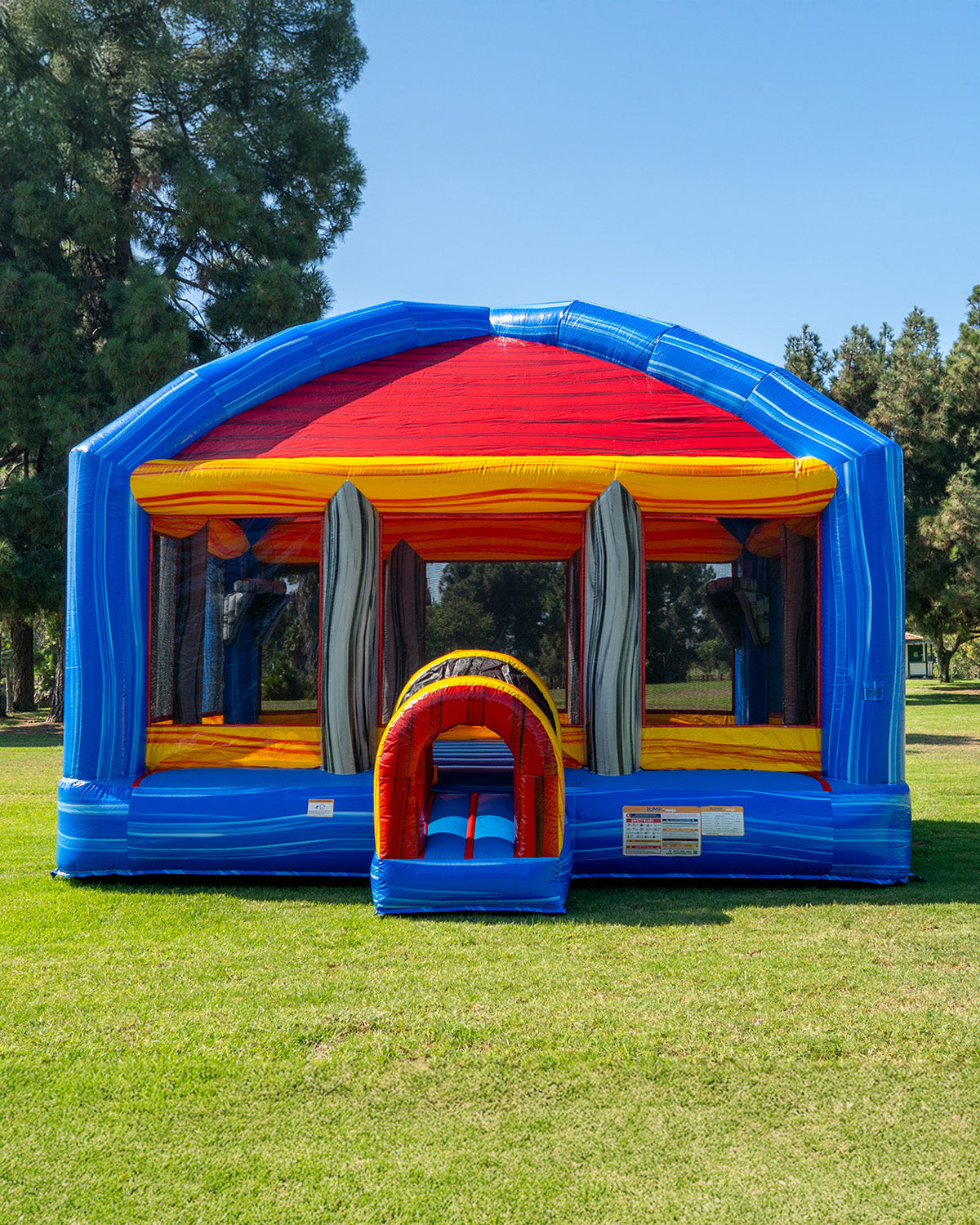
Key Takeaways:
- Inexperienced operators take 45 minutes to set up what a professional crew completes in 15 — the entire gap comes down to system, not speed.
- Quick-seal blower valves alone deliver a 25% setup time reduction, making them the single highest-impact equipment upgrade available.
- Pre-rolled packing and reverse delivery order loading together cut setup time by 30% at zero equipment cost.
- Combining all workflow optimizations adds 2.0 rentals per day, which translates to $5,000 in added seasonal revenue at standard booking rates.
- Operators with no maintenance protocol average 2.5 years of equipment life; those with a full protocol average 9 years — worn equipment slows every setup over time.
Every minute you spend on a setup that runs long is a minute you are not earning on the next job. Most bounce house operators are not slow because they lack effort. They are slow because they lack a system. This guide breaks down exactly what separates a 15-minute professional setup from a 45-minute amateur one, and gives you the step-by-step framework to close that gap permanently.
What Is Bounce House Setup Time and Why Does It Impact Your Daily Operations?
Setup time starts when your truck arrives and ends when the unit is fully ready for use. Every extra minute on-site raises your labor cost, limits how many bookings you can fit in a day, and shapes how clients perceive your business. The 45-minute setup is one of the most common and costly inefficiencies in the rental industry. It is entirely fixable.
Why Do Many Bounce House Setups Still Take 45 Minutes?
Most operators do not have a speed problem. They have a system problem. The causes are predictable, and so are the fixes.
Does Poor Pre-Delivery Preparation Slow Down Setup?
Yes. In the pre-event preparation stage alone, inexperienced operators average 8 minutes compared to 2 minutes for a professional crew. That 6-minute gap happens before you leave the warehouse. Disorganized loading, missing accessories, and tangled units compound every stage that follows.
Does Site Uncertainty Add Delays During Setup?
Yes. Site assessment takes a professional crew 1 minute and an inexperienced operator 5 minutes. Arriving without knowing the layout means turning a quick visual check into an on-site problem-solving session. You need surface type, gate width, and outlet location confirmed before you arrive. The minimum clearance for a standard bounce house is 3 feet on all sides. Find out before you get there.
Does Inconsistent Workflow Increase Setup Time?
Yes. The tarp and positioning stage takes professionals 2 minutes and inexperienced operators 5 minutes. Not because of physical difficulty, but because of decision-making. Without a fixed sequence, every job starts from scratch mentally. You slow down every time you have to think about what comes next.
Does Equipment Quality Affect Setup Speed?
Yes. Blower connection alone costs inexperienced operators 5 minutes versus 1 minute for a professional crew. Equipment stored without proper drying and folding averages only 2.5 years of lifespan with a 90% mildew risk. Degraded vinyl stiffens, zippers stick, and every stage takes longer than it should.
What Does a 15-Minute Bounce House Setup Actually Look Like?
A 15-minute setup is not rushed. It is rehearsed. Here is what each stage looks like when the system is running correctly.
What Happens in the First Stage (Positioning and Layout)?
Truck unloading takes a professional crew 3 minutes. Inflatables are loaded vertically and moved with a dolly straight to the setup location. For water slides, the site must have at least 5 feet of clearance on all sides before positioning begins. The unit is oriented correctly on the first placement with no repositioning needed.
What Happens in the Second Stage (Inflation and Anchoring)?
Anchoring is the most time-sensitive stage. Professionals finish it in 3 minutes. Inexperienced operators average 8 minutes, which is the largest single gap in the entire process. Anchor kits are pre-staged and ready before arrival. Inflation and the final check each take professionals 3 minutes, compared to 7 minutes for operators without a system.
What Happens in the Final Stage (Safety and Readiness Check)?
A fast setup that skips safety is a liability. Walk the perimeter, check all seams, tug every anchor point, and confirm the blower is running at full pressure. This is what separates a professional rental business from an amateur operation, and it is what clients remember.
What Is the Step-by-Step System to Reduce Setup Time to 15 Minutes?
Understanding the problem is step one. Building a repeatable system is step two. Here is how to do it.
How Can Preloading and Organization Save Time Before Arrival?
Pre-rolled packing alone delivers an 18% setup time reduction and 0.5 additional rentals per day. Loading in reverse delivery order so the first job is immediately accessible adds another 12% reduction and 0.3 more rentals per day. These are zero-cost improvements you can implement tonight.
How Can You Standardize Your Setup Sequence for Every Job?
Fix the order and never deviate: unload, position, inflate, anchor, inspect. When the sequence never changes, the decision-making disappears. Muscle memory takes over. Speed becomes a natural byproduct of consistency, not effort.
How Can Faster Inflation Systems Reduce Setup Time?
Tool-free blower connections reduce assembly from 10 to 15 minutes down to 1 to 2 minutes. Quick-seal blower valves deliver a 25% setup time reduction and 0.7 additional rentals per day, which is the single largest efficiency gain available from any one equipment upgrade. If you are still using threaded fittings and manual buckles, you are leaving time on the table at every event. Explore bounce house combos built for fast deployment.
How Can Site Pre-Assessment Eliminate On-Site Delays?
A brief call before delivery confirming yard dimensions, gate access, surface type, and outlet proximity delivers a 10% time reduction and 0.3 additional rentals per day. The call takes two minutes. The problems it prevents take twenty.
How Can Task Division Speed Up Setup When Working with a Team?
Crew role assignment delivers a 15% time reduction and 0.4 additional rentals per day. One person handles inflation. The other handles anchoring. Parallel work replaces sequential work. When all optimizations are combined, the total result is a 67% setup time reduction and 2.0 additional rentals per day.
What Equipment and Design Features Help You Set Up Faster?
The right equipment does most of the work. Here is what to prioritize.
How Do Blower Performance and Power Setup Affect Speed?
Commercial blowers range from 1 to 3 HP and 700 to 1,800 CFM. Matching the CFM rating to your unit's volume is the most important variable in inflation speed. The blower must sit on a stable, flat surface within 50 feet of the power source, using 12-gauge or thicker outdoor-rated cords on a dedicated 20-amp GFCI circuit. Correct power setup prevents the most common inflation delays, whether you are running bounce houses or commercial water slides.
How Do Anchoring Systems Impact Setup Efficiency?
Pre-staged anchor kits deliver an 8% time reduction and 0.2 additional rentals per day. Stakes must be at least 24 inches for units under 15 feet tall and at least 40 inches for units over 15 feet tall. On hard surfaces, sandbags must provide 200 to 300 lbs per anchor point. Knowing your anchoring spec before arrival eliminates guesswork on-site.
How Does Inflatable Design Influence Setup Time?
Design-optimized equipment with quick-seal valves, 15 oz vinyl, and streamlined blower routing reduces setup from the typical 20 to 30 minutes down to 6 to 10 minutes. The 15 oz commercial vinyl is 12 to 14% lighter than standard 18 oz material, enabling single-person setup on smaller units. For water slides, quick-seal hose valves cut water connection time from 15 minutes to 5 minutes, and a bilge pump removes 95% of residual water within 15 to 20 minutes at the end of each event. Learn what a properly designed inflatable looks like when it is built for operational efficiency.
What Mistakes Keep Setup Time Stuck at 45 Minutes?
Knowing the system is not enough if common errors keep overriding it. These three mistakes account for most regression.
Are You Skipping Preparation Before Delivery?
Yes, and it costs you on-site every time. Most commercial installations require a minimum of 150 lbs of anchor weight, a spec that only gets missed when no one checked the kit before leaving the warehouse. Pre-departure checklists are not optional for operators running a professional rental business.
Are You Using a Different Setup Process Each Time?
Inconsistency is invisible waste. Inflatables must be deflated if wind speeds exceed 15 mph or during rain. That protocol only gets applied consistently by operators following a fixed process. Operators who improvise from job to job do not just set up slower. They carry risk they cannot control.
Are You Relying on Low-Quality or Worn Equipment?
Costly material damage affects 65% of inflatable rental businesses annually. Professional maintenance extends equipment lifespan by 40%. Operators using the full maintenance protocol average a 9.0-year equipment lifespan with only a 5% mildew risk. Operators with no protocol average 2.5 years and a 90% mildew risk. That gap is the difference between building a business asset and slowly destroying one. Here is why durable equipment consistently outlasts the competition.
How Does Faster Setup Time Improve Revenue and Efficiency?
Speed is not just an operational metric. It is a revenue strategy.
Can Faster Setup Increase the Number of Daily Bookings?
Yes. Combining all workflow optimizations adds 2.0 rentals per day. At $125 per booking, two additional deliveries every weekend over a 20-week season adds $5,000 in annual revenue without additional marketing or new clients. The bookings already exist. Setup speed is what limits how many you can serve.
Does Faster Setup Reduce Labor and Delivery Costs?
Yes. When a two-person crew completes a setup in 15 minutes instead of 45, you cut the labor cost on that job by two-thirds. Over a full season, those savings compound into meaningful margin improvement.
Does Setup Speed Improve Customer Experience and Retention?
Yes. Clients who watch a smooth, fast operation do not negotiate on price. They book again and refer you to their neighbors. Setup speed is a visible signal of how seriously you run your business.
How Can You Build a Repeatable 15-Minute Setup System for Every Delivery?
A fast setup once means nothing. A fast setup every time means business.
What Should Be Included in Your Setup Checklist?
Cover six stages: pre-departure equipment verification, truck load order confirmation, site clearance check, blower and power setup, anchoring confirmation, and final safety inspection. If it is not written down, it is not a system.
How Do You Train Staff to Follow the Same Process?
Train on the sequence, not just the tasks. Every team member should complete five supervised setups before running solo. A one-page SOP with step numbers and time targets gives new hires a clear standard to hit from day one.
How Do You Track and Improve Setup Time Over Time?
Time every setup with a phone timer. Log the total and note the stage where time ran long. Review weekly. One bottleneck identified and fixed per month builds into a meaningfully faster operation by the end of the season.
What Are the Fastest Changes You Can Make to Reduce Setup Time Immediately?
Not every improvement requires an equipment investment. Some deliver results by tomorrow.
Can Better Organization Alone Cut Setup Time Significantly?
Yes. Pre-rolled packing and an optimized truck load sequence together deliver a 30% cumulative time reduction. No new equipment required. Reorganize your storage and your truck tonight and you will set up faster tomorrow morning.
Can Equipment Upgrades Deliver Immediate Speed Gains?
Yes. Quick-seal blower valves deliver a 25% time reduction from a single hardware change. If your current units require manual buckle connections, upgrading the blower attachment system pays for itself in recovered time within the first weekend of use.
Can Process Standardization Remove Delays Right Away?
Yes. Commit to one fixed sequence and use it on every job without exception. The hesitation that adds minutes to every stage disappears after three or four repetitions. Standardization costs nothing and works immediately.
Ready to Turn Faster Setup Into More Bookings and Higher Profit?
A 15-minute setup is not a goal reserved for elite operators. It is the standard every serious rental business should be running. Pre-roll your units, optimize your truck load, install quick-seal connections, pre-assess every site, and assign crew roles before you arrive. Do all of it consistently and the result is a 67% time reduction, two additional rentals per day, and a business that operates the way you always intended it to.
If you are ready to upgrade the equipment including rent-grade slip n slides that makes this system work, get one-on-one product advice from people who understand the rental business, not just the product catalog.


Leave a comment
This site is protected by hCaptcha and the hCaptcha Privacy Policy and Terms of Service apply.