
Holiday inflatable rentals represent a strategic revenue diversification opportunity for operators seeking to extend beyond the traditional summer season. These themed units transform October through December from historically slow months into profitable booking periods driven by corporate events, municipal festivals, and holiday celebrations. Premium holiday inflatables command rental rates between $350 and $1,500+, significantly outperforming standard equipment while targeting higher-budget clients.
The inflatable rental market demonstrates consistent growth, valued at $4.2 to $4.46 billion in 2024-2025, with projections reaching $6.2-$6.43 billion by 2034. Operators who strategically integrate holiday-themed units alongside year-round inventory achieve net profit margins of 30-40%, with top performers reaching 43%.
Key Takeaways
- Holiday inflatables represent 18% of the rental market and command premium rates of $350-$1,500+ per booking
- Strategic fleet composition maintains a 60-70% versatile year-round inventory before expanding into seasonal specialty items
- Premium holiday units deliver 77% profit margins compared to 57% for standard equipment
- Corporate and municipal clients from October through December create secondary revenue peaks during the traditional off-season
- Commercial-grade construction with 15-oz to 18-oz PVC vinyl and ASTM certifications ensures durability across multiple holiday seasons
What Are Holiday Inflatables and How Do They Differ from Standard Rentals?
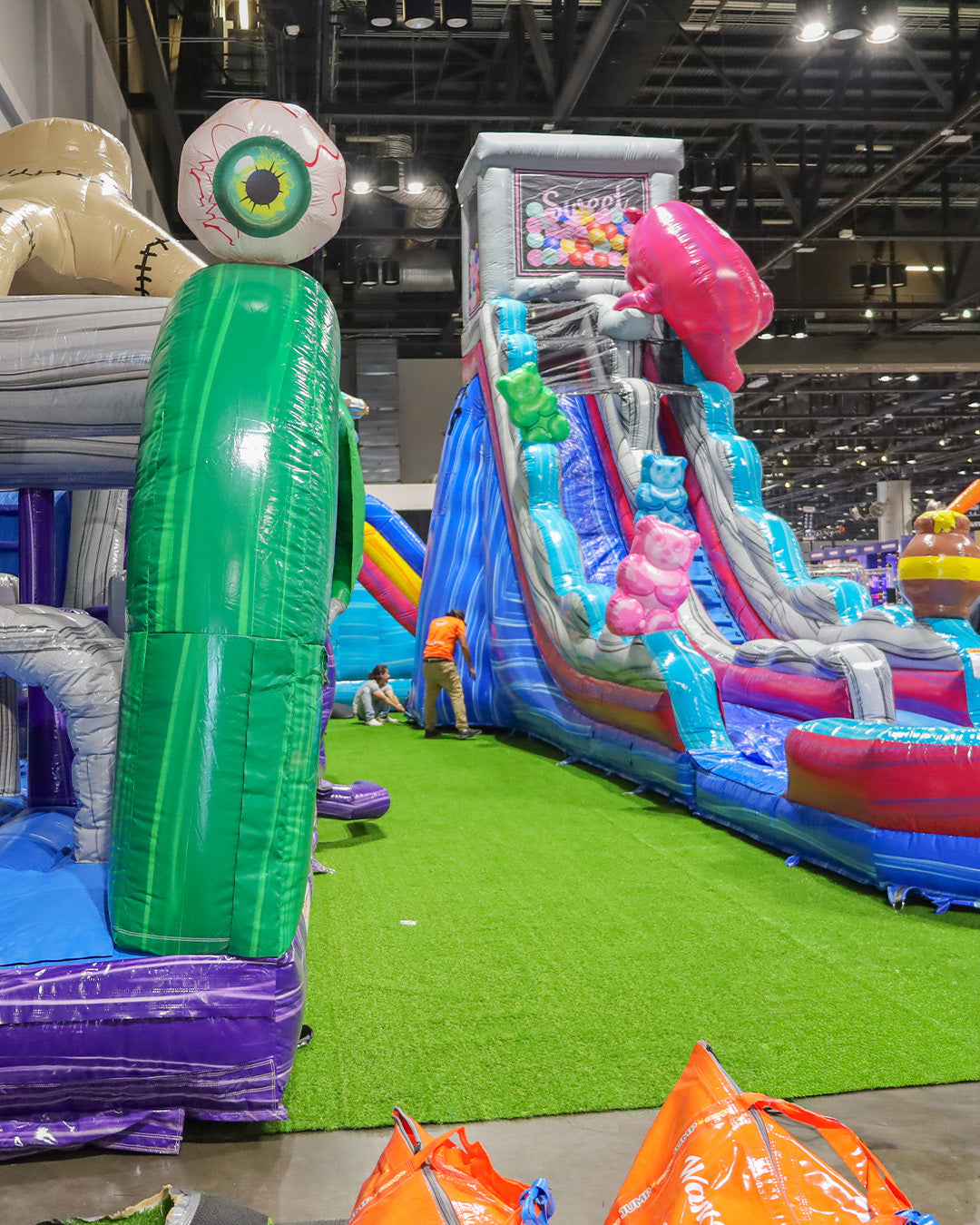
Holiday inflatables are seasonally themed bounce houses and combo units designed specifically for Christmas, Halloween, Easter, and other celebration periods. These units feature holiday-specific graphics, colors, and interactive elements that distinguish them from generic year-round equipment while commanding premium rental rates.
Standard rentals maintain neutral designs suitable for any occasion, whereas holiday inflatables target specific celebration windows with highly visual theming. Holiday units attract corporate event planners and municipal organizers willing to pay premium rates for themed entertainment.
What Designs and Features Make Holiday Inflatables Unique?
Holiday inflatable designs incorporate season-specific colors, characters, and interactive features that create memorable visual experiences. A Christmas bounce house typically features red and green color schemes, Santa Claus imagery, snowflake graphics, and sometimes integrated LED lighting for evening events.
Wet/dry combo units function as water slides in summer and dry slides in winter, maximizing equipment utilization across seasonal boundaries. Holiday inflatable rental rates range from $350 to $1,500+ for premium themed units, reflecting enhanced visual appeal and limited seasonal availability.
How Do Seasonal Themes Impact Rental Demand and Clientele?
Holiday inflatables represent 18% market share within the broader inflatable rental industry, creating distinct seasonal demand peaks beyond summer months. Water slide rental interest peaks 5.56 times higher in summer versus winter, while bounce house interest shows a more moderate 2.4x seasonal variation.
Search volume for water slides reaches 10.72 times higher in summer compared to winter, demonstrating extreme seasonality risk for water-only fleets. June through August accounts for 60% of total annual revenue for operators without diversified holiday inventory.
How Does Equipment Construction Vary for Holiday Use?
Holiday inflatables require identical commercial-grade construction standards as year-round equipment to withstand repeated setup, takedown, and transportation cycles. Commercial units demand a minimum of 15oz PVC vinyl for indoor inflatables and 18oz for outdoor water features.
Heat-welded seams create bonds stronger than the base material itself, preventing separation under stress during high-use holiday periods. Construction variations focus primarily on visual theming rather than structural differences, maintaining consistent safety and durability standards.
Why Is Seasonal Diversification Crucial for Inflatable Rental Success?
Seasonal diversification reduces revenue concentration risk by creating multiple annual demand peaks instead of relying exclusively on summer bookings. Water slide operators face significant seasonality risk with 12-16 week revenue windows, leaving eight months with minimal income.
Holiday rentals extend the revenue season by capturing October through December corporate and municipal demand that traditional summer equipment cannot address. This transforms business economics from feast-or-famine quarterly patterns into consistent monthly revenue streams.
How Do Operators Manage Peak Summer and Winter Holiday Demand?
Successful operators target corporate and municipal clients from October through December, shifting marketing focus from residential birthday parties to higher-budget institutional bookings. These clients typically require premium themed units for employee appreciation events, community festivals, and seasonal celebrations.
Strategic calendar management ensures equipment remains available for high-value holiday bookings rather than accepting lower-margin residential requests during peak periods. Operators implement tiered pricing structures that incentivize early holiday bookings while maintaining premium rates for last-minute corporate requests.
What Strategies Reduce Seasonality Risk Through Fleet Composition?
Operators maintain 60-70% versatile year-round inventory before expanding to seasonal items, ensuring consistent base revenue throughout calendar transitions. This foundation prevents cash flow disruptions when seasonal demand declines between major holidays.
Limiting standalone water slides to 30-40% of fleet mitigates seasonality risk by preventing overexposure to summer-dependent revenue streams. The remaining portfolio consists of dry combo units, standard bounce houses, and convertible wet/dry equipment that operates profitably across all seasons.
How Can Holiday Rentals Extend the Revenue Season?
Holiday rentals create secondary and tertiary revenue peaks during traditionally slow months, particularly October through December, when residential birthday parties decline. Corporate holiday parties, municipal tree lighting ceremonies, and community winter festivals generate substantial booking demand for Christmas bounce houses and seasonal themed entertainment.
Seasonal rental income strategies extend the typical 12-16 week summer window into a more sustainable 9-10 month operational calendar. This extension reduces annual revenue volatility while providing predictable income during periods when competitors experience zero bookings.
Who Are the Primary Customers for Holiday Inflatable Rentals?
Primary customers for holiday inflatable rentals divide into two distinct segments: residential party hosts during spring and fall, and corporate event planners during October through December. Corporate and municipal clients typically book premium themed units for employee appreciation events, community festivals, and institutional celebrations with entertainment budgets exceeding residential averages.
Residential customers include parents organizing birthday parties coinciding with holiday periods, schools planning seasonal carnivals, and religious organizations hosting community outreach events. These segments demonstrate different price sensitivities, booking timelines, and decision criteria requiring tailored marketing approaches.
How Do Consumer Preferences Shift Across Holidays and Age Groups?
Consumer preferences demonstrate significant age-based variation influencing equipment selection and marketing strategies. Among toddlers ages 2-3, 41% prefer birthday cake as the party highlight compared to 32% preferring gifts, suggesting sensory experiences dominate younger preferences.
Children ages 6-7 show inverted priorities, with 48% preferring receiving gifts versus 35% favoring cake, indicating interactive entertainment gains importance with age. Market messaging should shift based on the target age group, emphasizing visual appeal and safety for toddler-focused events while highlighting interactive games for older children.
What Geographic and Demographic Factors Influence Spending?
Geographic variation in consumer spending directly affects maximum achievable rental rates for holiday inflatable rentals across regional markets. The West Coast leads spending at $4,378 annually on entertainment, followed by the Northeast at $3,670 and the South at $3,022.
Urban households spend 18% more on entertainment than rural counterparts, creating premium pricing opportunities in metropolitan markets. These demographic realities establish ceiling rates for event marketing strategies, with operators in coastal urban areas commanding significantly higher per-booking revenue than rural southern markets.
What Motivations and Objections Shape Rental Decisions?
Budget constraints represent the dominant objection, with 43% of parents citing financial limitations as primary factors restricting party planning expenditures. Space limitations affect 26% of potential customers, particularly urban residents with small backyards or apartment dwellers requiring venue rentals.
Weather concerns can ruin outdoor events, creating risk aversion among customers booking spring and fall holiday celebrations without weather contingency plans. Successful operators address these objections through flexible cancellation policies, indoor equipment options, and transparent pricing that builds trust during initial consultations.
How Do Rental Rates and Profitability Compare Among Inflatable Categories?
Rental rates demonstrate substantial variation across inflatable categories, with premium holiday-themed units commanding significantly higher per-booking revenue than standard year-round equipment. Commercial units command $250-$400 daily rates versus $100 for consumer-grade equipment, reflecting quality differences and enhanced durability.
Standard rental breakdown generates $325 total revenue from $250 base rate plus $75 delivery fee, while premium bookings reach $950 through $800 base rate, $100 delivery, and $50 setup charges. This 192% revenue increase directly translates to expanded profit margins when operational costs increase proportionally less.
What Is the Pricing Structure for Holiday-Themed Units?
Indoor inflatable rental rates range from $200 to $400 per day, with holiday-themed units commanding premium positioning within this spectrum. Halloween inflatables and easter party inflatables typically price $50-$150 above comparable non-themed equipment due to limited seasonal availability and enhanced visual appeal.
Premium commercial inflatables command 40-75% pricing increases over standard units, justified by superior construction quality, distinctive theming, and corporate clients' willingness to pay for memorable experiences. Geographic market dynamics influence exact pricing, with urban coastal markets supporting rates at the upper range while rural southern markets tend toward lower pricing tiers.
How Do Premium Holiday Rentals Yield Higher Margins?
Premium rental breakdown delivers $950 total revenue through $800 base rate, $100 delivery fee, and $50 setup charge, compared to $325 for standard bookings. This revenue advantage combines with only modestly higher operational costs to generate a premium equipment's 4x profit advantage at $732 versus $185 per booking.
Premium equipment delivers 77% profit margins versus 57% for standard units, dramatically accelerating return on investment timelines despite higher initial purchase costs. Inflatable rental profit margin expansion from 15-25% to 35-50% with commercial equipment fundamentally transforms business economics from marginal to highly profitable operations.
What Are the Operational Costs Unique to Holiday Inflatable Events?
Standard rental costs total $140, comprising $60 labor, $30 fuel, $10 cleaning, $20 depreciation, and $20 insurance per booking. Premium rental costs reach $218 total through $90 labor, $40 fuel, $15 cleaning, $30 depreciation, and $43 insurance expenses.
Hidden costs consume $15,000-$25,000 annually across all equipment categories, including commercial liability insurance at $2,400-$6,000 yearly and storage facilities at $4,800-$9,600 annually. Unexpected costs consume 18-22% of total revenue, requiring operators to price aggressively to maintain positive cash flow.
What Are the Key Safety and Quality Standards for Holiday Inflatables?
Key safety standards for holiday inflatables mirror year-round equipment requirements, demanding commercial-grade materials and third-party certifications for liability protection. ASTM F2374-19/22 standards govern water slide safety specifications, while ASTM D6413 Class I or NFPA 701 certification ensures fire resistance for indoor use.
Commercial operators must demand 15oz-18oz PVC vinyl with heat-welded seams and require ASTM F2374 certification to meet insurance requirements. Maintenance and repairs consume $2,500-$5,000 yearly, representing unavoidable operational expenses for maintaining safety compliance.
Which Materials and Certifications Ensure Durability and Compliance?
Heat-welded (HF-welded) seams create a bond stronger than the base material, preventing separation failures. Commercial-grade PVC vinyl, minimum 18oz (0.4-0.6mm thick) for water slides, ensures puncture resistance during high-traffic events, while 15oz suffices for indoor inflatables.
ASTM F2374-19/22 standards for water slide safety establish manufacturing requirements covering anchoring systems, slide angles, and splash pool dimensions. ASTM D6413 Class I or NFPA 701 fire resistance certification for indoor use protects operators from liability when equipment deploys in gymnasiums, community centers, and enclosed venues.
How Do Safety Features Adapt to Holiday-Specific Designs?
Safety features maintain consistency across holiday and standard designs, with anchoring points, netting configurations, and entrance/exit placements following identical commercial specifications. Holiday theming adds visual elements without compromising structural integrity or reducing safety margins.
Operating bouncy castles safely requires consistent protocols regardless of seasonal theming, with weather monitoring, weight limit enforcement, and supervision ratios remaining constant. Operators must resist aesthetic modifications that compromise safety features.
What Maintenance Practices Support Year-Round Holiday Use?
Year-round holiday use demands rigorous cleaning protocols between seasonal deployments, with units requiring complete sanitization before extended storage periods. Proper storage in climate-controlled facilities prevents mildew growth, material degradation, and color fading.
Regular inspection schedules identify wear patterns, seam separation, and anchor point stress before failures occur during high-value holiday bookings. Preventive maintenance costs consume $2,500-$5,000 yearly, but prevent catastrophic equipment failures that generate customer complaints and potential liability claims.
How Can Operators Effectively Market Holiday Inflatable Rentals?
Effective marketing for holiday inflatable rentals requires seasonal campaign timing, segmented audience targeting, and visual content showcasing themed equipment in actual event settings. Operators must launch holiday campaigns 6-8 weeks before peak demand periods, allowing corporate event planners sufficient lead time for budget approvals.
Digital marketing channels, including Google Ads, Facebook targeting, and Instagram visual campaigns, generate the highest return on investment. Marketing strategy for commercial water slide rentals principles apply equally to holiday equipment, emphasizing high-quality photography, customer testimonials, and clear pricing transparency.
What Target Audiences Drive Corporate and Community Event Business?
Corporate event planners and human resources departments represent primary target audiences for October through December holiday bookings, with budgets substantially exceeding residential party expenditures. These decision-makers prioritize reliable vendors, professional setup crews, and equipment that creates memorable employee experiences without safety incidents.
Municipal recreation departments and community organizations book holiday inflatables for tree lighting ceremonies, winter festivals, and seasonal community celebrations with multi-year vendor relationships. Schools and religious organizations represent secondary audiences, typically booking during Easter and fall harvest festival periods.
Which Marketing Channels Best Reach Holiday Renters?
Google Ads targeting seasonal search terms captures high-intent customers actively researching holiday entertainment options 4-8 weeks before events. Facebook and Instagram campaigns with carousel ads showcasing multiple holiday themes generate awareness among corporate event planners during annual budget planning cycles.
Email marketing to previous customers announcing new holiday inventory creates early booking momentum while rewarding loyal clients with preferred access. Direct outreach to corporate event planners, municipal recreation departments, and school administrators establishes vendor relationships before competitive bidding processes begin.
How Does Themed Branding Enhance Rental Appeal?
Themed branding creates differentiation in saturated markets where competitors offer generic equipment without seasonal specialization. Professional photography showcasing holiday inflatables in actual event settings demonstrates visual impact more effectively than manufacturer stock photos.
Consistent seasonal branding across website content, social media profiles, and promotional materials positions operators as holiday entertainment specialists rather than general equipment rental services. This specialization justifies premium pricing while attracting corporate and municipal clients seeking vendors with demonstrated holiday event experience.
What Equipment Choices Optimize Holiday Inflatable Rental Profitability?
Equipment choices that optimize profitability prioritize commercial-grade construction, multi-holiday versatility, and premium theming that commands higher rental rates. Modular designs allowing theme swaps without purchasing separate complete units reduce capital requirements while maintaining seasonal variety.
ROI timeline reaches 4-6 months for premium equipment versus 8-12 months for standard units, accelerating capital recovery despite higher purchase prices. Combo units average 1.5 rentals per week, supporting 150+ annual events that generate 40%-60% higher rental revenue.
How Do Modular and Multi-Holiday Designs Improve ROI?
Modular designs featuring interchangeable themed panels allow single base units to serve Christmas, Halloween, and Easter markets without tripling storage requirements or capital investment. These versatile units generate bookings across three distinct seasonal peaks instead of sitting idle for nine months annually.
Multi-holiday designs compress inventory costs while maintaining seasonal variety, reducing storage facility expenses that consume $4,800-$9,600 annually for expanding fleets. Operators achieve superior return on investment by maximizing equipment utilization across multiple holiday periods.
What Role Does Commercial-Grade Equipment Play in Pricing Power?
Commercial-grade equipment commands premium pricing through superior durability, enhanced safety certifications, and a professional appearance that justifies higher rates to corporate clients. Equipment cost ranges from $1,395-$1,995 for classic bouncers, $2,995-$4,995 for combo units, and $1,675 to $5,895 for standard water slides.
Premium multi-lane water slide models exceeding $10,000 represent top-tier inventory targeting municipal events and large corporate gatherings. Safe materials behind bouncy castles directly influence pricing power, with commercial 18oz PVC vinyl construction justifying 40-75% rate premiums over consumer-grade alternatives.
How Does Fleet Size and Mix Influence Year-Round Revenue?
Fleet size directly correlates with revenue potential, with Year 1 generating $20,000-$40,000 revenue from 4-unit fleets and expanding to $50,000-$90,000 during Years 2-3 with 9-unit inventories. Years 4+ reach $100,000-$200,000+ revenue with 15+ units supporting 420-500 bookings at a median rate of $238.44.
Strategic fleet mix balances versatile year-round equipment with seasonal holiday specialization, preventing revenue concentration during narrow summer windows. JumpOrange, Bounce Horizon, Magic Jump, and XJUMP represent top-tier manufacturers offering commercial construction quality necessary for rental business durability requirements.
Holiday Inflatable Rentals: Building a Profitable Year-Round Event Business
Building a profitable year-round event business requires strategic integration of holiday inflatable rentals alongside versatile summer equipment, creating consistent revenue across all calendar quarters. The Bounce House Market, valued at $4.2 to $4.46 billion in 2024-2025, projects growth to $6.2-$6.43 billion by 2034, representing a CAGR of 4.1% to 5.81%.
Successful operators achieve net profit margins of 30-40%, with top performers reaching 43% through premium equipment selection and disciplined pricing strategies. Holiday-themed inventory transforms October through December from traditional off-season periods into secondary revenue peaks, reducing seasonality risk while capturing corporate and municipal demand.
Strategic fleet composition, maintaining 60-70% year-round versatile inventory before expanding into seasonal specialization, ensures consistent cash flow during seasonal transitions. Commercial-grade construction with 15-oz to 18-oz PVC vinyl, heat-welded seams, and ASTM certifications provides the durability necessary for multi-season operations while justifying premium rental rates.
Halloween collection offerings and complementary Christmas and Easter themed units extend the viable rental calendar from 12-16 weeks to 9-10 months annually. Operators who embrace seasonal diversification, invest in commercial equipment, and target corporate clientele build resilient businesses generating six-figure revenues with predictable profit margins.
Stop Letting October Through December Sit Empty
Your summer fleet goes quiet for eight months while corporate planners, municipalities, and holiday hosts keep booking. JumpOrange builds commercial-grade Christmas, Halloween, and Easter inflatables plus multi-season bounce house combos on 24 years of in-house manufacturing, with NFPA701 compliance, 15oz to 18oz PVC vinyl, and warranties up to 3 years, so a single investment earns across three seasonal peaks instead of one. Join the JEM Club for 15% off commercial equipment, free shipping on qualifying orders, and concierge support that helps you price, position, and book premium holiday units. Build the year-round rental business your competitors only talk about.


Leave a comment
This site is protected by hCaptcha and the hCaptcha Privacy Policy and Terms of Service apply.