Securing capital for an inflatable rental business requires understanding what lenders prioritize in loan applications. Banks and SBA lenders evaluate repayment capacity, seasonal revenue patterns, equipment collateral value, and the operator's ability to manage cash flow fluctuations. A well-prepared rental business case addresses these concerns directly with financial projections, documentation, and an inflatable loan strategy that demonstrates profitability.
The inflatable rental market is projected to reach $6.2 billion by 2034 with a 5.81% annual growth rate. Operators can scale from $25,000-$50,000 in first-year revenue to a consistent six-figure annual income by Year 3 with proper financing and inflatable rental business startup costs planning. This growth trajectory depends on selecting the right financing option and presenting a convincing case to lenders.
Key Takeaways
- Equipment financing uses the equipment as collateral, with approval rates between 60-70% and offers amounts from $5,000 to $500,000
- SBA 7(a) loans provide the lowest interest rates but require 30-90 days for approval and extensive documentation, including 2-3 years of tax returns
- Seasonal cash flow must be addressed in loan proposals since 60% of revenue occurs between June and August
- Premium commercial water slides deliver 77% profit margins with 4-6 month ROI timelines compared to standard bounce houses
- Business plans should be 20-30 pages with 3-5 years of financial projections, and maintain a 3:1 ratio between operational reserves and equipment investment
What Financing Options Are Available for Inflatable Rental Businesses?
Equipment financing holds 28% market share among inflatable rental operators seeking capital. This option uses the purchased equipment as collateral, resulting in approval rates between 60-70% and interest rates from 4% to 45% APR.
SBA 7(a) loans represent 22% of the financing market and provide amounts up to $5 million. Working capital loans account for 18% of market share with 24-48 hour approval times, while Merchant Cash Advances hold 15% market share with 58% approval rates despite higher costs.
How Does Equipment Financing Work?
Equipment financing provides $5,000 to $500,000 specifically for purchasing commercial inflatables using the equipment itself as collateral. The approval rate ranges from 60-70%, with interest rates between 4% and 45% APR, depending on creditworthiness. This financing method typically requires a credit score above 600 and two years of operating history for optimal terms.
The equipment secures the loan, making approval faster than unsecured financing options. Lenders evaluate the equipment's resale value and operational lifespan when determining loan amounts. Commercial-grade inflatables constructed from 15-oz to 18-oz PVC vinyl last 2-3 years with proper maintenance, ensuring the collateral outlives many short-term loan periods.
What Are SBA 7(a) Loans and Their Benefits?
SBA 7(a) loans are backed by the U.S. Small Business Administration and offer amounts up to $5 million. The government guarantee reduces lender risk, resulting in interest rates between 9.75% and 14.75% with repayment terms extending 5-10 years. These loans provide the lowest available rates but require 30-90 days for approval compared to 24-48 hours for working capital loans.
SBA lending demands extensive documentation, including comprehensive business plans and multiple years of financial statements. The longer approval timeline reflects thorough underwriting processes that evaluate business viability and repayment capacity. Established operators planning large-scale expansion or debt refinancing benefit most from this financing option.
When Should You Consider Working Capital Loans or Merchant Cash Advances?
Working capital loans provide short-term cash injections for operational needs rather than long-term asset purchases. These loans offer $5,000 to $250,000 with 24-48 hour approval times and interest rates from 10% to 99% APR. The fast funding supports seasonal cash flow gaps, marketing campaigns, and payroll obligations during slower months.
Merchant Cash Advances provide upfront capital in exchange for a percentage of future credit card sales. MCAs have a 58% approval rate with factor rates between 1.11 and 1.5, translating to effective APRs from 40% to 350%. Daily or weekly repayments can disrupt cash flow and erode the 30-40% net profit margins typical in the inflatable rental industry.
What Do Banks and SBA Lenders Look for in Loan Applications?
Banks and SBA lenders evaluate repayment capacity through financial metrics, documentation completeness, and risk management strategies. The approval rate for traditional small business loans stands at approximately 30%, making thorough preparation essential. Lenders prioritize operators who demonstrate an understanding of seasonal revenue patterns and maintain adequate operational reserves.
Your rental business case must address how bounce house business breakdown factors influence profitability and loan repayment. Financial projections should show realistic revenue expectations based on equipment type, local market conditions, and operational capacity. Lenders favor applications that present conservative growth assumptions rather than optimistic scenarios.
Which Documentation Is Essential for Approval?
Prepare a comprehensive business plan spanning 20-30 pages that details market analysis, target demographics, and growth strategy. Create 3-5 years of projected income statements, balance sheets, and cash flow statements showing monthly breakdowns for the first two years. Gather 2-3 years of personal and business tax returns, along with debt schedules listing all current business obligations.
Obtain legal documents, including LLC formation papers, operating agreements, and current business licenses. Lenders require proof of proper business structure and regulatory compliance before approving loans. Bank statements from the previous 6-12 months demonstrate cash flow patterns and financial management capabilities.
How Can You Address Seasonal Cash Flow in Your Loan Proposal?
Seasonal businesses with 60% of revenue concentrated between June and August create cash flow challenges for debt service. Present a cash flow management plan showing how winter months will be handled through operational reserves or alternative revenue streams. Demonstrate understanding that approximately 60% of annual revenue occurs in summer months while fixed loan payments continue year-round.
Include strategies for maintaining liquidity during slower periods, such as commercial event bookings or holiday-themed rentals. Lenders evaluate whether operators have sufficient reserves to cover 3-6 months of operating expenses, including loan payments. Showing awareness of seasonal rental income patterns strengthens credibility with lenders.
What Financial Metrics Highlight Your Business's Repayment Capacity?
Typical net profit margins of 30-40% demonstrate strong repayment capacity for inflatable rental operations. Operators can scale from $25,000-$50,000 in Year 1 revenue to six-figure income by Year 3 with proper equipment investment and market positioning. These growth trajectories show lenders that loan payments align with expanding revenue streams.
Highlight equipment-specific profitability, such as the 77% profit margin on commercial water slides compared to 57% on standard bounce houses. Document how premium equipment generates higher per-booking revenue, accelerating loan repayment timelines. Financial metrics should demonstrate that monthly loan payments represent a manageable percentage of projected monthly revenue.
How Do Consumer Financing Preferences Influence Your Loan Strategy?
Interest rates matter to 95% of borrowers when selecting financing options for inflatable rental businesses. Repayment terms influence 88% of borrower decisions, while 82% prioritize approval ease during the selection process. Understanding these preferences helps operators choose financing that balances cost, approval speed, and repayment flexibility.
Loan amount availability matters to 78% of borrowers seeking sufficient capital for complete equipment packages. Bank financing tips suggest aligning loan amounts with specific equipment purchases rather than overextending credit capacity. Operators who match financing type to equipment cost and revenue potential optimize both approval chances and profitability.
Why Are Interest Rates and Repayment Terms Critical?
Interest rates directly impact total financing costs and monthly payment obligations for equipment purchases. Repayment terms matter to 88% of borrowers because longer terms reduce monthly payments but increase total interest paid. Equipment financing at 12% APR for five years results in $943 monthly payments on a $50,000 loan compared to $870 monthly for a seven-year SBA 7(a) loan at 11.5% APR.
Approval ease influences 82% of borrower decisions as operators balance time constraints against favorable terms. Working capital loans are approved within 24-48 hours but carry interest rates from 10% to 99% APR. SBA loans require 30-90 days for approval but offer rates as low as 9.75% APR.
How Does Lender Relationship Impact Loan Success?
Lender relationships matter to 72% of borrowers seeking favorable terms and streamlined approval processes. Existing relationships drive over 40% of loan applications, as established banking history demonstrates creditworthiness and financial stability. Operators with existing business accounts often receive preferential consideration during underwriting.
Banks evaluate transaction history, deposit patterns, and account management when assessing loan applications from current customers. Building relationships before seeking financing improves approval odds and may result in better interest rates. Maintaining consistent communication with lenders throughout the business lifecycle creates opportunities for additional capital as operations expand.
What Are the Cost and Payment Plan Differences Among Loan Types?
A $50,000 equipment financing loan at 12% APR for five years requires $943 monthly payments totaling $56,716. An SBA 7(a) loan at 11.5% APR for seven years reduces monthly payments to $870 but extends the repayment period. Working capital loans at 18% APR for two years demand $2,496 monthly payments totaling $59,904.
Merchant Cash Advances with a 1.4 factor rate over 18 months cost $70,000 total on a $50,000 advance. Equipment leases typically require $950 monthly payments over five years, totaling $57,000 without guaranteed ownership. These cost differences significantly impact the 30-40% net profit margins typical in the inflatable rental industry.
How Do Monthly Payments and Total Costs Compare?
Equipment financing balances moderate monthly payments with reasonable total costs over the loan term. SBA 7(a) loans offer the lowest monthly payment at $870 but extend repayment to seven years. Working capital loans require substantially higher monthly payments at $2,496, creating cash flow pressure during slower seasonal periods.
MCAs extract $70,000 from a $50,000 advance through daily or weekly deductions from credit card sales. Factor rates between 1.11 and 1.5 translate to effective APRs ranging from 40% to 350%. Understanding inflatable rental profit margins helps operators evaluate whether high-cost financing erodes profitability.
What Are the Long-Term Financial Implications?
Factor rates in MCAs translate to APRs between 40% and 350%, depending on repayment speed and factor structure. MCA daily or weekly repayments disrupt cash flow by continuously extracting percentages from revenue regardless of seasonal fluctuations. Very high financing costs can erode 40% net margins, leaving operators with minimal profit after debt service.
Equipment financing and SBA loans build business credit history while MCAs typically do not report to credit bureaus. Long-term implications include the ability to secure additional financing as operations expand and equipment needs grow. Operators who choose lower-cost financing options preserve more capital for operational reserves and fleet expansion.
How Does Equipment Choice Affect Financing and ROI?
Standard bounce houses costing $2,000-$3,500 have a 57% profit margin with 8-12 month ROI timelines. Commercial water slides costing $4,500-$10,995 deliver 77% profit margins with 4-6 month ROI periods due to premium rental rates. Premium equipment operators achieve a 4x profit advantage, generating $732 per booking compared to $185 for standard units.
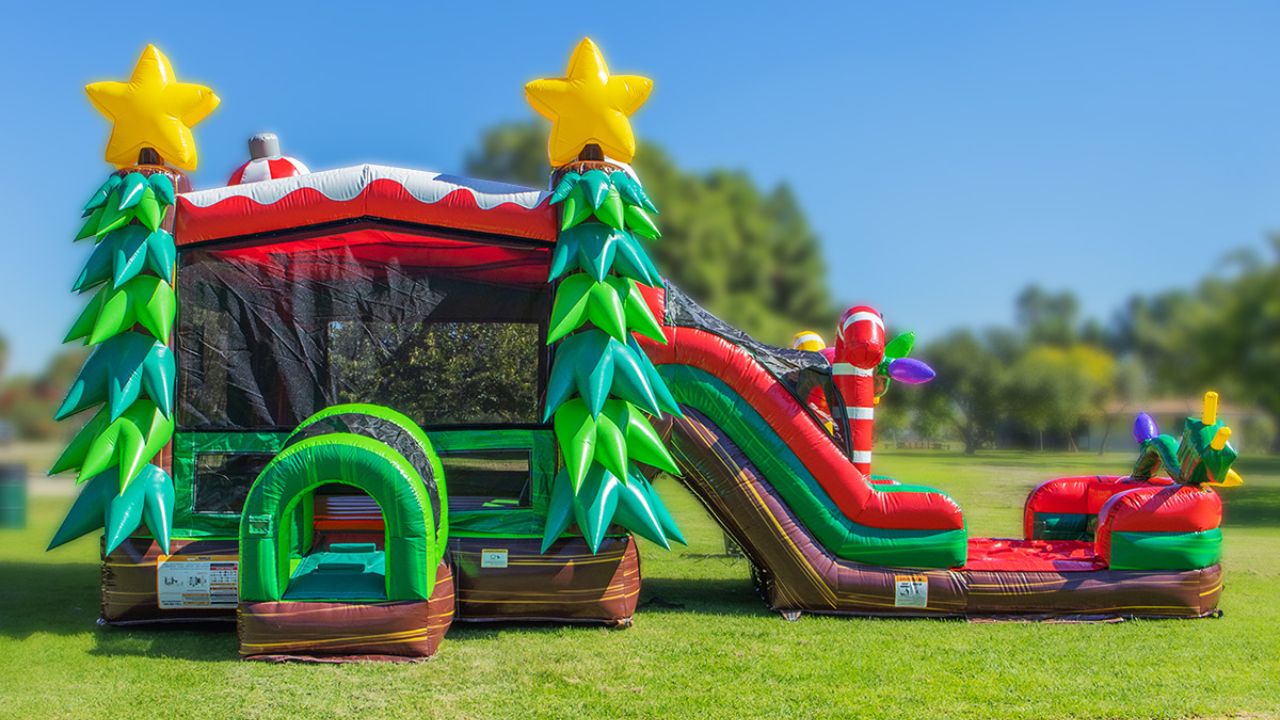
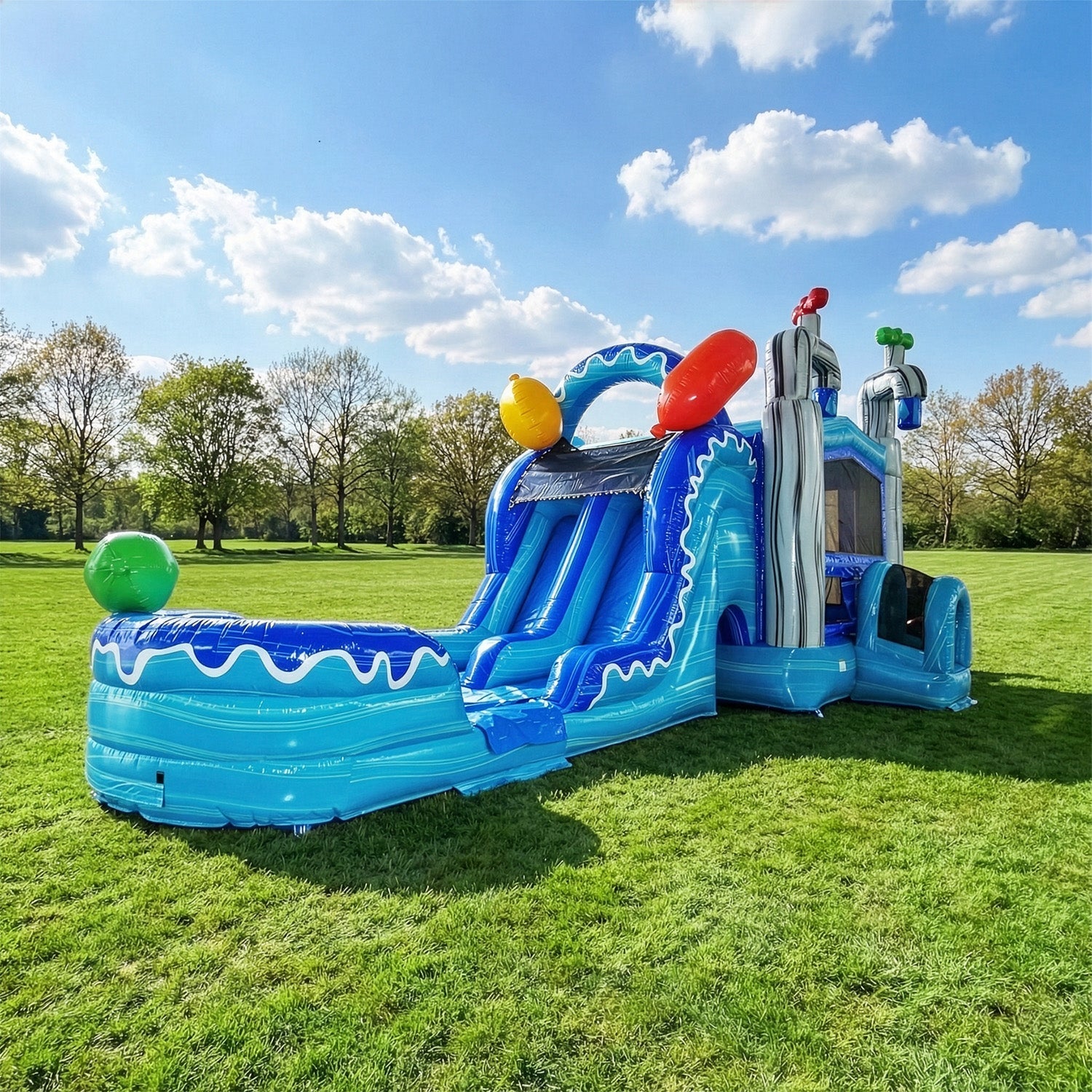
Equipment choice directly influences the loan amount needed and the collateral value lenders can secure. Combo units priced between $2,400 and $4,700 offer versatile rental options with 6-9 month ROI timelines. The faster bounce house business ROI from premium equipment accelerates loan repayment and fleet expansion capabilities.
What Are the ROI Timelines for Standard Bounce Houses vs. Commercial Water Slides?
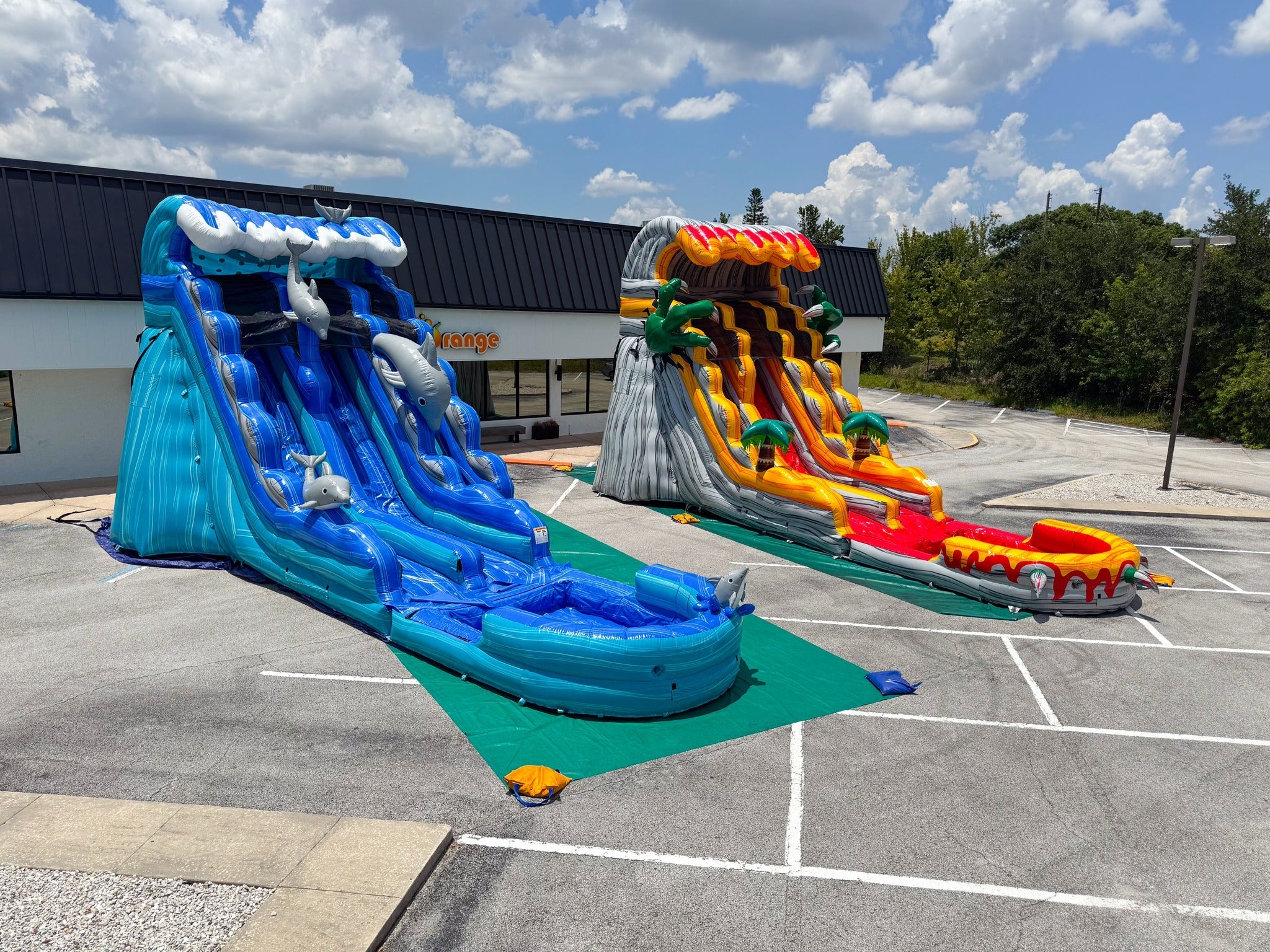
Standard bounce houses require 8-12 months to recover initial equipment costs through rental revenue. Commercial water slides achieve ROI within 4-6 months due to higher rental rates ranging from $600 to $1,500 per day. The 77% profit margin on water slides compared to 57% on standard units demonstrates the profitability advantage of premium equipment.
Premium equipment commands higher rental fees while maintaining strong demand during peak season months. Operators who invest $10,000 in a commercial water slide recover costs faster than those purchasing multiple standard bounce houses. Combo units priced between $2,400 and $4,700 provide middle-ground ROI timelines of 6-9 months with greater rental versatility.
How Does Equipment Lifespan Affect Collateral Viability?
Commercial-grade inflatables last 2-3 years or longer with proper maintenance and storage practices. Commercial-grade equipment constructed from 15-oz to 18-oz PVC vinyl withstands frequent use and weather exposure better than residential-grade materials. Lenders evaluate equipment lifespan when determining collateral value and loan terms for equipment financing.
Provide manufacturer data showing expected equipment lifespan and warranty coverage when applying for loans. Equipment that maintains value throughout the loan term reduces lender risk and may result in better interest rates. Operators who demonstrate understanding of maintenance requirements and replacement cycles strengthen their rental business case.
How Can You Build a Convincing Business Plan for Lenders?
The inflatable rental market is projected to reach $6.2 billion by 2034, growing at a 5.81% CAGR. Business plans should be 20-30 pages covering market analysis, competitive positioning, operational strategy, and financial projections. Financial projections should span 3-5 years with detailed monthly breakdowns for the first two years.
Include specific details about target demographics, pricing strategy, and marketing channels in the business plan. Lenders evaluate whether operators understand their local market conditions and competitive landscape. A comprehensive party rental business plan demonstrates strategic thinking and increases confidence in repayment capacity.
What Market and Financial Details Should Be Included?
The party supply rental market was valued at $19.98 billion in 2023, with strong growth projections. Market analysis should identify local demand drivers, competitor pricing, and underserved demographic segments. Include research on seasonal booking patterns, average rental fees, and projected booking frequency based on fleet size.
Financial projections must cover 3-5 years, showing conservative revenue growth and expense scaling. Break down startup costs, operating expenses, and revenue assumptions by equipment type and booking frequency. Demonstrate understanding that a fleet of 8-12 units is needed for a consistent six-figure annual income.
How Do You Demonstrate Growth Potential and Risk Management?
Fleet expansion plans should show how initial equipment purchases lead to adding 8-12 units over three years. Demonstrate growth potential by documenting how premium equipment generates higher per-booking revenue and faster ROI. Include strategies for geographic expansion, corporate client acquisition, and seasonal revenue diversification.
Maintain a 3:1 ratio between operational reserves and equipment investment to show financial prudence. Risk management strategies should address insurance requirements, equipment maintenance schedules, and backup equipment for mechanical failures. Lenders favor operators who anticipate potential challenges and present specific mitigation strategies.
What Strategies Enhance Approval Chances with Banks and SBA Lenders?
Typical net profit margins of 30-40% demonstrate strong repayment capacity that appeals to conservative lenders. Highlight how 60% of revenue occurring between June and August necessitates careful cash flow management and operational reserves. Present specific strategies for managing seasonal fluctuations while maintaining consistent debt service payments.
Understanding equity vs debt financing helps operators determine optimal capital structure for their situation. Equipment financing for durable bounce house combos preserves ownership equity, while SBA loans may require personal guarantees that affect personal financial exposure. Operators who articulate these tradeoffs demonstrate financial sophistication that increases lender confidence.
How to Highlight Profit Margins and Seasonal Revenue?
Emphasize that typical net profit margins of 30-40% provide a substantial cushion for loan repayment obligations. Document how these margins remain consistent across different equipment types while premium units generate higher absolute profits per booking. Show lenders that profit margins support debt service payments even during slower months.
Address that 60% of revenue occurs between June and August by presenting monthly cash flow projections. Demonstrate how summer profits fund operational reserves that cover winter expenses and loan payments. Include backup revenue strategies such as holiday rentals or corporate events that supplement seasonal income.
Why Are Operational Reserves Important to Lenders?
Maintaining a 3:1 ratio between operational reserves and equipment investment demonstrates financial stability and risk management. Operational reserves cover unexpected equipment repairs, insurance deductibles, and slow booking periods without jeopardizing loan payments. Lenders view adequate reserves as evidence of mature financial planning and reduced default risk.
Calculate reserve requirements based on six months of operating expenses, including loan payments, insurance, storage, and maintenance costs. Show how reserve levels will be maintained as the business scales and equipment inventory expands. Operators who commit to maintaining reserves throughout the loan term differentiate themselves from less prepared applicants.
Inflatable Rental Business Loan Insights for Successful Capital Acquisition
Securing financing for an inflatable rental business requires matching loan type to equipment needs, growth timeline, and cash flow capacity. Equipment financing and SBA 7(a) loans offer the most favorable terms for operators prioritizing long-term profitability and sustainable growth. Avoiding high-cost options like Merchant Cash Advances preserves the 30-40% profit margins that make this industry attractive.
Successful operators present comprehensive documentation, address seasonal cash flow patterns, and demonstrate understanding of equipment ROI timelines. JumpOrange supports rental entrepreneurs with financing resources and commercial-grade equipment that accelerates profitability. Building a convincing rental business case positions operators for approval and sets the foundation for six-figure annual revenue.
Ready to Put Your Loan to Work? Start With Equipment That Earns
A strong loan application is only half the story. What you buy with that capital decides how fast you pay it back. JumpOrange builds commercial-grade inflatables that hold their collateral value, recover their cost in months rather than years, and keep earning through season after season. From water slides with 77% margins to combo units that book all summer, our lineup gives lenders a reason to say yes and gives you a fleet that funds its own growth.
Talk to the JumpOrange team about matching your financing plan to the right equipment, and turn your approved loan into a rental business that pays for itself. Explore Commercial Inflatables including rental inflatable water slides or Join the JEM Club for member pricing, free shipping, and expert guidance built for operators like you.


Leave a comment
This site is protected by hCaptcha and the hCaptcha Privacy Policy and Terms of Service apply.