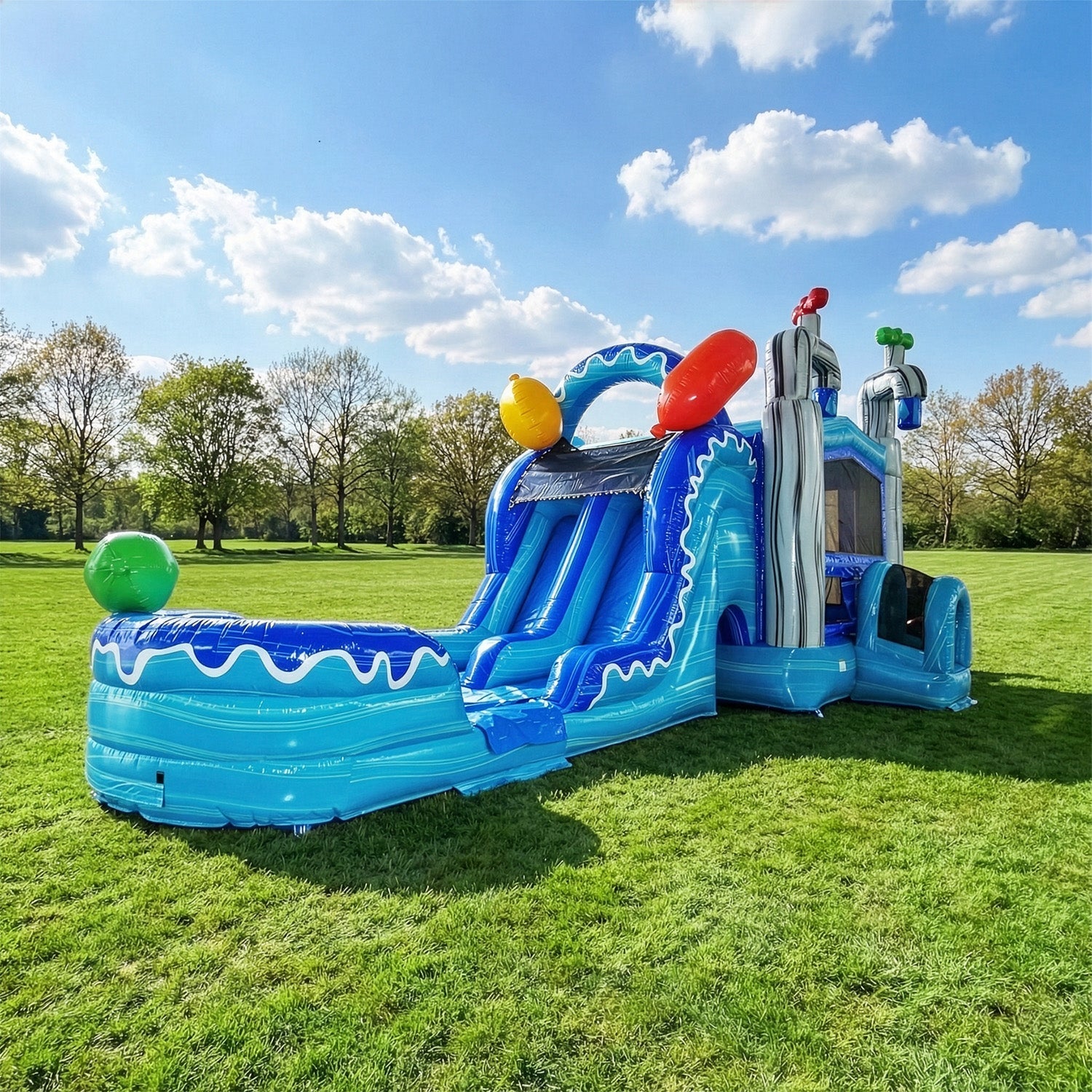
Summer water slide demand represents the most concentrated revenue opportunity in the inflatable rental industry. Operators who understand seasonal patterns and optimize inventory accordingly capture the majority of annual income during this narrow window.
The economic reality of summer water slide demand requires strategic planning well before the season begins. Rental business strategy must account for equipment acquisition, market positioning, and pricing models that maximize returns during peak months while sustaining operations year-round.
Key Takeaways
- Water slide rental interest peaks 5.56 times higher in summer versus winter months
- June through August accounts for 60% of the total annual revenue for rental operators
- Premium commercial water slides deliver 77% profit margins versus 57% for standard units
- Wet/dry combo units generate 40-60% higher revenue than single-feature inflatables
- Proper fleet composition maintains 60-70% year-round inventory before expanding seasonal units
What Drives Seasonal Demand for Water Slides?
Seasonal demand for water slides stems from outdoor entertainment preferences that peak during summer months. Consumer search behavior and booking patterns demonstrate extreme concentration during the warmest quarter of the year.
Weather-dependent activities create predictable demand cycles across the inflatable rental market. Understanding these patterns enables operators to allocate capital toward the highest-performing equipment categories.
How Do Consumer Preferences Shift During Summer Months?
Consumer preferences shift dramatically toward water-based entertainment when temperatures rise above comfortable outdoor levels. Water slide rental interest reaches 5.56 times higher in summer compared to winter periods.
Search volume for inflatable water slides climbs 10.72 times higher during peak season months. Standard bounce house interest shows a milder 2.4 times seasonal variation, demonstrating more consistent year-round appeal.
Why Is Water Slide Utilization Concentrated in a Short Peak Period?
Water slide utilization concentrates in a short peak period because outdoor water activities require warm weather conditions. June through August accounts for 60% of total annual revenue across the rental industry.
Premium units deploy 3-4 times per weekend during these months, maximizing asset returns. Operators must capture this concentrated demand to justify the capital investment in specialized water equipment.
What Are the Key Motivations and Objections of Rental Customers?
Key motivations for rental customers include creating memorable outdoor experiences and providing safe entertainment for children. Budget constraints represent the primary barrier, with 43% of parents citing cost limitations.
Venue and backyard capacity restrictions affect 26% of potential bookings, particularly in urban markets. Weather concerns about ruined outdoor events create hesitation, requiring operators to offer flexible rescheduling policies that build consumer confidence.
What Are the Core Product Categories in Inflatable Rentals?
Core product categories in inflatable rentals divide into three distinct segments with different seasonal patterns. Water slides, standard inflatables, and holiday units each serve specific market needs and revenue opportunities.
Market share distribution reveals water slides at 28%, standard bounce houses at 35%, and holiday inflatables at 18%. Equipment selection must balance seasonal concentration against year-round revenue stability.
How Do Summer Outdoor Water Slides Differ from Other Inflatables?
Summer outdoor water slides differ from other inflatables through specialized construction requiring integrated water systems and enhanced safety features. Commercial water slides command premium pricing due to higher manufacturing costs and operational complexity.
Equipment cost ranges from $1,675 to $5,895 for standard commercial units, with premium models exceeding $10,000. Standard bounce houses cost significantly less at $1,395-$1,995, creating different financial dynamics for seasonal versus year-round inventory.
What Advantages Do Indoor and Year-Round Inflatables Offer?
Indoor and year-round inflatables offer consistent booking potential regardless of weather or season. Rental rates range from $200-$400 per day, providing steady baseline revenue during off-peak months.
Indoor units require a minimum of 15oz commercial-grade PVC vinyl to withstand higher usage frequency and fire safety regulations. Combo units costing $2,995-$4,995 deliver versatility that extends usable asset time across multiple seasons.
How Do Holiday Event Inflatables Extend Rental Seasons?
Holiday event inflatables extend rental seasons by creating demand during traditionally slow months like November and December. These units capture 18% market share through specialized designs for Christmas, Halloween, and Easter celebrations.
Rental rates for holiday inflatables reach $350-$1,500+ for premium themed units, often targeting corporate clients. Unzip-and-swap designs allow one base unit to serve multiple holidays, reducing storage requirements while maximizing seasonal versatility.
How Can Operators Mitigate Seasonality Risk?
Operators mitigate seasonality risk through strategic fleet composition that balances high-margin seasonal items with consistent year-round performers. Diversification prevents revenue collapse during slower months when summer water slide demand disappears.
Financial sustainability requires maintaining cash flow across all twelve months rather than concentrating income. Proper inventory planning transforms the traditional boom-bust cycle into steadier monthly revenue streams.
What Is the Role of Fleet Diversification in Year-Round Revenue?
Fleet diversification plays a central role in year-round revenue by ensuring consistent booking opportunities regardless of season. Operators should maintain a 60-70% versatile year-round inventory before expanding to specialized seasonal items.
Standalone water slides should represent only 30-40% of total fleet composition, limiting exposure to summer concentration. Bounce house and water slide combo units bridge the gap between seasonal extremes, functioning effectively across multiple months.
How Do Wet/Dry Combo Units Increase Usable Asset Time?
Wet/dry combo units increase usable asset time by functioning as water slides during summer and dry inflatables during cooler months. These versatile units average 1.5 rentals per week, supporting 150+ events annually compared to 60-80 for water-only equipment.
Combo units generate 40-60% higher revenue than single-feature inflatables across a full calendar year. Dual functionality eliminates the need to store idle equipment for eight months, improving capital efficiency and storage cost management.
How Can Holiday-Themed Inflatables Supplement Peak Season Income?
Holiday-themed inflatables supplement peak season income by creating secondary revenue spikes during October through December. Corporate events, municipalities, and winter festivals represent high-value target markets willing to pay premium rates.
Modern manufacturers offer interchangeable panel systems that transform one base unit across multiple holidays. This design innovation reduces capital requirements while expanding booking opportunities during months when traditional summer equipment sits unused.
What Are the Construction and Safety Standards for Water Slides?
Construction and safety standards for water slides dictate minimum material specifications and certification requirements. Commercial operators must meet regulatory thresholds that exceed consumer-grade inflatable standards.
Proper construction directly impacts equipment lifespan, safety performance, and rental pricing power. Best water slides for rental business applications prioritize durability and compliance over initial purchase price.
Which Materials and Seam Types Ensure Commercial Durability?
Materials and seam types ensure commercial durability when operators specify a minimum 18oz PVC vinyl rated at 0.4-0.6mm thickness. Heat-welded seams create bonds stronger than the base material itself, preventing separation under repeated stress.
HF-welded seams represent the commercial standard for water slides subjected to daily deployment cycles. Double, triple, or quadruple stitching reinforces non-welded areas, extending operational lifespan to 5-10 years with proper maintenance.
What ASTM and Fire Safety Certifications Are Required?
ASTM and fire safety certifications are required to operate legally in most jurisdictions and secure commercial liability insurance. ASTM F2374-19/22 standards establish safety requirements specifically for inflatable water slides.
Indoor installations demand ASTM D6413 Class I or NFPA 701 fire resistance certification to protect occupants. Commercial water slide regulations by state vary significantly, requiring operators to verify local compliance requirements before equipment purchase.
How Do Safety Features Impact Consumer Confidence and Rental Rates?
Safety features impact consumer confidence by addressing parental concerns about injury risk at outdoor events. Non-slip climbing surfaces and integrated splash pools reduce accident liability while supporting premium pricing.
Visible safety elements justify higher rental rates as parents prioritize child protection over cost savings. Equipment meeting certified commercial standards commands 40-75% pricing increases versus consumer-grade alternatives lacking proper safety engineering.
How Do Market Demographics Influence Pricing and Demand?
Market demographics influence pricing and demand through regional spending patterns and population density variations. Geographic location determines maximum achievable rental rates based on local entertainment budgets.
Consumer spending capacity varies significantly across different regions and urban versus rural markets. Operators must adjust pricing strategies to align with demographic realities in their service area.
How Does Regional Consumer Spending Affect Rental Rates?
Regional consumer spending affects rental rates through entertainment budget allocation differences across geographic areas. West Coast households spend $4,378 annually on entertainment, while Northeast households allocate $3,670.
Southern markets show lower spending at $3,022 annually, requiring adjusted pricing expectations for comparable services. These variations create different ceiling rates for premium equipment in otherwise similar competitive markets.
What Age-Related Preferences Shape Equipment Selection?
Age-related preferences shape equipment selection based on developmental stages, and party highlights priorities. A survey of 4,949 parents revealed that ages 2-3 prioritize birthday cake at 41% versus gifts at 32%.
By ages 6-7, gift-giving peaks at 48% importance while cake drops to 35%. Operators should stock age-appropriate equipment matching these developmental preferences, emphasizing sensory experiences for toddlers and competitive games for older children.
How Do Urban Vs. Rural Markets Differ in Inflatable Rental Potential?
Urban versus rural markets differ in inflatable rental potential through population density and entertainment spending patterns. Urban households spend 18% more on entertainment than rural households, supporting higher baseline demand.
Venue capacity restrictions affect 26% of urban bookings due to smaller yards and outdoor spaces. Rural markets offer fewer geographic constraints but lower population density, requiring operators to expand service radius for equivalent booking volume.
What Are the Financial Dynamics of Water Slide Rentals?
Financial dynamics of water slide rentals center on equipment cost recovery timelines and per-booking profitability margins. Understanding capital requirements and return periods determines inventory expansion strategies.
Premium equipment carries higher acquisition costs but delivers faster payback through superior margins. Profit-boosting pricing strategies for commercial water slide rentals focus on maximizing per-event returns rather than volume-based approaches.
How Does Equipment Cost Relate to Rental Pricing and ROI?
Equipment cost relates to rental pricing through market positioning as a premium or budget service provider. Water slide rental rates range from $150-$325 for 14-foot models and $300-$600+ for larger configurations.
Commercial water slides achieve ROI within 4-6 months during peak season through concentrated deployment. Water slide rental pricing strategy must account for the short revenue window by maximizing rates during high-demand months.
What Are Typical Profit Margins and Hidden Operating Costs?
Typical profit margins reach 30-40% net for successful operators who properly account for all operating expenses. Hidden costs total $15,000-$25,000 annually, consuming 18-22% of total revenue if not factored into pricing.
Commercial liability insurance requires $2,400-$6,000 annually, while storage facilities cost $4,800-$9,600 yearly. Maintenance and repairs add $2,500-$5,000 in expenses that operators must recover through disciplined rate structures.
How Does Premium Equipment Impact Per-Booking Profitability?
Premium equipment impacts per-booking profitability by expanding profit margins from 15-25% to 35-50% compared to consumer-grade alternatives. A premium booking generates $732 net profit versus $185 for standard equipment on comparable events.
This 77% versus 57% margin difference accelerates ROI timelines to 4-6 months for premium units compared to 8-12 months for standard inventory. Water slide rental income summer revenue breakdown demonstrates how commercial-grade equipment enables sustainable six-figure businesses.
What Strategies Maximize Revenue During the 90-Day Peak Season?
Strategies that maximize revenue during the 90-day peak season focus on scheduling optimization, premium pricing models, and targeted marketing campaigns. Operators must capture concentrated summer demand to justify annual operating costs.
Peak season revenue determines overall business viability and equipment expansion capacity. Disciplined execution during June through August creates the financial foundation for year-round operations.
How Can Operators Optimize Scheduling and Utilization Rates?
Operators optimize scheduling and utilization rates by deploying premium units 3-4 times per weekend during peak months. Calendar management systems prevent double-booking while maximizing equipment deployment frequency.
Strategic time-blocking reserves premium weekend slots for the highest-paying customers willing to book months in advance. Off-peak weekday slots can accommodate discounted bookings that fill otherwise idle capacity without cannibalizing weekend premium rates.
What Pricing Models Support Faster Investment Payback?
Pricing models supporting faster investment payback factor, annual hidden costs of $15,000-$25,000 into per-event rates. Operators achieve equipment payback within 12 events through disciplined pricing rather than competing solely on cost.
Value-based pricing emphasizes safety certifications, premium features, and professional service over lowest-price positioning. Water slide marketing should highlight commercial-grade construction and certified compliance to justify premium rates that accelerate capital recovery.
How Does Marketing Tailored to Consumer Segments Increase Bookings?
Marketing tailored to consumer segments increases bookings by addressing specific decision criteria for different buyer personas. Parents prioritize safety certifications and age-appropriate equipment, while corporate planners focus on reliability and professional setup.
Segmented messaging through social media advertising and email campaigns converts higher percentages by speaking directly to audience concerns. Creating a winning marketing strategy for your commercial water slide rentals requires understanding demographic preferences and objection patterns across different customer types.
Optimizing Summer Water Slide Demand for Sustainable Year-Round Profitability
Summer water slide demand creates substantial revenue opportunities for operators who balance seasonal concentration against year-round stability. The 90-day peak window requires strategic equipment selection, premium pricing discipline, and targeted marketing to capture 60% of annual income.
Sustainable profitability emerges when the rental business strategy extends beyond the summer months through diversified inventory and holiday equipment expansion. Operators who invest in commercial-grade construction, maintain proper fleet composition at 60-70% year-round units, and implement value-based pricing build resilient businesses that thrive across all seasons. JumpOrange has supported rental operators in this strategic approach since 2002 through commercial-grade equipment and industry expertise.
Stock Your Fleet Before the 90-Day Window Opens
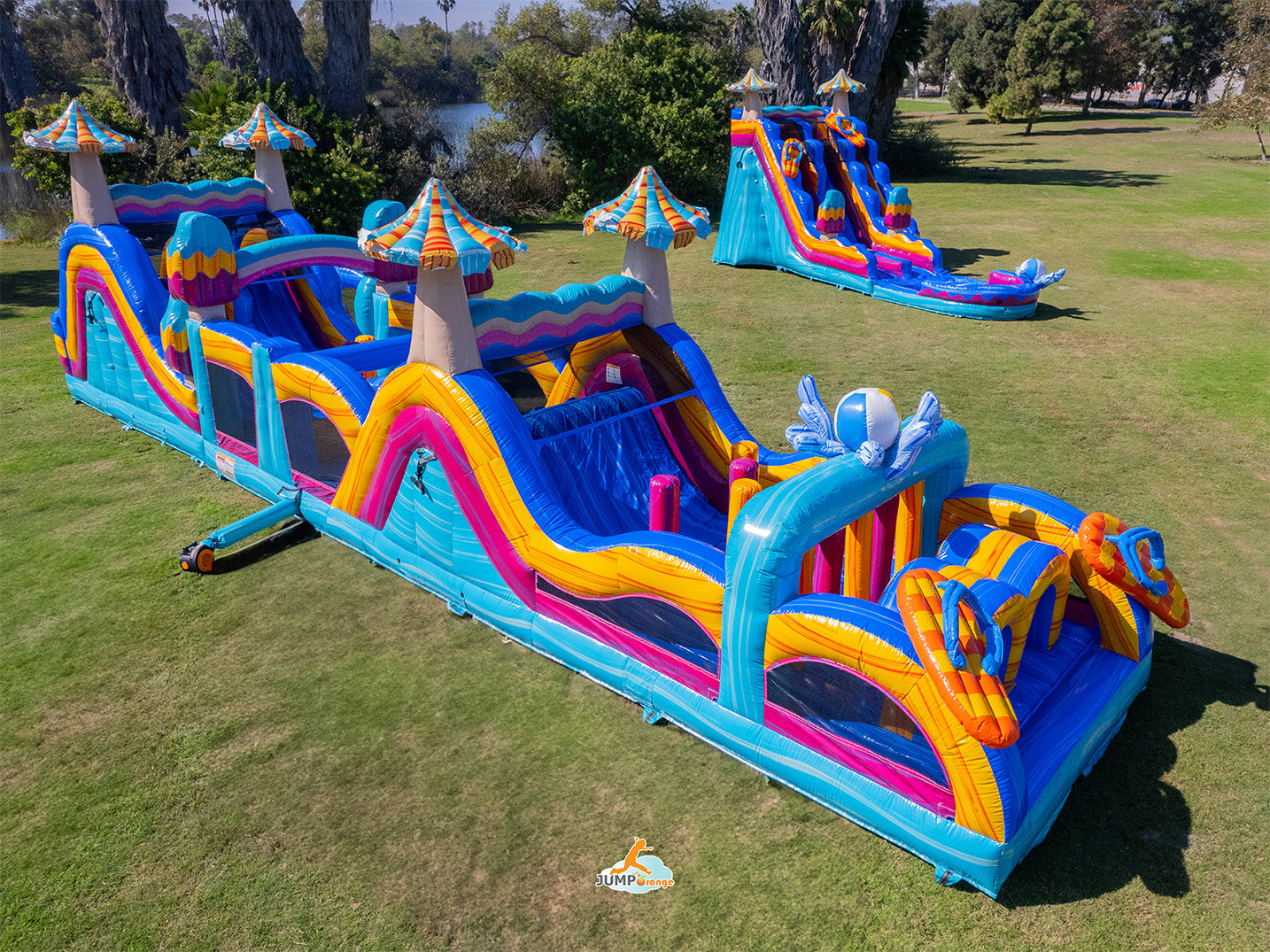
The summer revenue spike rewards operators who prepare early. The rental businesses that capture those 3-to-4 weekend deployments are the ones with commercial-grade water slides and wet/dry combos already on the truck when the heat hits. Buy heavy-duty slip n slides online from JumpOrange, which builds the 15oz-and-up commercial inflatables, certified water slides, and versatile combo units that hold up to daily peak-season cycles and keep earning long after summer ends. Browse the JumpOrange commercial water slide and combo lineup, and ask about JEM Club pricing so your fleet is ready to turn demand into profit this season.



Leave a comment
This site is protected by hCaptcha and the hCaptcha Privacy Policy and Terms of Service apply.