
Winter inflatable rentals offer rental operators strategic pathways to sustained profitability during traditionally dormant months. By diversifying equipment portfolios and targeting holiday events, businesses transform seasonal downturns into revenue opportunities.
Operators who rely exclusively on outdoor water slides face concentrated income windows spanning just 12-16 weeks. Strategic fleet composition balances high-margin summer equipment with versatile indoor units that generate consistent bookings year-round.
Key Takeaways
- Wet/dry combo units generate 40-60% higher revenue than single-feature inflatables and support 150+ annual events
- Holiday inflatables command $350-$1,500 rental rates and transform October-December into profitable corporate event periods
- Premium commercial equipment delivers $732 net profit per booking versus $185 for standard units (77% margin vs 57%)
- Maintaining a 60-70% versatile year-round inventory mitigates seasonality risk before expanding into water slides
- Indoor inflatables require ASTM D6413 Class I or NFPA 701 fire resistance certification for commercial use
What Are the Core Categories in Inflatable Rentals?
The inflatable rental market divides into three distinct product categories that serve different seasons and customer segments. Each category requires specific construction standards, pricing strategies, and operational approaches to maximize profitability.
How Do Indoor Inflatables Differ from Outdoor Water Slides?
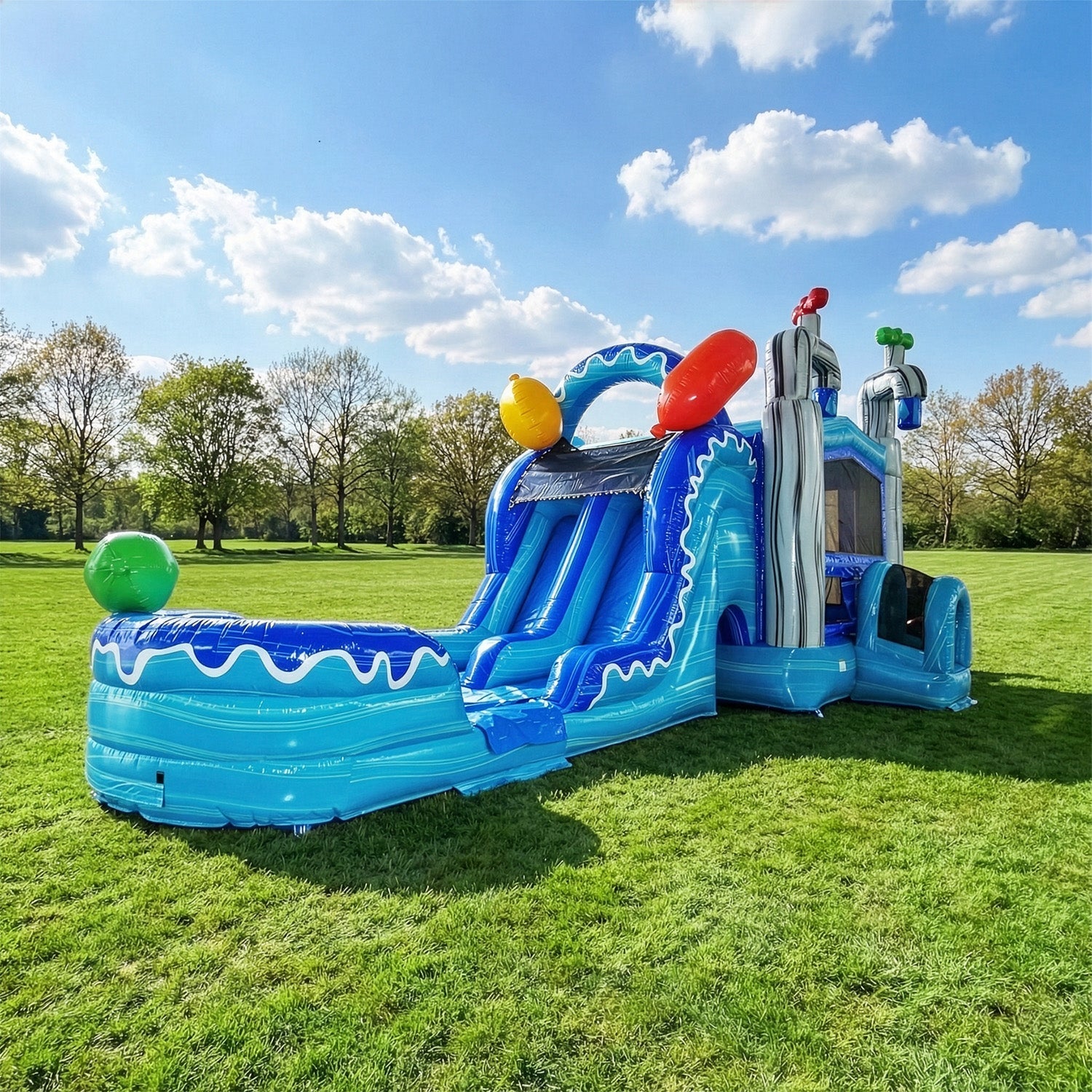
Indoor inflatables operate year-round in climate-controlled venues, while water slides require outdoor summer conditions and water access. Wet/dry combo units bridge this gap by functioning as water slides in summer and dry slides in the winter months.
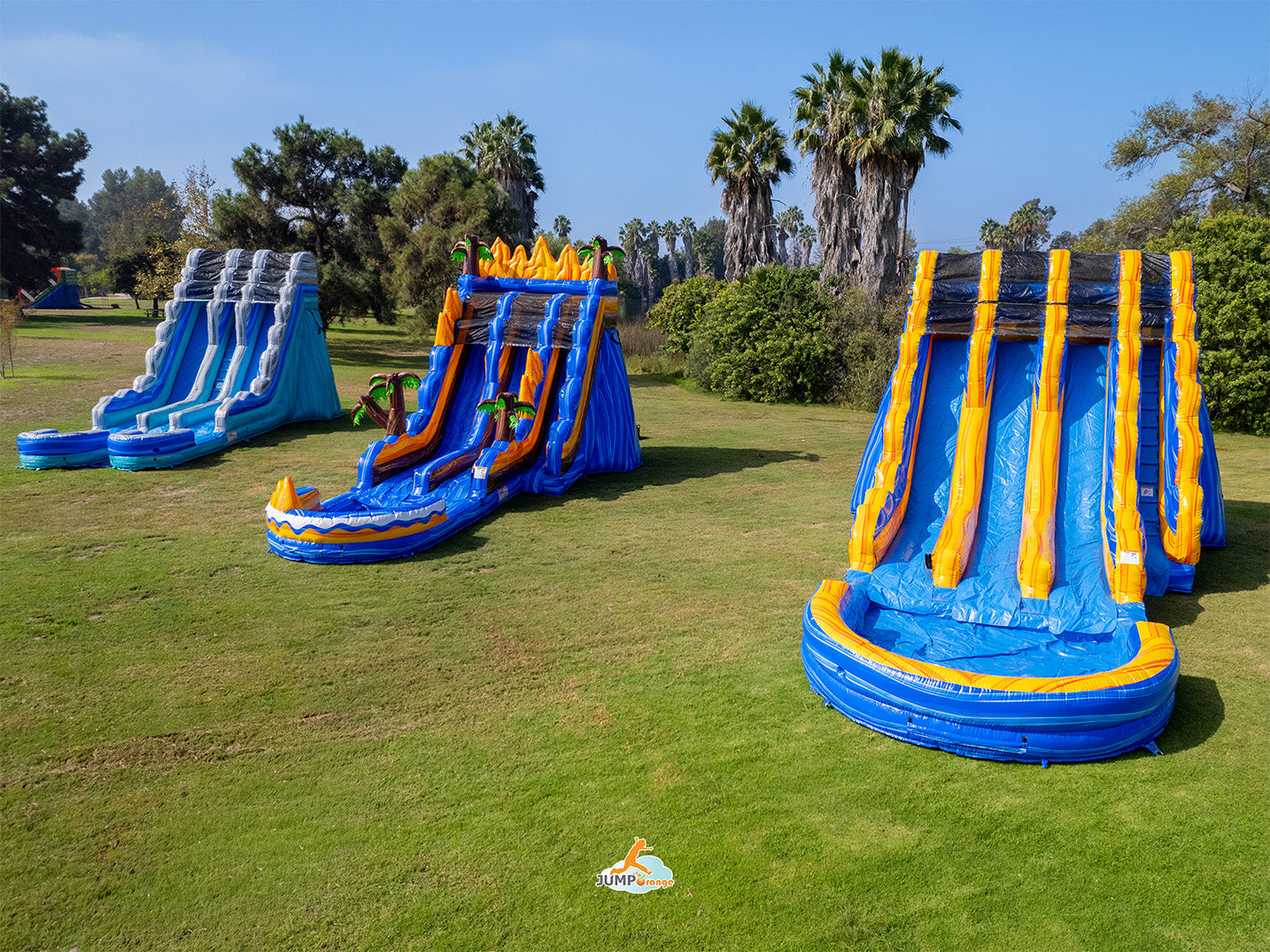
Water slide equipment costs range from $1,675 to $5,895 for standard commercial units and exceed $10,000 for premium models. Rental rates typically span $150-$325 for 14-foot models and $300-$600 for larger configurations.
Commercial water slides require a minimum of 18oz commercial-grade PVC vinyl construction to withstand frequent wet use. ASTM F2374 certification ensures slides meet safety requirements for commercial rental operations.
What Defines Holiday Event Inflatables?
Holiday event inflatables feature seasonal designs targeting specific celebration periods, including Halloween, Christmas, and Easter. These themed units command premium pricing and extend rental seasons into traditionally slow October-December months.
Design innovations include interchangeable themed panels, allowing one base unit to serve multiple holidays through simple swaps. This versatility reduces storage requirements and capital expenditure while maximizing equipment utilization throughout the year.
How Does Market Share Vary Among These Categories?
Standard bounce houses represent 35% of the total inflatable rental market share and form the foundational equipment category. Water slides capture 28% market share, concentrated primarily in June-August peak summer months.
Holiday inflatables comprise 18% market share but demonstrate rapid growth as operators seek off-season income opportunities. The remaining market share is distributed across obstacle courses, interactive games, and specialty units.
Why Is Seasonality a Critical Factor in Inflatable Rental Income?
Seasonality creates extreme revenue concentration that threatens business sustainability and creates cash flow volatility for operators. Understanding demand patterns enables strategic equipment investments that smooth income throughout the calendar year.
What Causes the Summer Peak in Inflatable Rentals?
Water slide rental interest peaks at 5.56 times higher in summer compared to winter months. Search volume for water slides demonstrates even greater variation at 10.72 times higher during peak season.
Standard bounce house interest shows a milder 2.4x seasonal variation due to year-round birthday party demand. June through August accounts for 60% of total annual revenue, with premium units deploying 3-4 times per weekend.
How Can Operators Mitigate Seasonality Risks?
Operators should maintain a fleet composition of 60-70% versatile year-round inventory before expanding into seasonal water slides. This foundation provides a stable baseline revenue that supports business operations during slower months.
Investing in wet/dry combo units effectively doubles the usable season of capital assets. Operators should limit standalone water slides to 30-40% of fleet composition to mitigate concentrated seasonality risk.
Targeting the October-December holiday season with premium themed inflatables creates secondary revenue peaks. This strategic rental diversification balances summer water slide income with winter holiday bookings.
What Role Do Wet/Dry Combo Units Play in Extending Rental Seasons?
Combo units generate 40-60% higher rental revenue compared to single-feature inflatables through extended seasonal deployment. These versatile units average 1.5 rentals per week and support 150+ rental events annually.
Combo unit acquisition costs typically range from $2,995 to $4,995 for commercial-grade models. The expanded rental season and higher utilization rates accelerate ROI timelines compared to specialized seasonal equipment.
Who Are the Primary Consumers and What Do They Value Most?
Parents organizing children's birthday parties represent the primary consumer segment driving residential inflatable rental demand. Understanding age-based preferences and demographic spending patterns optimizes marketing messaging and inventory selection.
How Do Children's Age Groups Affect Rental Preferences?
Among toddlers ages 2-3, 41% value birthday cake and food most at celebrations. Only 32% of toddlers in this age range prioritize receiving gifts as the highlight.
Children ages 6-7 demonstrate inverted preferences, with 48% valuing gifts most at birthday celebrations. Cake's importance drops to 35% for this older age group, signaling developmental shifts in priorities.
What Are the Demographic Patterns Affecting Spending on Rentals?
The West Coast leads national entertainment spending at $4,378 annually per household. Northeast households spend $3,670 annually, while Southern households allocate $3,022 to entertainment categories.
Urban households spend 18% more on entertainment compared to rural counterparts due to higher income levels. These geographic patterns directly influence maximum achievable rental rates and market pricing strategies in different regions.
What Motivates and Concerns Renters When Choosing Inflatable Services?
Budget constraints represent the primary limiting factor, with 43% of parents citing financial limitations in party planning. Venue and backyard capacity restrictions affect 26% of potential customers when evaluating rental options.
Safety, cleanliness, and unique visual appeal drive positive purchasing decisions among target demographics. Professional delivery, reliable setup, and hassle-free teardown services differentiate premium operators from budget competitors.
How Should Operators Design Their Fleet for Year-Round Profitability?
Fleet composition determines revenue stability and profitability across seasonal fluctuations in rental demand. Strategic equipment selection balances acquisition costs, rental rates, utilization frequencies, and maintenance requirements.
What Is the Ideal Fleet Mix to Maximize Revenue?
The optimal fleet maintains 60-70% year-round versatile inventory, including standard bounce houses and combo units. This foundation ensures consistent baseline revenue during the slower winter months when outdoor equipment sits idle.
Water slides should comprise 30-40% of total fleet capacity to capture premium summer demand without excessive seasonality exposure. Holiday event inflatables fill remaining portfolio slots, targeting October-December corporate and community events.
How Do Premium Units Compare to Standard Equipment?
Premium rentals generate $732 net profit per booking with 77% margins compared to $185 profit and 57% margins for standard units. This 4x profit advantage derives from higher base rates, delivery fees, and professional setup charges.
Premium equipment ROI timelines span 4-6 months versus 8-12 months for standard units despite higher acquisition costs. Premium rental breakdowns include a $800 base rate plus $100 delivery and $50 setup, totaling $950 per booking.
Standard rental pricing structures combine $250 base rates with $75 delivery fees, totaling $325 per booking. The reduced profit per transaction requires significantly higher booking volumes to achieve equivalent annual revenue targets.
What Are the Benefits of Commercial-Grade Equipment Over Consumer-Grade?
Commercial equipment enables 40-75% pricing increases compared to consumer-grade alternatives due to superior durability and professional appearance. Profit margins expand from 15-25% for consumer equipment to 35-50% for commercial-grade units.
Commercial-grade PVC vinyl requires a minimum 15-oz to 18-oz thickness for rental applications and extended operational lifespans. Heat-welded seams create bonds stronger than the base material, ensuring structural integrity under repeated inflation cycles.
Commercial inflatables deliver 5-10 year operational lifespans with 1,500-2,000 hours of use when properly maintained. This durability supports sustainable profit margins and reduces replacement frequency compared to consumer-grade alternatives.
What Are the Best Practices for Pricing and Maximizing ROI?
Profitability requires disciplined pricing that accounts for visible and hidden operational costs affecting net margins. Understanding total cost structures enables accurate rate setting that achieves investment payback within target timeframes.
How Is Profitability Different Between Standard and Premium Rentals?
Premium rentals deliver $732 net profit per booking after accounting for labor, fuel, maintenance, and insurance costs. Standard rentals generate $185 net profit per booking with proportionally lower gross revenue and similar operational expenses.
The margin differential stems from premium equipment commanding higher base rates and justifying additional service fees. Professional setup charges, extended rental periods, and delivery premiums contribute to expanded gross revenue per deployment.
What Hidden Costs Should Operators Anticipate?
Annual hidden costs typically range from $15,000 to $25,000 beyond initial equipment investments and direct operational expenses. Commercial liability insurance requires $2,400-$6,000 annually, depending on coverage limits and claim history.
Storage facilities consume $4,800-$9,600 annually at rates of $400-$800 monthly for climate-controlled space. Maintenance and repairs average $2,500-$5,000 yearly, with unexpected costs consuming 18-22% of total revenue.
How Quickly Can Operators Expect to Recoup Their Investment?
Water slide ROI timelines span 4-6 months during the peak summer season when equipment deploys multiple times weekly. Operators achieve complete payback within 12 events through disciplined pricing that accounts for total operational costs.
Year one revenue typically reaches $20,000-$40,000 with a foundational 4-unit fleet operating part-time. Years 2-3 revenue expands to $50,000-$90,000 as operators grow to 9-unit fleets and establish market presence.
Years 4+ revenue potential exceeds $100,000-$200,000 with 15+ unit fleets and optimized operational efficiency. These scaling trajectories assume consistent marketing efforts, competitive pricing, and reliable service quality.
How Can Holiday-Themed Inflatables Unlock Off-Season Revenue?
Holiday-themed inflatables transform traditionally dormant October-December months into profitable secondary revenue peaks targeting corporate clients. Strategic holiday equipment investments diversify income streams and reduce dependence on summer outdoor events.
What Are the Key Holiday Periods for Inflatable Rentals?
October-December represents the primary holiday rental season, with Halloween and Christmas driving the majority of demand. Corporate holiday parties, community festivals, and retail promotional events create concentrated booking opportunities.
March-April Easter season provides supplementary holiday revenue for operators serving family-oriented events and church celebrations. August-September back-to-school and early Halloween events extend summer revenue into the traditional shoulder season.
How Do Design Innovations Enhance Holiday Rental Appeal?
Modern holiday inflatables feature interchangeable themed panels, allowing operators to transform base units for multiple celebrations. This modular design reduces storage requirements and capital expenditure compared to purchasing separate specialized units.
Integrated LED lighting and interactive moving parts elevate visual appeal and justify premium pricing for evening events. These design enhancements differentiate holiday event inflatables from standard bounce houses and attract corporate budgets.
Who Are the Target Audiences for Holiday Inflatables?
Corporate clients represent the primary target audience for holiday inflatables seeking professional entertainment for employee appreciation events. Municipalities and community organizations book holiday units for public festivals and seasonal celebrations.
Holiday inflatable rental rates span $350-$1,500 for premium themed units, depending on size and features. This pricing premium reflects specialized seasonal demand and corporate entertainment budgets exceeding typical residential party allocations.
What Are the Safety and Quality Standards for Year-Round Inflatables?
Safety certifications and construction quality determine legal compliance, insurance eligibility, and long-term equipment durability. Understanding required standards prevents costly non-compliance issues and protects operators from liability exposure.
What Construction Features Are Essential for Commercial Inflatables?
Commercial inflatables require a minimum 15-oz to 18-oz PVC vinyl thickness to withstand frequent rental use and transportation stress. Heat-welded seams create molecular bonds stronger than the base material, preventing separation under inflation pressure.
Double, triple, or quadruple stitching reinforces non-welded areas and high-stress connection points throughout the structure. Reinforced anchor points and integrated safety netting prevent user injuries and equipment damage during operation.
Which Certifications Are Required for Indoor Use?
ASTM F2374-19/22 standards establish comprehensive inflatable safety requirements for commercial rental operations nationwide. ASTM D6413 Class I or NFPA 701 fire resistance certification proves critical for indoor bounce houses and climate-controlled venue deployments.
Fire resistance certification enables access to school gymnasiums, community centers, and corporate facilities requiring flame-retardant materials. Operators without proper certifications face venue rejections and lost booking opportunities during the winter indoor season.
How Does Equipment Durability Impact Long-Term Profitability?
Commercial-grade construction delivers 5-10 year operational lifespans with 1,500-2,000 hours of active use when properly maintained. This extended durability spreads acquisition costs across hundreds of rental events, reducing effective per-booking depreciation.
Premium materials justify higher initial investments through reduced repair frequencies and extended replacement cycles. Operators using commercial equipment avoid mid-season failures that damage customer relationships and require emergency equipment purchases.
Winter Rental Strategies: Leveraging Indoor and Holiday Inflatables for Sustainable Off-Season Income
Winter rental strategies center on equipment diversification that maintains cash flow when outdoor water slides sit dormant. Operators who balance versatile year-round inventory with strategic holiday investments achieve consistent monthly revenue regardless of season.
The inflatable rental industry rewards operators who view their business as year-round enterprises rather than summer-only ventures. Strategic fleet composition combining indoor bounce houses, wet/dry combos, and holiday-themed units creates resilient income streams across all twelve months.
Successful operators recognize that weather-resistant planning and seasonal diversification separate thriving businesses from struggling competitors. JumpOrange supports rental entrepreneurs with commercial-grade equipment built for extended operational lifespans and consistent profitability across varying market conditions.
Build a Rental Business That Pays All Year, Not Just All Summer
Slow winter months don't have to drain your income. JumpOrange builds commercial-grade indoor bounce houses, heavy-duty inflatable water slides, wet/dry combos, and holiday-themed inflatables engineered for the 5 to 10 year operational lifespans that turn one purchase into hundreds of bookings. Whether you're diversifying your fleet for off-season corporate events or adding versatile units that work in any weather, our equipment is made to keep earning when competitors' fleets sit idle. Explore the JumpOrange lineup and flexible financing options that put premium inflatables within reach without draining your working capital, then start booking the holiday season you've been missing.


Leave a comment
This site is protected by hCaptcha and the hCaptcha Privacy Policy and Terms of Service apply.