
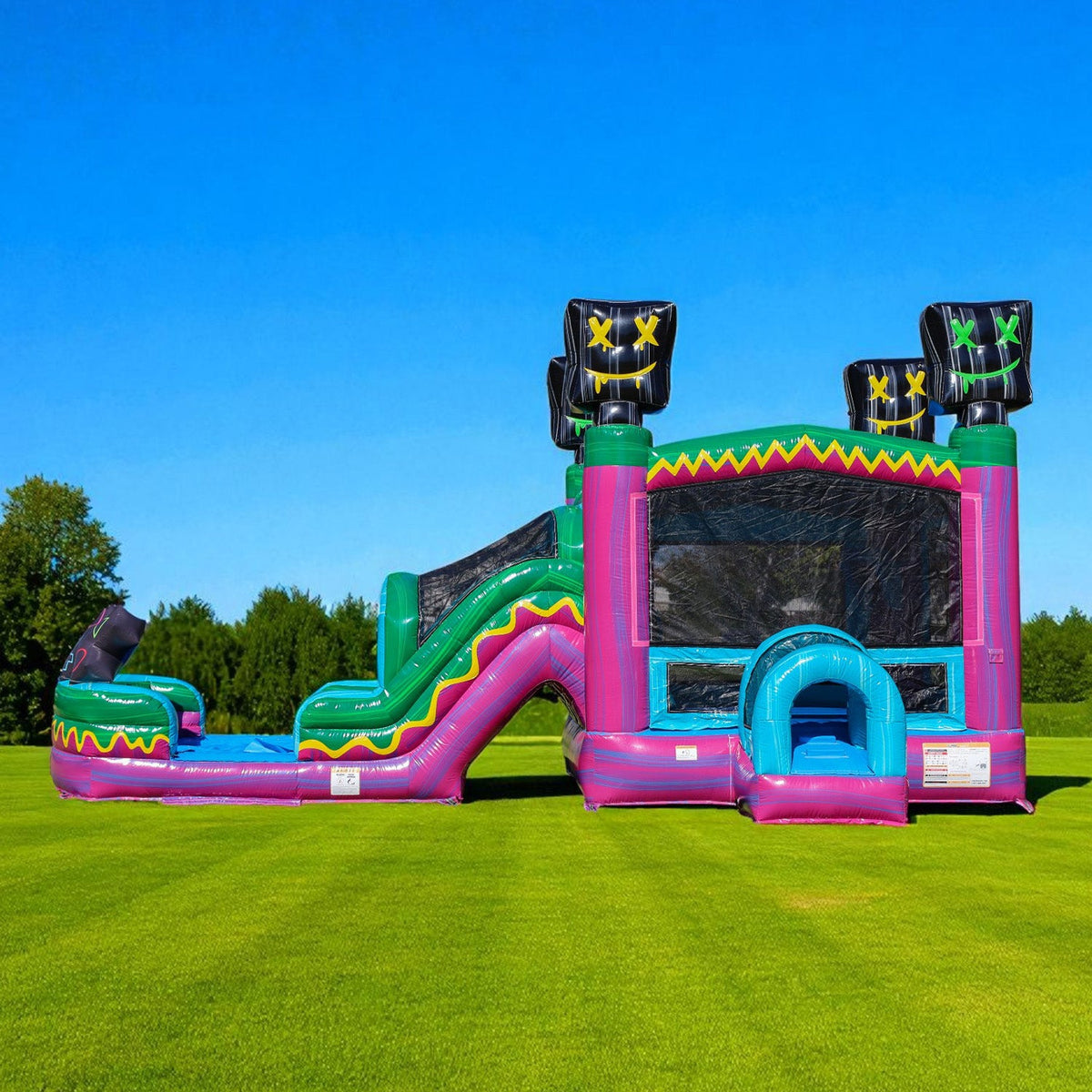
Rental operators and event hosts face conflicting priorities when selecting slip and slide length. Customers search for 100ft units at rates equal to 30ft models, yet median suburban backyards provide only 57ft of usable depth. Commercial suppliers concentrate inventory in the 30 to 35ft tier while search demand peaks at 40ft, a length tier most manufacturers do not stock.
Here’s what we break down: understanding which slip and slide length matches yard realities and customer intent requires examining space requirements, water infrastructure, setup logistics, and purchase behavior. This analysis combines manufacturer specifications, US residential lot data, and keyword search volume to identify which length tiers deliver practical fit and rental profitability.
Key Takeaways
- Commercial suppliers stock 30ft slip and slides most heavily, with all 17 JumpOrange SKUs in the 30 to 35ft range
- A 30ft slip and slide requires approximately 62ft of total yard length, including run-off and safety buffers
- 100ft slip and slides receive 130 monthly US searches despite needing 152ft of straight, clear terrain and 40+ gallons per minute
- Median new US homes sit on 8,543 square foot lots with derived usable rear yards of approximately 57 x 60ft
-
Price per linear foot ranges from $73 to $221 across commercial units, driven by lane count and features rather than length alone
Slip and Slide Length Categories Vary by Manufacturer and Marketing Name
Commercial slip and slide sizes cluster in distinct manufacturer bands rather than the 20ft, 50ft, and 100ft tiers customers search for. All 17 JumpOrange slip and slide SKUs measure 30 to 35ft, while industry data shows custom heights from 19ft to 29ft alongside standard 19 to 22ft collections elsewhere in the market. The 30ft length dominates commercial catalogues, with dual lane units outnumbering single lane configurations 2.4 to 1 in the 19 to 22ft height band.
JumpOrange publishes units at 20, 24, 25, and 27ft marketing heights, though specifications reveal inconsistencies. The SHARK SIGHTED DUAL LANE 24 FT SLIDE carries SKU JC-WSD22SS, a 22 series part number despite its 24ft marketing name, while the Deep Sea 25ft model has a platform height of 17ft distinct from total unit height.
US Commercial Suppliers Concentrate Inventory in the 30ft Tier
US commercial suppliers stock 30ft slip and slides as the dominant inventory tier. JumpOrange concentrates its entire slip and slide catalogue in the 30 to 35ft range. Industry benchmarks for the broader 19 to 22ft collection show 60 catalogued models: 39 dual lane models weighing 460 to 620 lbs at 42.5ft L x 19ft W, 16 single lane designs weighing 350 to 560 lbs at 34.5 to 62ft L, and 9 slide plus slip models measuring 62ft combined length.
Dual-lane units command market share, outnumbering single lane by 2.4 to 1 in the 19 to 22ft tier. Market surveys show custom heights ranging from 19ft to 29ft within this tier, while industry data lists a 100ft slip-and-dip model at 102 x 10 x 10ft dimensions without published retail pricing.
Manufacturer Length Bands Differ in Definition and Measurement
Platform height measures the actual standing height at the top of the slide, distinct from total unit height used in marketing names. The JumpOrange Deep Sea 25ft slide has a platform height of 17ft, creating an 8ft difference between structural measurement and advertised size.
This definitional inconsistency affects product comparison across suppliers who may label units by peak height, bed length, or combined slide plus slip configuration. Marketing names frequently misalign with SKU series numbers, as the SHARK SIGHTED DUAL LANE 24 FT SLIDE carries a 22 series part number.
Customer Search Volume Peaks at the 40ft Length Tier
Customer preferences for slip and slide length appear in monthly search volume data that contradicts manufacturer inventory concentration. The 40ft slip and slide receives 160 US monthly searches, with the highest variant at 90, making it the most-searched length tier despite minimal commercial availability.
The 30ft slip and slide draws 130 US monthly searches at $0.20 to $0.25 CPC, matched exactly by the 100ft slip and slide at 130 searches with $0.20 to $0.30 CPC and a premium $1.90 CPC for "100 foot slip and slide for sale."
The 50ft slip and slide generates 110 US monthly searches at $0.20 CPC, while the 20ft slip and slide captures only 50 monthly searches. Search volume reveals 75ft as commercially insignificant with 10 monthly searches nationally.
Slip and Slide Length Determines Total Yard Space Requirements
Total yard length requirements exceed bed length by 30 to 52ft when accounting for run-off, staging, and safety perimeters. A 20ft slip and slide requires approximately 50ft of straight yard length including 10ft run-off, 8ft launch zone, and 12ft combined buffer, while 100ft units demand 152ft total with 25ft landing zone, 15ft staging, and perimeter clearance. Bed length alone never equals space requirement, as riders leaving a 50ft bed at speed need deceleration distance measured separately.
The 6ft perimeter clear zone applies to all sides plus entrance and exit zones, making width requirements increase from 22ft for single-lane units to 26ft for dual-lane configurations. Operators must verify straight-line clearance rather than total square footage.
Total Yard Length Requirements Include Run-Off and Staging Zones
Total yard length requirements exceed bed length once run-off, staging, and safety buffers are added, as the table below shows. A minimum 6ft clearance on all sides establishes the baseline buffer beyond these figures.
A 50ft unit extends total requirement well beyond the 30ft tier, and 75ft beds place installations outside the usable range of median suburban lots at 57ft rear yard depth.
|
Bed Length |
Total Yard Length Needed |
Setup Area (W x L) |
Notes |
|
20ft |
50ft |
18 x 40ft |
10ft run-off, 8ft launch zone, 12ft buffer |
|
30ft |
62ft |
20 x 50ft |
12ft run-off, 8ft staging, 12ft buffer |
|
50ft |
87ft |
— |
Exceeds median 57ft rear yard depth |
|
75ft |
119ft |
— |
Outside usable range of most suburban lots |
|
100ft |
152ft |
— |
25ft landing zone, 15ft staging, perimeter clearance |
Width and Sidewall Dimensions Affect Yard and Gate Fit
Single lane width minimums range from 4 to 5ft wide to accommodate adult shoulders without contact with sidewalls. Dual lane configurations require a minimum 10ft total width to provide safe separation between simultaneous riders, while sidewall height minimums of 12 inches keep adults from rolling off at speed, with 18 inches preferred for adult-rated units. Industry data shows 100ft slip-and-dip models measuring 10ft wide, matching JumpOrange 30ft units at 10 to 11ft wide.
Width determines whether a unit fits through standard residential gates, as understanding average water slide sizes reveals that slides in the 15 to 18ft range fit through standard 36-inch residential side gates when deflated and rolled. Compact slides measuring 25 to 35ft long by 12 to 15ft wide fit through standard fence gates, with two-person crews completing setup in 20 to 30 minutes.
Slope and Grade Conditions Impact Setup and Safety
Ideal surface conditions require flat grass with no more than 2 to 3% grade change across full length. A slight downhill slope of 5 to 10 degrees provides beneficial acceleration, reducing water flow needed while increasing slide speed. Commercial units need stake-down points every 8 to 10ft along both sides, translating to 8 to 10 stakes for 30ft units and 22 to 26 stakes for 100ft installations. Hard surface installations demand sandbag or water barrel ballast at 50 to 80 lbs per anchor point, creating a total ballast requirement of 1,100 to 2,080 lbs for 100ft units.
Water and Setup Requirements Scale With Slip and Slide Length
Water supply demands scale sharply with length, as water requirements for slip and slides range from 4 to 6 gallons per minute for 12 to 15ft slides to 40 or more GPM for 100ft beds. A 25 to 30ft slide consumes 8 to 10 GPM over a six-hour rental, totaling 2,880 to 3,600 gallons per event. Standard garden hoses deliver 5 to 10 GPM, meaning 100ft installations may require four to eight hoses running simultaneously.
Setup logistics vary from two-person crews completing 30ft installations in 20 to 30 minutes to trained crews of five or more spending 90 to 120 minutes on 100ft slip beds weighing 1,200 to 1,500 lbs dry.
Water Supply Needs Scale by Length Tier
Water supply needs scale directly with bed length, as the table below shows.
|
Bed Length |
Water Supply Needed |
6-Hour Event Water Volume |
|
12 to 15ft |
4 to 6 GPM |
1,440 to 2,160 gallons |
|
17 to 22ft |
6 to 8 GPM |
— |
|
25 to 30ft |
8 to 10 GPM |
2,880 to 3,600 gallons |
|
35 to 40ft |
15 to 25 GPM |
— |
|
100ft and longer |
40+ GPM or multiple inlets |
2,400+ gallons |
Operators in drought-restricted markets including Southern California, Arizona, and parts of Texas encounter booking objections based on water consumption rather than rental rates.
Crew Sizes, Setup Times, and Transport Requirements Scale With Length
Compact units measuring 25 to 35ft L x 12 to 15ft W require a two-person crew with 20 to 30 minutes setup time. Slides in the 15 to 18ft range need a two-person crew completing delivery, setup, and retrieval in under 2 hours round trip, allowing three drops in a single day. The 25 to 30ft tier requires a crew of three to four people spending 45 to 90 minutes on setup, with units weighing 500 to 800 lbs packed and demanding box truck transport.
Units measuring 35 to 40ft require trained crews of five or more, weigh 1,000 to 1,500 lbs packed, and pack down to pallets requiring liftgate or forklift handling. The 100ft slip class requires four to six people and 90 to 120 minutes for proper installation, with dry weight reaching 1,200 to 1,500 lbs.
Anchoring and Ballast Specifications Apply by Installation Surface
Each anchor point must resist a minimum force of 1600 N (360 lbf) according to JumpOrange specifications. Industry benchmarks publish a minimum 75-pound anchoring force per tie-down point, with 80 lb anchoring water bags meeting this threshold on concrete, asphalt, or gymnasium floors under ASTM F2374 compliance. Weight-based anchoring for commercial operations requires 200 to 450 lbs per anchor point.
A 30ft unit needs 8 to 10 stakes positioned at one stake every 8 to 10ft on both sides, while 100ft units demand 22 to 26 stakes for proper load distribution. Stakes must be driven vertically rather than angled, as angled installation loses 40 to 60% of holding force.
Slip and Slide Length Affects Purchase Price and Rental Income
Purchase prices vary from $73 to $221 per linear foot across commercial catalogues, driven by lane count and integrated features rather than bed length alone. The JumpOrange Tiara Slip N Slide 30ft lists at $2,195 ($73 per linear foot), while the Galaxy, Oasis, and Cali Palms 30ft models price at $3,195 ($107 per linear foot) for identical bed length with enhanced theming.
Dual lane configurations command premium pricing, as the Shark Sighted Dual Lane 35ft reaches $2,995 ($86 per linear foot). Rental rates span $150 to $400 per day across the 30 to 35ft tier based on features and capacity.
Price Range and Price per Linear Foot Vary by Length and Features
JumpOrange 30ft models range from $2,195 to $3,195 depending on theming, while the dual lane Flash model commands a premium at $221 per linear foot, as the table below shows.
|
Model Group |
Length |
Price |
Price per Linear Foot |
|
Tiara Slip N Slide |
30ft |
$2,195 |
$73 |
|
Ice Pops, Shark Sighted, Target, Ocean Battle, Mermaid |
30ft |
$2,695 |
$90 |
|
Galaxy, Oasis, Cali Palms, Dolphin, Pool Party, Enchanted Forest, Level Up, Mysterious Jungle, I’mperfectly |
30ft |
$3,195 |
$107 |
|
Flash Dual Lane with pop-out slip |
35ft |
$7,745 |
$221 |
Price per linear foot ranging from $73 to $221 demonstrates that length does not determine value. Lane count, integrated slide towers, pool type, and theming drive pricing differentiation more than bed measurement alone.
Rental Rates Vary With Slide Length and Features
The JumpOrange Oasis Slip N Slide 30ft rents for $150 to $250 per day with a 1 HP blower and single-user capacity. The Galaxy Slip N Slide 30ft commands $200 to $300 per day with a 1 HP blower, while the Shark Sighted Dual 35ft achieves $250 to $350 per day with a 1.5 HP blower and a maximum of 2 users. The Flash 20ft Dual Lane 35ft reaches $300 to $400 per day with a 1.5 HP blower and a maximum of 4 users. Mid-range 18 to 22ft units nationally rent for $275 to $400 per full day in most US markets. Weekend bookings run 40 to 60% above weekday rates.
Payback Periods Differ Across Length Tiers
A commercial-grade 30ft slip and slide costing $2,500 can generate $150 to $250 per rental. With 20 rentals per season, the 30ft tier produces $3,000 to $5,000 in annual revenue, achieving gross payback within the first year before freight, blowers, stakes, labor, insurance, and delivery costs. A 19ft single lane requires 13 rentals to reach gross payback at a $285 day rate, while a 20ft dual lane needs 20 rentals at a $310 day rate.
Adding freight at $595, blowers at $229 to $438, and stakes at $80 to $110 extends true payback to approximately 24 to 29 rentals or two full seasons at 12 bookings per season.
Yard Size and Access Constraints Limit Slip and Slide Installations
US residential lot sizes establish hard limits on which slip and slide sizes fit typical installations. The median lot for new single-family detached homes sold measured 8,543 square feet in 2025, with 64% of new homes sitting on lots under 9,000 square feet. The Pacific region shows median lots under 0.13 acres (5,663 square feet), the smallest in the nation, while homes built in the 1970s to 1990s occupy median lots 63% larger than 2025 new builds at 13,939 versus 8,543 square feet.
Derived usable rear yard for median new builds approximates 3,420 square feet, or approximately 57 x 60ft after subtracting front setback, house footprint, and side clearances. This 40% rear-yard ratio reveals that the 25th percentile derived usable rear yard measures approximately 2,080 square feet (40 x 52ft), while the 75th percentile reaches approximately 7,400 square feet (74 x 100ft).
US Residential Lot Sizes Set Limits on Slide Footprint
The median lot for new single-family detached homes sold reached 8,543 sq ft in 2025. Sixty-four percent of new homes sit on lots under 9,000 sq ft, continuing a multi-decade trend toward smaller parcels. Pacific region median lots measure under 0.13 acres (5,663 sq ft), creating structural barriers to large slide installations in California and coastal markets.
Homes built in the 1970s to 1990s occupy median lots of 13,939 sq ft, 63% larger than 2025 new builds. This generational difference makes housing age a more reliable targeting variable than income for operators marketing slides requiring 60ft or more of linear depth.
Gate Widths and Yard Surface Types Influence Installation Feasibility
Pedestrian gates measure 36 inches in most residential applications. Double-gate residential standard reaches 8ft total width. Slides in the 15 to 18ft range fit through standard 36 in residential side gates when deflated and rolled, while compact slides 25 to 35 ft long by 12 to 15 ft wide fit through standard fence gates with careful maneuvering.
Hard surface installations require sandbag or water barrel anchoring at typically 50 to 80 lbs per anchor point. Concrete, asphalt, and gymnasium floors demand 200 pounds per anchor point for commercial operations.
Backyard Usable Space Estimates Determine Length Suitability
Usable rear yard area is approximately 3,420 sq ft (57 x 60) for median new construction. This represents 40% of the total lot. The 25th percentile derived usable rear yard measures approximately 2,080 sq ft (40 x 52 ft), limiting installations to compact single-lane units under a 35 ft total setup requirement.
The 50th percentile derived usable rear yard reaches approximately 4,348 sq ft (55 x 79 ft), accommodating slides up to 45ft bed length with proper buffer. The 75th percentile derived usable rear yard provides approximately 7,400 sq ft (74 x 100 ft), opening access to 50 to 62ft combined slide plus slip configurations.
Overhead Clearance and Safety Setback Requirements Apply to Every Installation
Vertical clearance demands exceed slide height by a minimum of 15 ft above the highest point for branches, lines, or structures. A 25ft slide with 15ft overhead clearance needs 40ft clear column of air, excluding most mature suburban tree canopy from suitable installation sites.
Setback distances from hazards include a minimum 15ft clearance from overhead power and utility lines and a minimum 6ft clearance from fences.
ASTM requires a minimum of four anchor points and establishes 15 mph as the default maximum wind speed where the manufacturer provides no operating limit, as understanding slope requirements for water slides affects both anchoring strategy and wind vulnerability. Deflation alert systems become mandatory for any inflatable with platforms or play areas exceeding 8ft (2.4 m), making them required for units in the 20ft and taller category.
Vertical Clearance Requirements Increase With Slide Height
A minimum 15 ft clearance above the highest point is required for branches, lines, or structures. A 25 ft slide requiring 15 ft overhead clearance needs a 40 ft clear column of air, eliminating most residential installations under mature trees or near two-story rooflines.
Indoor installations require at least 15 ft ceiling clearance above the unit's highest point, restricting gymnasium and recreation center bookings to facilities with full-height ceilings.
Setback Distances From Trees, Power Lines, and Fences Follow Set Minimums
Overhead power and utility lines require a minimum 15 ft clearance to prevent contact during inflation, operation, or wind-induced sway. Fences demand a minimum of 6 ft clearance to allow anchor placement and perimeter access, while tree branches need trimming for low limbs that could puncture or snag top vinyl.
Buried utilities require advance coordination by calling 811 several days ahead of staking operations. Equipment access gates need 5 to 6 ft width for moving deflated units.
Regulatory Standards Set Anchoring and Wind Operation Limits
ASTM requires a minimum of four anchor points for all inflatable amusement devices. Wind operation limits default to 15 mph maximum sustained wind speed where the manufacturer gives no published limit. Data shows 51% of wind incidents occurred below the 25 mph ASTM design threshold, reinforcing 15 mph shutdown as industry standard.
Deflation alert systems become mandatory for any inflatable with platforms or play areas exceeding 8 ft (2.4 m), making them required equipment for slides in the 20ft and taller category. The JumpOrange Deep Sea 25 ft carries a platform height of 17 ft, placing it well above the 8 ft trigger.
The 30ft Tier Matches Customer Search Demand and Yard Realities Most Closely
Customer search behavior diverges from yard capacity at the 40ft and 100ft tiers. The 40ft slip and slide receives 160 monthly searches as the highest-volume length query, yet minimal commercial availability exists as a discrete SKU in this tier. The 100ft slip and slide matches 30ft search volume at 130 monthly queries despite requiring 152ft of straight, clear terrain and a 40+ GPM water supply that excludes it from 95% of residential installations.
The 30ft tier aligns supply, demand, and site compatibility better than any alternative. All 17 JumpOrange slip and slide SKUs concentrate in the 30 to 35ft range, matching 130 monthly searches and fitting derived usable rear yards of 57 x 60ft with minimal overhang. The 75ft tier generates only 10 monthly searches nationally.
Slip and Slide Lengths: Balancing Customer Demand with Yard and Setup Constraints
Selecting appropriate slip and slide length requires matching customer search behavior to physical site constraints and operational capacity. The 30ft tier dominates commercial inventory for structural reasons, as it fits standard residential gates at 36 inches when deflated, requires two-person crews completing 20 to 30 minute setups, and accommodates median suburban rear yards at 57ft depth. Operators pursuing 100ft installations target the top quartile of US lots at 7,400+ square feet of usable yard or shift entirely to commercial venue bookings at parks, schools, and corporate sites.
Yard space for slip-and-slide installations depends on derived rear yard rather than total lot, as the 40% usable ratio applied to median 8,543-square-foot lots yields only 3,420 square feet of clear space. The 50ft tier sits at the boundary of residential feasibility, demanding 87ft total length—achievable in above-median yards but tight in new construction. Features including essential safety elements affect rental rates more than bed length alone, as dual lane configurations and integrated pools command $100 to $150 premiums over single lane equivalents at identical dimensions.
JumpOrange addresses the length selection challenge through concentrated SKU offerings at the 30ft tier, allowing rental entrepreneurs to build inventory depth in the size category that balances customer demand, yard compatibility, and setup efficiency. Operators seeking commercial-grade slip and slides or exploring taller water slide options benefit from understanding which length tiers generate rental volume versus which satisfy occasional specialty bookings. Knowing how much water different slide sizes require prevents quoting units into drought-restricted markets or venues with inadequate supply infrastructure.
Rental businesses achieve the fastest payback in the 19 to 30ft tier, where 12 to 20 rentals at $150 to $360 day rates recover purchase costs before freight and accessories. The 100ft tier demands specialty marketing to the narrow venue segment, providing 152ft of straight terrain, municipal water access, and advance permit coordination. Entrepreneurs building rental fleets maximize utilization by concentrating purchases in the 30ft category where supply meets demand and yard access constraints create minimal booking friction.
Get the Right Slip and Slide Length From JumpOrange
Choosing between a 20ft, 30ft, 50ft, or 100ft slip and slide comes down to matching yard reality with customer demand, and JumpOrange has spent over two decades helping rental entrepreneurs make that call correctly the first time. Our commercial-grade slip and slides are built in the 30ft to 35ft range that fits median suburban yards, clears standard gate widths, and delivers the fastest payback of any length tier.
Speak with a JumpOrange product specialist to confirm the right length for your market, or browse our heavy-duty inflatable commercial water slides and slip and slide collection to compare models, pricing, and included accessories. Call 1.877.388.5867 or request a free quote online, and our team will help you match slip and slide length to your yard access, water supply, and rental goals.
Frequently Asked Questions About Slip and Slide Length
What Slip and Slide Length Fits a Standard Backyard?
A 30ft slip and slide fits most standard suburban backyards, since it needs approximately 62ft of total yard length once run-off, staging, and safety buffers are included. Median new US homes sit on 8,543-square-foot lots with derived usable rear yards near 57 x 60ft, which comfortably accommodate the 30ft tier with minimal overhang. Yards under the 25th percentile, at roughly 40 x 52ft, are better matched to compact single-lane units under 35ft total setup length. Always measure straight-line depth rather than total square footage before booking.
Why Do 40ft and 100ft Slip and Slides Have High Search Demand but Low Availability?
The 40ft slip and slide receives 160 monthly US searches, the highest volume of any length tier, yet almost no commercial manufacturer stocks it as a discrete SKU. The 100ft slip and slide matches 30ft search volume at 130 monthly queries despite needing 152ft of straight, clear terrain and 40 or more gallons per minute of water supply. Manufacturers concentrate production in the 30ft to 35ft range because it balances yard compatibility, setup speed, and rental payback better than either extreme. Operators searching for 40ft or 100ft units should expect longer lead times or custom orders.
How Much Water Does a Slip and Slide Need per Rental?
Water needs scale sharply with length: 12 to 15ft slides use about 4 to 6 gallons per minute, while 25 to 30ft slides use 8 to 10 gallons per minute over a six-hour rental. A 100ft installation may need 40 or more gallons per minute, often requiring four to eight garden hoses running at once since a standard hose delivers only 5 to 10 gallons per minute. Operators in drought-restricted markets, including Southern California, Arizona, and parts of Texas, should confirm water access before booking longer units. Matching length to available water supply prevents cancelled or unsafe setups.
How Long Does It Take to Set Up a Commercial Slip and Slide?
A two-person crew typically installs a 30ft slip and slide in 20 to 30 minutes, while units in the 35 to 40ft range require trained crews of five or more due to their 1,000 to 1,500 lb packed weight. A 100ft slip bed needs four to six people and 90 to 120 minutes for proper anchoring and inflation. Setup time affects how many bookings a crew can complete per weekend, which is why the 30ft tier delivers the fastest turnaround for rental businesses. Stake spacing, water hookup, and ballast placement all add to total setup time on longer units.
What Slip and Slide Length Offers the Fastest Rental Payback?
The 19ft to 30ft tier delivers the fastest payback, with a $2,500 commercial 30ft unit typically recovering its cost within 12 to 20 rentals at $150 to $360 day rates. Adding freight, blowers, and stakes extends true payback to roughly 24 to 29 rentals, or about two seasons at 12 bookings per season. The 100ft tier demands specialty marketing toward parks, schools, and corporate venues rather than residential bookings, since it exceeds the yard capacity of 95 percent of US homes. Rental businesses that concentrate inventory in the 30ft tier see the shortest gap between purchase and profitability.


Leave a comment
This site is protected by hCaptcha and the hCaptcha Privacy Policy and Terms of Service apply.