
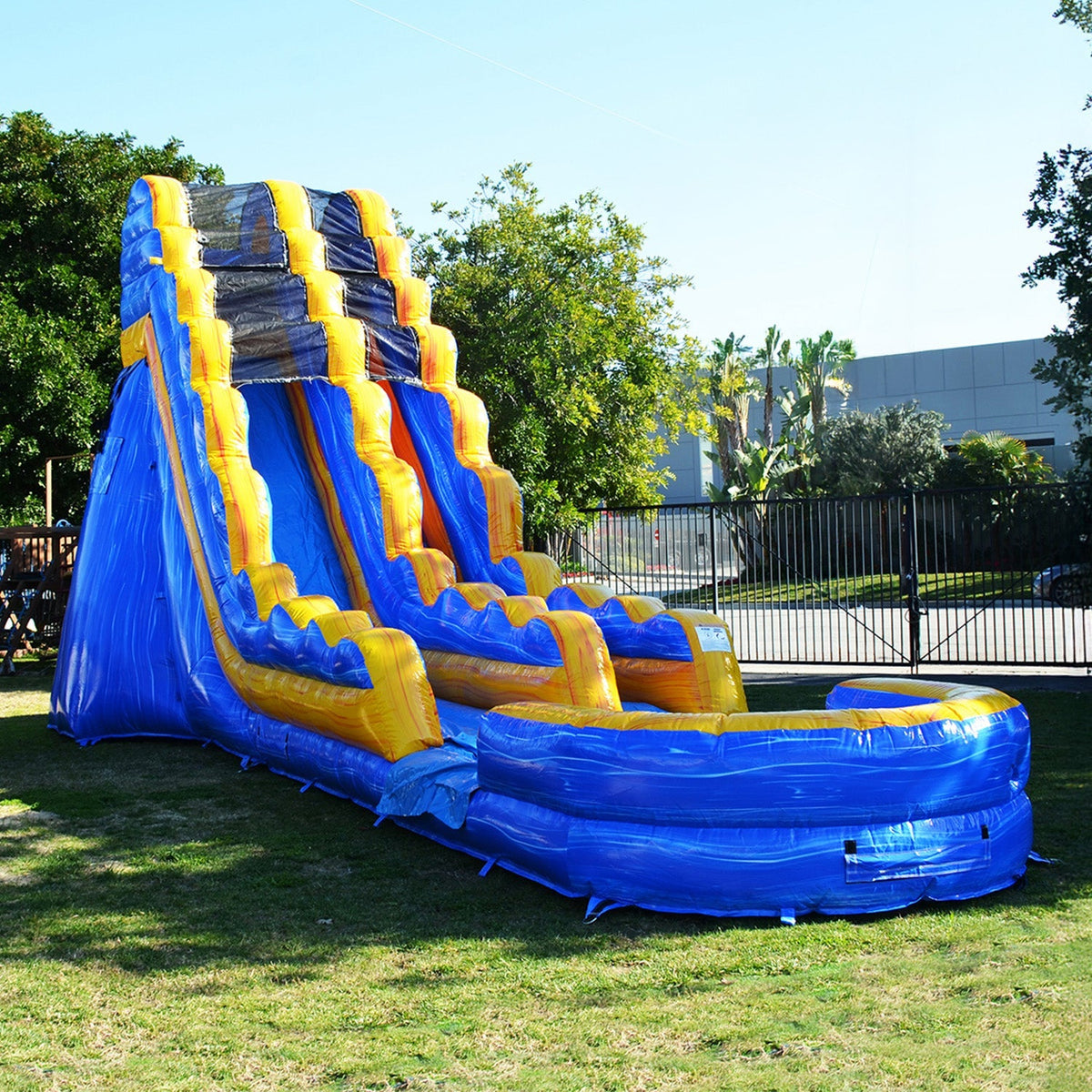
Towering water slides begin at 18 ft in height and represent the premium tier of commercial inflatable rentals. These large water slides require specialized setup protocols, significant yard clearance, and adherence to strict safety standards that smaller units do not. Understanding water slide height limits is essential for operators evaluating fleet expansion and pricing strategy.
The commercial market clusters around 19 to 22 ft, 25 ft, and 27 ft height tiers. Platform height, defined as the actual standing height before the slide, differs from peak height and directly affects ASTM deflation alert requirements. Operators must reconcile manufacturer specifications, yard dimensions, and local permit triggers before quoting premium water slides into residential or commercial sites.
Key Takeaways
- Towering water slides are defined as 18 ft and above, with platform height measuring actual standing height before the slide
- A 25 ft slide needs a 40 ft clear column of air, excluding most mature tree canopy from setup sites
- ASTM F2374 requires anchoring at 360 lbf minimum per point, with 19 US states citing these standards in law
- Median US new-build lots at 8,543 sq ft fit single-lane slides up to 22 ft but not 62 ft slide-plus-slip combinations
-
Search volume shows 40 ft slip-and-slide leads demand at 160 monthly searches, while 75 ft records only 10
What Defines a Towering Water Slide and Its Market Variations?
What Are the Common Height Tiers and Model Differences?
Towering water slides are defined as 18 ft and above in height, measured at the platform. Platform height is the actual standing height before the slide, not the peak height. Manufacturers cluster products around 19 to 22 ft, 25 ft, and 27 ft tiers.
The BounceWave 19-22 ft collection includes 39 dual lane models and 16 single lane models. Dual lane models weigh 460 to 620 lbs at 42.5 ft L x 19 ft W x 20 to 22 ft H. Single lane models weigh 350 to 560 lbs at 34.5 to 62 ft L x 17.6 to 21 ft W.
How Do Footprint Dimensions and Configurations Vary by Height?
Single lane width is 4 to 5 ft wide to accommodate adult shoulders. Dual lane total width is a minimum of 10 ft, creating different yard fit profiles. The BounceWave 22ft Rip Curl + Slip measures 62 x 21 ft, combining slide and slip pieces.
The JumpOrange Deep Sea 25 ft measures 45 x 15 ft and lists at $7,995. A 20 ft dual lane at 19 ft wide occupies more horizontal space than a 25 ft single lane at 15 ft wide, meaning the taller single lane unit fits yards that the shorter dual lane cannot.
What Are the Typical Purchase Prices and Rental Rates by Height Tier?
The BounceWave 19ft Island Flow Palms measures 35 x 17.6 ft and costs $3,495. The 20ft Island Flow Hybrid dual lane at 42.5 x 19 ft costs $4,565. The 22ft Rip Curl + Slip at 62 x 21 ft costs $5,395.
An 18 ft slide day rate is $285 in Tennessee. A 22 ft slide day rate is $360, representing a 26% premium for 4 ft of additional height.
|
Model |
Height |
Footprint (L x W) |
Price |
|
BounceWave 19ft Island Flow Palms |
19 ft |
35 x 17.6 ft |
$3,495 |
|
BounceWave 20ft Island Flow Hybrid (dual lane) |
20 ft |
42.5 x 19 ft |
$4,565 |
|
BounceWave 22ft Rip Curl + Slip |
22 ft |
62 x 21 ft |
$5,395 |
|
JumpOrange Deep Sea |
25 ft |
45 x 15 ft |
$7,995 |
What Spatial and Safety Requirements Govern Towering Water Slide Setup?
How Much Setup Space and Buffer Is Needed for Safe Operation?
A 25 ft slide needs a 40 ft clear column of air, excluding most mature tree canopy. A 100 ft slip needs 152 ft of straight, clear, level ground, equivalent to two and a half median backyards. The 22 ft slide-plus-slip at 62 x 21 ft does not fit the median backyard when proper buffer is included.
Ideal surface is flat grass with no more than 2-3% grade. Anything steeper than 5 to 10 degrees requires additional braking features at the landing zone.
What Are Overhead Clearance and Setback Guidelines from Hazards?
Overhead power lines require a minimum 15 ft clearance above the unit's highest point. No contact with buildings, eaves, or gutters is permitted during operation or sway. Operators must trim low tree limbs that could puncture, scratch, or snag vinyl during inflation.
Fire hose connections and hydrant hookups may be needed for units exceeding 100 ft in length. Staging zones on both ends add 20 to 30 ft beyond the bed length for corporate events.
What Are ASTM F2374 Anchoring Standards and Wind Safety Protocols?
ASTM F2374 is the Standard Practice for Design, Manufacture, Operation, and Maintenance of Inflatable Amusement Devices. Nineteen US states explicitly cite ASTM standards in law, making compliance legally mandatory. Each anchor point must resist a minimum force of 1600 N or 360 lbf.
Wind limit rules state units must not operate above the manufacturer's stated maximum sustained wind speed. Where no wind limit is given, operators must adopt 15 mph as the default maximum. Fifty-one percent of wind incidents occurred below the 25 mph ASTM design threshold, according to inflatable anchoring requirements documented in industry safety reports.
How Do Operational Needs Affect Electrical and Water Setup?
What Are Blower Requirements and Electrical Power Considerations?
The 1.5 hp Zoom XLT runs at 115V, 1065 CFM, and 10 amps with a 25 ft cord. A 2.0 hp blower draws 1,500 watts and 12 to 14 amps, requiring a dedicated 20-amp circuit. Blower startup surge reaches up to 17 amps or 1,955 watts, just under a 2,000-watt generator capacity.
Blower prices are $189 for 1.0 hp, $209 for 1.5 hp, $229 for 2.0 hp, and $289 for 3.0 hp. Blowers rated 1.5 hp and above require a dedicated 20-amp circuit to handle the startup surge.
|
Horsepower |
Power Draw |
Price |
Circuit Needed |
|
1.0 hp |
Standard 115V |
$189 |
Standard circuit |
|
1.5 hp (Zoom XLT) |
115V, 10 amps, 1065 CFM, 25 ft cord |
$209 |
Standard circuit |
|
2.0 hp |
1,500W, 12 to 14 amps |
$229 |
Dedicated 20-amp circuit |
|
3.0 hp |
Surge up to 17 amps / 1,955W |
$289 |
Dedicated 20-amp circuit |
How Much Water Supply and Drainage Capacity Is Needed?
A garden hose delivers 5 to 10 GPM under typical residential pressure. A 100 ft slip requires 40+ GPM, meaning operators need 4 to 8 hoses running simultaneously. Landing pools must be filled 8 to 12 in deep to cushion the stop without creating drowning hazards.
A 25 ft slide consumes 2,880 to 3,600 gallons per 6-hour event, creating a booking objection in drought markets. Understanding how much water is needed for a water slide prevents logistical failures at residential sites without adequate supply or drainage capacity.
What Crew Sizes, Setup Times, and Transport Logistics Are Typical?
The 15-18 ft class requires a two-person crew and under 2 hours round trip. Operators can complete three drops per day with this size tier. The 25-30 ft class requires a crew of 3-4 people and 45-90 minutes for setup.
Units in the 35-40 ft class require crews of 5 or more personnel. These units pack to 1,000-1,500 lb pallets requiring liftgate or forklift access. The 100 ft slip class needs 4-6 people and 90-120 minutes, with dry weight exceeding 1,200-1,500 lbs.
What Are Commercial Slip and Slide Length Tiers and Their Practical Implications?
Which Lengths Are Commonly Offered and Popular in the US Market?
JumpOrange has 17 slip and slide SKUs, all measuring 30 to 35 ft in length. Inflatable slip and slide generates 1,400 monthly US searches in aggregate. The 40 ft slip and slide tier records 160 monthly US searches, the highest volume of any specific length.
The 30 ft slip and slide tier records 130 monthly US searches at the same volume as 100 ft. The 75 ft slip and slide tier records only 10 monthly US searches, the lowest demand in the category.
What Yard Length and Width Clearances Do Different Slip Lengths Require?
A 30 ft slip bed requires 62 ft of total straight-line yard length including buffer. A 50 ft slip bed requires 87 ft when run-off, staging, and perimeter buffer are included. A 100 ft slip bed requires 152 ft of straight, clear, level ground, more than double the median suburban backyard depth.
Single lane width is 4 to 5 ft wide, requiring 16 to 17 ft total width with 6 ft buffer on each side. Dual lane slips at 10 ft wide require 22 ft total width with proper clearance zones.
How Does Water Consumption and Pricing Scale with Slip Length?
The JumpOrange Tiara Slip N Slide at 30 ft costs $2,195, or $73 per linear foot. Price per linear foot ranges from $73 to $221, driven by lane count and integrated features. The 22 ft slide-plus-slip at 62 ft combined length is 55% longer than a plain 22 ft unit.
Commercial inflatable slip and slide units require 15 to 30 GPM for adequate surface coverage. Units 100 ft and longer may need fire hose connections, portable pumps, or hydrant hookups to meet 40+ GPM demand.
|
Length |
Yard Length Needed (with buffer) |
Monthly US Searches |
|
30 ft |
62 ft |
130 |
|
40 ft |
Not specified in manufacturer data |
160 |
|
50 ft |
87 ft |
110 |
|
75 ft |
Not specified in manufacturer data |
10 |
|
100 ft |
152 ft |
130 |
How Do US Backyard Sizes Influence Fit and Installation Feasibility?
What Are Typical Residential Lot Sizes and Regional Variations?
The median US lot size for new single-family homes is 8,543 sq ft in 2025. Homes built in the 1970s-1990s sit on median lots of 0.32 acres or 13,939 sq ft, 63% larger than 2025 new builds. The Pacific division median lot is under 0.13 acres or 5,663 sq ft, the smallest in the nation.
New England median lots exceed 0.4 acres or 17,400+ sq ft, double the national median. Median custom home lots measure one acre or 43,560 sq ft as of 2024, creating a distinct market segment.
How Much Usable Backyard Space Is Available for Water Slide Setup?
Sixty-four percent of new homes sit on lots under 9,000 sq ft in 2025. Half of single-family homeowners live on lots between 5,200 and 18,500 sq ft, based on AHS distribution data. Around 80% of US homes can host an 18 ft slide on area alone.
Around 70% can host a 22 ft slide-plus-slip-on area, but area is a permissive test. The dimensional test is stricter because the average size of a water slide for a small backyard must satisfy both length and width constraints simultaneously, not just total square footage.
How Do Gate Widths and Access Constraints Affect Slide Placement?
Standard pedestrian gates measure 36 in, the most common residential size. Garden and utility gates measure 42 to 48 in to accommodate lawn mowers and wheelbarrows. Standard double gates measure 8 ft, consisting of two 4 ft leaves.
Slides in the 15-18 ft class fit through 36 in gates when deflated and rolled. Compact 25-35 ft slides fit through standard gates only when carefully packed, requiring advance confirmation of access paths.
What Are Surface and Anchoring Considerations for Different Setup Terrains?
How Does Surface Type Affect Anchoring Methods and Ballast Needs?
J stakes measure 3/4 in x 18 in carbon steel and cost $80 per 10. Double-headed stakes measure 3/4 in x 24 in carbon steel and cost $110 per 10. Sandbags at 50 lb capacity cost $9.95 each, while commercial-grade water bags cost $355 per 10.
Stakes in concrete or asphalt will fail, requiring ballast-only anchoring at 200 to 450 lbs per anchor point. Operators must call 811 before staking, several days ahead, to locate buried utilities.
What Are Best Practices for Protecting Slides and Ensuring Stability?
Stakes must be driven vertically, not angled, because angled installation loses 40 to 60% of holding force. A tarp placed under the unit protects the vinyl bottom from friction and extends operational lifespan. Commercial units need stake-down points every 8 to 10 ft along both sides of the bed.
Never anchor units to vehicles, fences, or trees because these can shift or fail under pressure. Following water slide safety guidelines reduces liability exposure and prevents equipment damage from improper anchoring.
What Gaps Exist Regarding Artificial Turf and Other Surfaces?
No manufacturer source addressed artificial turf, decking, or paver patios in published setup guides. These surfaces are common in Sun Belt markets where large water slides generate the highest demand. Operators must contact manufacturers directly for surface-specific anchoring guidance to avoid warranty violations.
Commercial-grade 80 lb water bags meet ASTM F2374 minimum holding force on hard surfaces. Impact attenuation mats are required at entry and exit points when units are placed on concrete or asphalt.
What Are Demand Signals and Search Trends for Height and Length Preferences?
Which Height and Length Tiers Are Most Searched and Commercially Intentional?
The 20 ft water slide generates 370 monthly US searches, the highest volume of any specific height tier. The 100 ft slip and slide records 130 monthly US searches, matching the 30 ft tier despite being the least practical for residential setup. The 50 ft slip and slide records 110 monthly US searches.
The 27 ft water slide rental carries a $1.00 CPC and keyword difficulty of 39, indicating high commercial intent. Slip and slide rental generates 150 monthly searches at $1.40 CPC, the highest cost per click in the category.
How Does Supply Compare to Customer Demand Across Tiers?
Requested tiers of 20, 25, 30, 50, 75, and 100 ft do not match how the US commercial market is stocked. The 20 ft tier is rare as a standalone commercial unit, appearing primarily in consumer markets. The 40 ft tier has the highest search volume at 160 monthly searches but was not in the original scope.
JumpOrange's sweet spot is 35-45 ft, while industry benchmarks show most competitors focus on 50-100 ft, reflecting fleet profile differences. The BounceWave 19-22 ft collection shows dual lane models outnumber single lane models 2.4 to 1, indicating market preference for higher capacity units that command premium pricing similar to rental pricing strategies for bounce houses.
What Rental Pricing and Booking Patterns Correspond to These Trends?
Weekend bookings run 40 to 60% above weekday rates across all height tiers. Free delivery typically extends within 15 to 20 miles, then $2 to $3 per mile round trip. Operators achieve 10 to 15 bookings per unit per month during peak season in established markets.
A single commercial water slide generates $3,000 to $5,000 per month during peak season. Per-booking operating costs range from $93 to $168, including labor, fuel, water, cleaning, and insurance allocation.
Towering Water Slides: Balancing Height Restrictions, Setup Realities, and Pricing Potential
Towering water slides represent the premium tier of commercial inflatable rentals, demanding specialized expertise in setup, safety compliance, and site evaluation. Operators must balance water slide height limits against yard dimensions, overhead clearance, and local permit requirements. The market clusters around 19 to 22 ft, 25 ft, and 27 ft tiers, with each presenting distinct operational challenges.
Height alone does not determine yard fit; a 20 ft dual lane at 19 ft wide occupies more horizontal space than a 25 ft single lane at 15 ft wide. The median US lot at 8,543 sq ft accommodates single-lane slides up to 22 ft but not 62 ft slide-plus-slip combinations. Homes built in the 1970s-1990s on median 0.32-acre lots offer 63% more space than 2025 new builds, making housing age a better targeting variable than income when marketing large water slides.
ASTM F2374 compliance is mandatory in 19 US states, requiring a 360 lbf minimum holding force per anchor point and operational shutdown at 15 mph wind when no manufacturer limit is specified. A 25 ft slide requires a 40 ft clear column of air, excluding most mature suburban tree canopy. Understanding water park equipment installation requirements prevents costly setup failures and liability exposure.
Search volume reveals demand patterns that contradict fleet inventory: 40 ft slips lead at 160 monthly searches while 75 ft records only 10, yet manufacturers stock more 75 ft units than 40 ft. The 27 ft water slide rental carries a $1.00 CPC and keyword difficulty of 39, signaling high commercial intent despite low search volume. Operators can capture premium pricing for corporate parties and festivals by stocking units that serve the top quartile of US lots and commercial venues.
The 22ft Rip Curl + Slip at $5,395 demonstrates how integrated slide-plus-slip designs deliver 62 ft of combined entertainment at 55% more length than standalone 22 ft units. Dual lane models command $700 to $1,000 premiums over single lane equivalents at the same height tier. With gross payback ranging from 12 to 20 rentals, financial return depends less on unit cost than on accurate site qualification and market fit.
For operators evaluating fleet expansion into towering water slides, the decision framework prioritizes yard dimension analysis over square footage alone. Regional lot size variation matters: Pacific division lots at under 0.13 acres favor narrow single lane designs, while New England lots exceeding 0.4 acres accommodate dual lane and slide-plus-slip configurations. Gate width at 36 to 48 in creates a hard stop for units exceeding the 18 ft class without front yard access or double gate availability.
Ready to Add a Towering Water Slide to Your Fleet?
Towering water slides deliver some of the strongest per-unit returns in a rental fleet, but only when height, footprint, and anchoring line up with the sites you actually serve. JumpOrange's product specialists can help you match a height tier to your typical yard sizes, crew capacity, and booking calendar before you commit to a purchase.
Call JumpOrange at 1-877-388-5867 or request a quote to talk through which 19 to 27 ft model or durable inflatable bounce house combos fit your market. JEM Club members also receive 15% off full-price commercial units and free shipping on qualifying orders, so ask about membership when you connect with our team.
Frequently Asked Questions
What Height Qualifies as a Towering Water Slide?
Towering water slides start at 18 ft in platform height, the actual standing height before the slide rather than the peak height. The commercial market clusters around 19 to 22 ft, 25 ft, and 27 ft tiers. Units below 18 ft fall into the standard commercial category, with different setup and pricing expectations.
How Much Yard Space Does a 25 Ft Water Slide Need?
A 25 ft water slide needs a 40 ft clear column of air above the unit, which excludes most mature tree canopy from viable setup sites. Ground footprint depends on the specific model, so operators should also budget staging space on both ends for delivery and breakdown. Confirming overhead and ground clearance before booking prevents last-minute site rejections.
Is ASTM F2374 Anchoring Required in My State?
Nineteen US states explicitly cite ASTM F2374 in law, making compliant anchoring a legal requirement rather than an optional safety measure. The standard requires each anchor point to resist a minimum force of 360 lbf, or 1600 N. Even where a state has no explicit citation, following ASTM F2374 protects operators from liability exposure and insurance disputes.
How Many Crew Members Are Needed to Set Up a Towering Water Slide?
Crew size scales with height and length. The 15-18 ft class needs a two-person crew and under two hours round trip, while the 25-30 ft class needs three to four people and 45 to 90 minutes for setup. Units in the 35-40 ft class require five or more crew members and equipment for handling 1,000 to 1,500 lb pallets.
What Is the Price Difference Between a 20 Ft and 27 Ft Water Slide Rental?
Day rates increase with height: an 18 ft slide rents for around $285 in Tennessee, while a 22 ft slide rents for about $360, a 26% premium for four additional feet. The 27 ft tier carries a $1.00 CPC and a keyword difficulty of 39, signaling strong commercial intent even though search volume is lower than shorter tiers. Operators who stock taller units can often support higher day rates through the added setup expertise and premium positioning involved.



Leave a comment
This site is protected by hCaptcha and the hCaptcha Privacy Policy and Terms of Service apply.