Tropical water slide themes saturate manufacturer catalogues, yet market evidence reveals a split between supply and demand. Ocean and marine designs account for 17 distinct products across three major manufacturers, while tropical variations represent 13 additional units. Shark water slides generate 450 monthly US searches while dolphin designs pull only 80, yet both appear equally throughout product lines. Understanding these patterns helps rental business owners allocate capital toward themes that drive actual bookings rather than designs that simply look appealing in manufacturer photography.
Below, you'll find a breakdown of how ocean and tropical themes compare in search demand, how landing pool configurations affect footprint and drying time, the safety and insurance requirements that apply to pool-equipped units, purchase price patterns across manufacturers, seasonal booking swings, and the maintenance realities that shape long-term profitability for themed water slides.
Key Takeaways
- Ocean themes generate 790 monthly searches compared to 420 for tropical themes, with shark water slides leading at 450 searches monthly
- Pool-equipped slides occupy 4 to 8 feet less space than pool-free runouts, making them better suited for residential yards with access constraints
- Detachable splash pools allow units to operate wet or dry, earning 60 to 70 percent of peak wet-slide rates during shoulder seasons
- Water slide rental demand swings 14.5 times from December trough to June peak, compared to only 3.4 times for dry bounce houses
- Four of six same-tier comparisons show zero price difference between themed and generic water slides at purchase
What Defines Tropical Water Slides and Their Popular Themes?
Tropical water slide designs incorporate palm trees, beaches, Caribbean imagery, and ocean elements across units ranging from 14-foot entry models to 24-foot dual-lane configurations. Manufacturers catalog dolphins, sharks, tropical beaches, waterfalls, and ocean campers as distinct product lines, with pricing from $2,295 to $8,995 depending on size and features.
The theme taxonomy splits between ocean-marine and tropical-beach families. Ocean designs emphasize dolphins, sharks, waves, and blue water graphics, while tropical units feature palm trees, tiki elements, island beaches, and Caribbean colors. This distinction matters less at purchase than during marketing, where search volume patterns reveal which sub-themes generate discovery demand versus aesthetic differentiation.
What Are the Common Tropical and Ocean Design Elements?
Ocean and marine distinct products number 17 across surveyed manufacturers, featuring dolphins, sharks, waves, bays, and blue water themes. Tropical and beach distinct products total 13, incorporating palm trees, islands, Caribbean references, surf imagery, and beach campers. Examples span from JumpOrange's Dolphin Splash at 14 feet through Happy Jump's Caribbean Bay at large-format tiers.
Theme elements appear consistently regardless of landing configuration. A 15-foot detachable-pool unit carries the same dolphin artwork as a 19-foot attached-pool version. This manufacturer approach treats tropical water slide themes as surface decoration rather than feature-driven product differentiation, explaining why four of six same-tier price comparisons show zero delta between themed and generic units.
How Do Dolphin, Palm Tree, and Ocean Themes Differ in Appeal?
Ocean and marine themes aggregate to 790 monthly US searches across shark, dolphin, mermaid, and ocean-specific keywords. Tropical and beach aggregate to 420 monthly searches spanning tropical, palm tree, beach, tiki, and luau terms. Shark water slides alone generate 450 monthly searches, representing 57 percent of ocean family volume and exceeding the complete tropical category.
Dolphin water slides pull 80 monthly searches while tropical water slides reach 100 searches, both well below the 9,900-search baseline for generic water slide rental. The appeal gap between ocean-marine and tropical-beach appears in both aggregate volume and peak individual theme performance. Ocean theme water slides function as discovery features customers search by name, while tropical designs serve as summer aesthetic positioning that supports conversion after customers land on rental websites through category terms.
Which Themes Are Most Available from Manufacturers and Retailers?
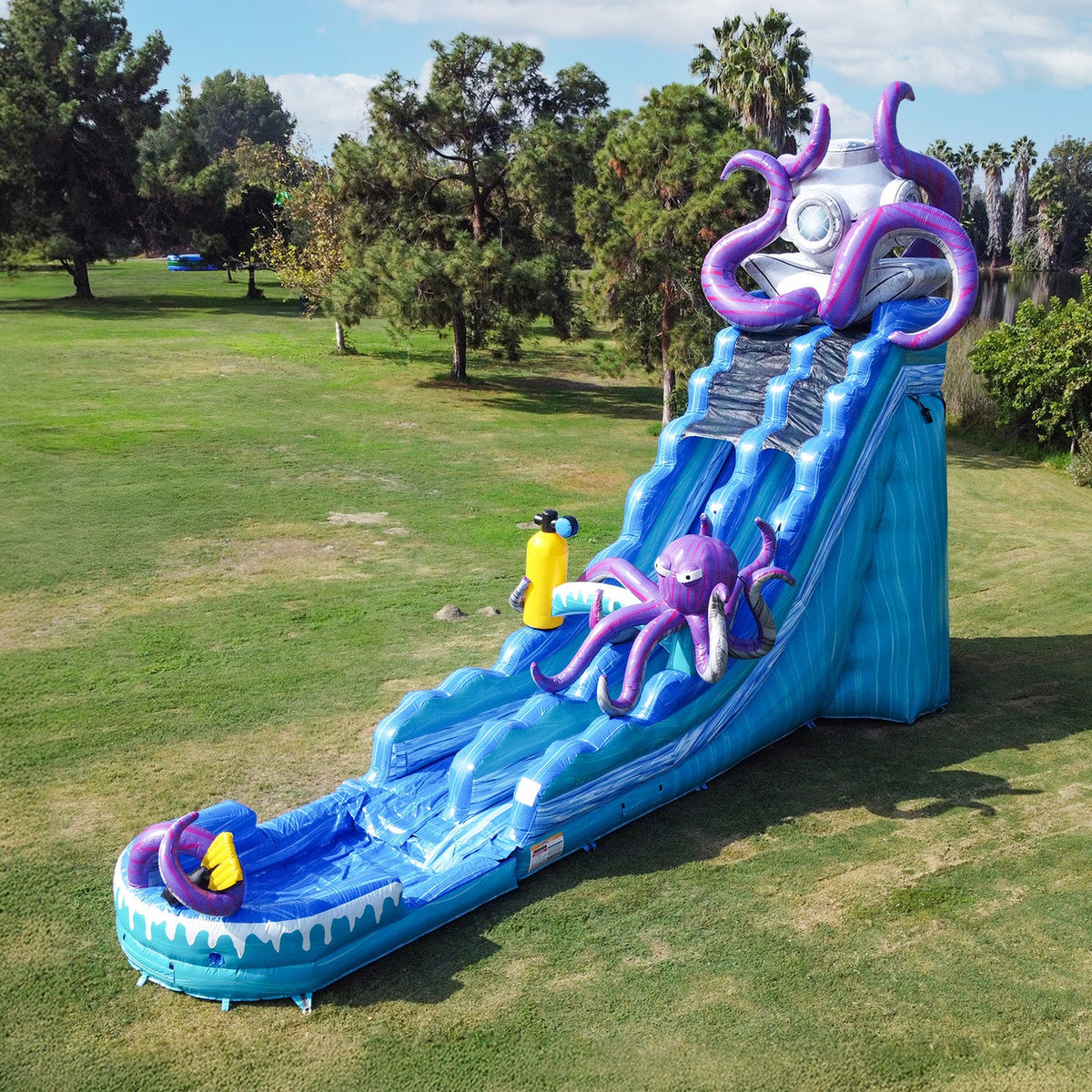
JumpOrange offers Dolphin Splash at 14 feet, Cali Palms at 15 feet, Dolphins at both 15 and 19 feet, Shark Sighted slip n slide, and Beach Camper dual lane. Happy Jump provides Island Wave, Beach Breaker, Blue Malibu, Caribbean Bay, a 22-foot Tropical model, and Angel Falls.
Manufacturer pricing reveals no consistent premium theme. Happy Jump's 22-foot Tropical WS8622-T lists at $2,995 compared to $3,799 for the Blue Marble WS8622, making the themed unit $804 cheaper. JumpOrange's 14-foot Dolphin Splash and Rainbow Cloud both price identically at $2,645, as do the 19-foot Dolphins and Gummy Bears at $4,495. Theme functions as a free differentiator rather than a premium feature.
How Do Landing Configurations Affect Water Slide Performance?
Landing configurations determine footprint, water consumption, drying labor, and regulatory exposure more directly than slide height or theme selection. Six distinct types exist: attached splash pools sewn as one body, detachable pools that zip off for dry operation, extended slip lanes with lateral drainage, dual landing zones for racing formats, pool-free runouts with inflated decks, and hybrid pool-plus-slip-lane combinations. Configuration choice affects whether units fit through residential gates, how many bookings can run consecutively, and which state regulations apply.
Understanding how landing zones perform under actual rental conditions prevents operators from discovering incompatible features after purchase. A pool-equipped 18-foot slide requires 2 to 4 hours of drying time, while a pool-free runout needs only 1.5 hours, directly impacting same-day turnaround capability.
What Are the Different Landing Pool Types and Their Features?
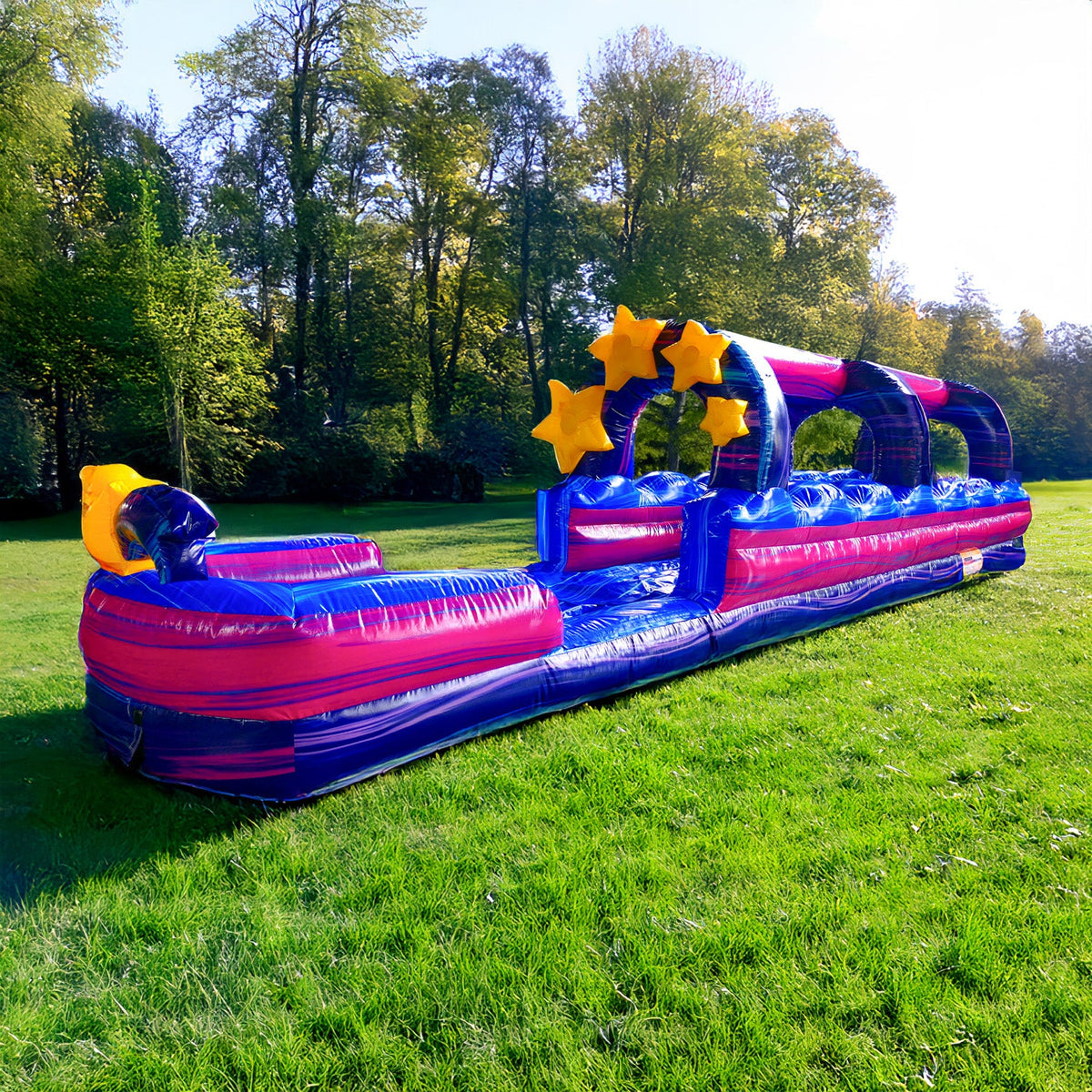
Attached splash pools integrate with the slide as one sewn body and cannot be removed. Detachable splash pools zip or strap off, allowing the same SKU to operate wet with water or dry. Extended slip lanes feed riders onto long flat surfaces where water drains laterally, while pool-free runouts end in inflated decks ridden dry or wet via top-mounted soakers only.
Practical operating depth in inflatable landing pools ranges from 6 to 12 inches. No US manufacturer publishes numeric operating depth specifications despite this measurement triggering regulatory thresholds in multiple states. Dual landing zones typically share one pool between two racing lanes.
How Do Pool-Equipped and Pool-Free Configurations Compare in Footprint and Weight?
Pool-equipped slides occupy footprints 4 to 8 feet shorter than pool-free runouts at equivalent height tiers. At the 14- to 15-foot tier, pool-equipped units measure 4 feet shorter; at 18 to 19 feet, they run 5 feet shorter. A pool stops riders in approximately eight feet, while friction-based pool-free decks need longer distances.
Pools add 40 pounds at the 14-15 foot tier, 70 pounds at 18-19 feet, and 115 pounds at 24 feet and above. Happy Jump's verified WS4130 18-foot slide with detachable pool weighs 390 pounds. The weight penalty remains proportionally small, but the footprint advantage favors pool-equipped designs when yard access gates or setup space constrain bookings.
What Are the Water Usage and Cleanup Implications of These Configurations?
A 14 to 15-foot attached pool requires 300 gallons for the initial fill, taking 38 minutes at 8 GPM hose flow, with four-hour bookings totaling 1,500 gallons. A 16- to 19-foot pool needs 500 gallons initially, 63 minutes to fill, and 2,180 gallons per event. Twenty- to 24-foot pools consume 700 gallons upfront, 88 minutes to fill, and 2,740 gallons total, while 25- to 30-foot units use 1,000 gallons initially, 125 minutes to fill, and 3,160 gallons across a booking.
Slip-lane pool-free configurations use 1,440 gallons over four hours through continuous flow alone. The pool adds only 300 to 1,000 gallons of one-time fill cost. Water expense represents single-digit dollars per booking at municipal rates, making drying time rather than consumption the real operational cost.
|
Slide Size |
Initial Fill (gal) |
Fill Time |
Gallons per 4-Hour Booking |
|
14-15 ft (attached pool) |
300 |
38 min |
1,500 |
|
16-19 ft (pool) |
500 |
63 min |
2,180 |
|
20-24 ft (pool) |
700 |
88 min |
2,740 |
|
25-30 ft (pool) |
1,000 |
125 min |
3,160 |
|
Slip-lane (pool-free) |
N/A |
Continuous flow |
1,440 |
What Are the Safety and Regulatory Considerations for Pool-Equipped Slides?
Pool-equipped water slides trigger regulatory frameworks that dry inflatables avoid, yet no unified national standard governs the category. ASTM F2374 establishes voluntary consensus criteria for inflatable amusement device design and operation, while NFPA 701 tests fabric flame propagation. State regulations vary dramatically, with New Jersey requiring manufacturer type certification for water slides exceeding 15 feet and Massachusetts specifying splash-down pool depths between 2.5 and 3.5 feet for fixed facilities.
Insurance carriers treat wet units as distinct underwriting risks. Operators must verify coverage applies to pool-equipped slides before purchasing inventory, as discovering exclusions after acquisition creates uninsured assets. The regulatory landscape requires state-by-state compliance research.
Which Safety Standards Govern Inflatable Water Slides?
ASTM F2374 represents the Standard Practice for Design, Manufacture, Operation, and Maintenance of Inflatable Amusement Devices. NFPA 701 defines Standard Methods of Fire Tests for Flame Propagation of Textiles and Films, measuring material flammability rather than structural safety. There are no mandatory national safety standards; F2374 becomes binding only where states adopt it through legislation.
ASTM F2374 does not publish a landing pool water depth limit, supervision ratio for wet units, or pool-specific requirement accessible through public documentation. NFPA 701 tests fabric burning behavior and has no bearing on landing configuration or operational protocols.
How Do State Regulations Impact Pool Depth and Certification Requirements?
Colorado limits wading pool depth to 18 inches at center and 12 inches at sidewalls under 6 CCR 1010-11. Massachusetts specifies splash-down pool depth between 2.5 and 3.5 feet at the flume end for fixed facilities. New Jersey regulates water slides exceeding 15 feet as amusement rides requiring manufacturer type certification.
Pennsylvania maintains over 1,400 licensed inspectors enforcing amusement ride standards that include inflatable water slides. Maricopa County, Arizona, charges $135 per body of water for advisory inspections. The 15-foot threshold in New Jersey creates a regulatory boundary where 14-foot and 16-foot units occupy different compliance frameworks.
What Insurance Challenges Do Wet Units Present for Operators?
Annual premiums for small operators running 1 to 5 units range from $1,800 to $2,500 for general liability coverage. Operators managing 5 to 10 or more units pay $5,000 to $9,000 and above. Alternative published ranges show home-party operators at $500 to $1,500 and commercial operations at $1,500 to $4,000 annually.
Standard minimum insurance limits require $1 million per occurrence, with many venues mandating $1M/$2M combined coverage. Some carriers exclude wet units outright. Lack of supervision appears as a named policy exclusion across multiple carriers, making attendant staffing a liability management necessity.
How Do Purchase Price and Rental Rates Vary by Theme and Pool Configuration?
Purchase price variation between themed and generic water slides contradicts operator assumptions about premium artwork commanding higher acquisition costs. Pool inclusion affects price through added material and weight rather than consistent percentage premiums. Rental rate premiums for pool-equipped units range from zero in markets charging identical wet and dry rates to 45 percent in peak-season demand windows.
The economic case for dolphin-themed water slides or tropical designs depends on booking rate lift rather than purchase cost differential. Operators analyzing which configurations generate profitable returns must account for drying labor, insurance impacts, and lost double-booking capacity alongside catalogue price comparisons.
What Is the Price Difference Between Themed and Generic Water Slides?
JumpOrange's 14-foot Dolphin Splash lists at $2,645 compared to the Shark Sighted slip at $2,695, making the pool unit $50 cheaper. Happy Jump's 22-foot Tropical WS8622-T prices at $2,995 against the Blue Marble WS8622 at $3,799, creating an $804 advantage for the themed model. Four of six same-tier comparisons show zero price difference when controlling for size and configuration.
JumpOrange's Dolphin Splash 14-foot slide costs $2,645 while the Cali Palms 15-foot version reaches $3,495. The $850 gap reflects size and detachable pool features rather than theme. Manufacturers price by structural tier, lane count, and series designation, treating artwork as commodity differentiation.
|
Model |
Theme Family |
Size |
Price |
|
JumpOrange Dolphin Splash |
Ocean |
14 ft |
$2,645 |
|
JumpOrange Shark Sighted (slip) |
Ocean |
14 ft |
$2,695 |
|
JumpOrange Rainbow Cloud |
Generic |
14 ft |
$2,645 |
|
JumpOrange Cali Palms |
Tropical |
15 ft |
$3,495 |
|
JumpOrange Dolphins |
Ocean |
19 ft |
$4,495 |
|
JumpOrange Gummy Bears |
Generic |
19 ft |
$4,495 |
|
Happy Jump Tropical WS8622-T |
Tropical |
22 ft |
$2,995 |
|
Happy Jump Blue Marble WS8622 |
Generic |
22 ft |
$3,799 |
How Does Pool Inclusion Affect Purchase Cost and Freight?
Happy Jump's 22-foot double bay with slip lane lists at $8,298 compared to $5,598 without, adding $2,700 for extended landing configuration. Happy Jump WS4130 18-foot slide spans 33 by 11 feet, weighs 390 pounds, requires one 1.5 HP blower, and prices at $2,895. Pools add 40 pounds at 14-15 feet, 70 pounds at 18-19 feet, and 115 pounds at 24 feet and above.
Happy Jump's 24-foot single lane with slip WS4155 costs $8,000, while the 22-foot double lane WS4152 lists at $5,395. The larger single-lane slip format commands $2,605 more than the shorter dual-lane pool configuration, demonstrating how landing type drives price more than height alone.
What Rental Rate Premiums Are Associated with Pool-Equipped Units?
Water slide day rates span $250 to $575 across US markets, with mid-range 18 to 22-foot units commanding $275 to $400. South Florida mid-size water slides rent for $300 to $500, while large 18- to 22-foot units reach $350 to $600. Orange County California operators charge $449 flat for 18-foot slides.
Tampa entry water slides start from $169, while rural base rates range from $100 to $175. Dry mode operation earns 60 to 70 percent of peak wet-slide rates, implying a 43 to 67 percent premium for water features where markets support differential pricing.
How Does Theme Demand Vary Seasonally and Regionally?
Seasonal demand patterns for tropical water slide themes amplify beyond general water slide rental volatility, with luau party searches swinging 151 times from January trough to June peak. Regional climate differences extend wet rental seasons in Sun Belt markets while compressing northern operational windows. These variations create distinct inventory strategies for different geographies, particularly regarding detachable pool investments that enable dry-mode shoulder season utilization.
Understanding when peak demand windows open helps operators time inventory purchases and marketing launches. Water slide rental search volume more than doubles between February and April, indicating March as the critical warehouse stocking deadline.
What Are the Search Volume Trends for Tropical and Ocean Themes?
Water slide rental generates 9,900 US monthly searches, establishing the category baseline. Shark water slide reaches 450 monthly searches while tropical water slide achieves 100 and dolphin water slide registers 80. Inflatable water slide with pool draws 150 monthly searches.
The 9,900-search category term dwarfs all theme-specific modifiers by two orders of magnitude, revealing that customers discover rental operators through generic product searches rather than themed queries. Theme selection influences conversion on operator websites after click-through rather than functioning as primary acquisition keywords.
How Does Seasonality Influence Rental Demand for Themed Water Slides?
Water slide rental searches measure 1,904 in December 2025 and climb to 27,559 in June 2026, creating a 14.5x seasonal swing. Water slide rental seasonality runs 14.5 times from trough to peak compared to only 3.4 times for the dry bounce house category. Wet category swings dwarf dry category fluctuations, making detachable pools that enable shoulder-season dry operation strategically valuable.
Luau party seasonality reaches 151 times variance, moving from 101 searches in January to 15,223 in June. Tropical themes concentrate demand into narrower windows than the base water slide product, effectively creating four-month assets within a seven-month wet season.
What Regional Patterns Affect Theme Popularity and Rental Activity?
South Florida mid-size water slides command $300 to $500 rental rates while large 18 to 22-foot units reach $350 to $600 in Miami-Dade, Broward, and Palm Beach markets. Orange County California operators price 18-foot slides at $449 flat. Tampa entry water slides start from $169, while rural markets support $100 to $175 base rates.
Regional rate variation reflects competitive density, climate-driven season length, and local willingness to pay rather than theme preference differences. Sun Belt operators benefit from extended seasons that justify pool-equipped inventory investment, while northern operators face compressed windows where detachable pools enable equipment utilization beyond wet months.
What Operational Factors Influence the Choice of Pool-Equipped Tropical Slides?
Drying time emerges as the binding constraint on pool-equipped water slide fleet capacity, exceeding water cost, freight impact, and acquisition price differential in operational significance. Pool units require 2 to 4 hours of sunny drying time before safe repacking, while pool-free runouts need only 1.5 hours, directly limiting same-day turnaround bookings. Detachable pools solve the seasonal utilization problem by converting four-month wet assets into seven-month platforms that operate dry during shoulder periods.
Supervision requirements and liability exposure increase with standing water features. Operators must develop protocols that protect against claims while remaining economically viable, typically adding $50 to $150 attendant fees to pool-equipped bookings at community and school events.
How Does Drying Time Impact Rental Turnaround and Capacity?
Full drying time for standard commercial slides spans 2 to 4 hours on warm sunny days. Drying with two one-third horsepower axial fans extends to 3 to 5 hours for 20-foot slides. Overnight drying protocols require 6 to 8 hours to ensure complete moisture removal.
A 20 to 24-foot pool unit needs 3.5 hours drying compared to 1.5 hours for slip lanes and 24 minutes for dry runouts. If a unit cannot be dried within 12 hours of packing, operators must re-inflate for a dry cycle regardless of schedule to prevent mold onset. This hard operating rule converts drying capacity into a fleet size constraint more binding than acquisition budget for operators managing six or fewer units.
|
Configuration |
Typical Drying Time |
|
Dry runout (pool-free) |
24 minutes to 1.5 hours |
|
Slip lane |
1.5 hours |
|
20-24 ft pool-equipped slide |
3.5 hours |
|
Standard commercial slide (fan-assisted) |
3 to 5 hours |
|
Overnight protocol |
6 to 8 hours |
Why Are Detachable Pools Advantageous for Shoulder Seasons?
Shoulder month rates in May and September reach 80 to 85 percent of peak pricing power. Dry mode earns 60 to 70 percent of peak wet-slide rates when water features cannot justify setup complexity. JumpOrange's XLD series offers detachable deep pools on the Cali Palms 15-foot slide, while Happy Jump WS4130 18-foot slide includes detachable pool plus optional landing pad plus optional slip and slide attachments.
Detachable splash pools zip or strap off, letting the same unit run wet or dry from one SKU. This convertibility transforms a four-month wet season asset into a seven-month revenue generator by capturing spring and fall bookings that would otherwise go to dry bounce houses.
How Should Operators Manage Supervision and Liability Risks?
Lack of supervision appears as a named policy exclusion across multiple insurance carriers. Common insurance exclusions include improper setup, lack of supervision, wind speeds above 15 to 20 mph, and participant-to-participant injuries. Attendant add-ons cost $50 to $150 per event in published market rates.
Standard minimum insurance limits require $1 million per occurrence across most venues. A single severe claim causes 50 to 100 percent premium increases or outright non-renewal. Operators must price attendant cost into pool-equipped bookings at community and school events where supervision expectations exceed backyard birthday party norms.
How Durable Are Tropical Themes and What Are the Maintenance Considerations?
Tropical water slide themes remain permanent throughout unit lifespan because no manufacturer publishes panel replacement or artwork refresh services. Commercial vinyl weights range from 15-ounce standard at JumpOrange to 18-ounce material used elsewhere. Commercial units last 3 to 5 years under heavy rental use or 5 to 7 years for 18-ounce PVC under regular deployment.
Theme permanence elevates initial selection importance since faded artwork cannot be economically refreshed. Proper cleaning and storage protocols extend lifespan, while established seam mold creates permanent staining and persistent odor. Storage above 40 degrees Fahrenheit prevents vinyl brittleness, and humidity below 60 percent RH reduces mold risk during off-season warehousing.
What Materials and UV Protection Methods Are Used in Themed Slides?
Commercial vinyl weight reaches 15 ounces standard at JumpOrange and 18 ounces at other manufacturers. Commercial unit lifespan under PVC construction spans 3 to 5 years with heavy rental use and extends to 5 to 7 years for 18-ounce PVC under regular deployment. UV exposure gradually degrades polymer structures in both PVC and nylon.
Storage above 40 degrees Fahrenheit prevents vinyl brittleness and extends lifespan across seasonal shutdown periods. Storage humidity targets fall below 60 percent relative humidity to minimize mold formation. Artwork applies to colored vinyl panels rather than printing on top in most commercial units, providing inherent fade resistance.
How Does Theme Permanence Affect Long-Term Resale and Artwork Replacement?
Commercial units possess tremendous resale value relative to residential units with little or no resale value. Established seam mold causes permanent staining that cannot be fully remediated, with odor returning within days of treatment and representing the number one cause of premature retirement in commercial water slide fleets. No manufacturer publishes a panel replacement or reprint service.
No manufacturer surveyed offers artwork refresh as a service, eliminating the option to update faded graphics or change themes mid-lifecycle. Mould onset occurs within 24 to 48 hours if units pack damp under warm conditions. The inability to refresh artwork means theme selection at purchase determines positioning capability for the entire 3 to 7-year unit lifespan.
What Are Typical Costs and Procedures for Repairing Themed Panels?
Basic patch repair costs range from $20 to $150 depending on damage extent. Seam repair costs span $60 to $600 based on severity and linear distance requiring re-stitching. Replacement vinyl sells at $12.75 per yard in 5-foot widths plus $19.60 shipping through aftermarket suppliers.
Heavy-duty walking-foot sewing machines handle vinyl panel work, while household machines cannot feed vinyl or stack multiple layers. Post-event cleaning per unit requires 15 to 20 minutes of labor for standard washing and inspection protocols.
Tropical Water Slide Themes: Strategic Insights for Rental Success
Ocean themes outperform tropical designs in measurable search demand while commanding identical acquisition costs. Shark water slides generate 450 monthly searches compared to 100 for tropical terms, yet manufacturers price both families equivalently within size tiers. Smart operators allocate inventory budgets toward ocean theme water slides that customers request by name rather than tropical aesthetics that function primarily as summer visual positioning.
Pool-equipped units fit tighter spaces than operators typically assume, occupying footprints 4 to 8 feet shorter than pool-free runouts. This counterintuitive advantage makes pools the solution for residential yards with gate access constraints. Detachable pools convert seasonal assets into year-round revenue generators, earning 60 to 70 percent of wet rates during shoulder months when fixed-pool units sit idle.
The 15-foot regulatory threshold in New Jersey and the dramatic seasonal swing in wet category demand create strategic decision points that affect long-term profitability. Operators entering regulated states should confirm manufacturer certification before purchase, while those in seasonal climates must size fleets around drying capacity rather than acquisition budget. Theme costs nothing at purchase but remains permanent throughout unit lifespan, making initial selection a multi-year commitment without refresh options.
Ready to Add Tropical and Ocean-Themed Water Slides to Your Fleet?
JumpOrange has manufactured commercial-grade inflatables since 2002, and our team can help you weigh theme selection against pool configuration, drying capacity, and your local regulatory requirements before you commit to inventory. Explore the commercial water slide collection to compare ocean and tropical models side by side, including detachable-pool options built for shoulder-season flexibility.
Call our team at 877-388-5867 or request pricing and a product recommendation to find the theme and configuration, including heavy-duty inflatable slip and slides, that fits your market, your storage space, and your booking calendar. JEM Club members also receive a discount on full-price commercial inflatables and free shipping on qualifying orders.
Frequently Asked Questions
Are pool-equipped water slides harder to store than dry bounce houses?
Pool-equipped water slides are not harder to store. Pool-equipped units occupy footprints 4 to 8 feet shorter than pool-free runouts at equivalent height tiers, since the landing pool absorbs rider momentum in about eight feet rather than requiring a longer friction-based deck. The tradeoff is added weight, ranging from 40 pounds at the 14- to 15-foot tier up to 115 pounds at 24 feet and above. For operators working around residential gate access, the shorter footprint usually outweighs the added weight during transport and setup.
How much does a themed water slide cost compared to a standard model?
Manufacturer pricing shows no consistent premium for tropical or ocean artwork. Four of six same-tier comparisons show zero price difference between themed and generic units, and JumpOrange's 14-foot Dolphin Splash and Rainbow Cloud both price at $2,645. Price differences that do appear track size, lane count, and pool configuration rather than the theme itself.
Do ocean or tropical themed slides typically need special insurance?
Insurance carriers treat any pool-equipped unit as a distinct underwriting risk regardless of theme, since standing water changes liability exposure. Annual general liability premiums for small operators running 1 to 5 units typically range from $1,800 to $2,500, and most venues require $1 million per occurrence in coverage. Operators should confirm their policy does not exclude wet units before purchasing inventory, since lack of supervision appears as a named exclusion with several carriers.
How long does a pool-equipped water slide take to dry between bookings?
A 20- to 24-foot pool-equipped slide typically needs about 3.5 hours to dry on a sunny day, compared to 1.5 hours for a slip lane and as little as 24 minutes for a dry runout. Fan-assisted drying extends the window to 3 to 5 hours for larger slides, and units that cannot dry within 12 hours of packing must be re-inflated for a full dry cycle to prevent mold. This drying window, not purchase price or water cost, is usually the binding constraint on same-day booking capacity.
Can rental operators expect ocean themes to book more often than tropical themes?
Ocean and marine themes generate roughly 790 monthly US searches compared to 420 for tropical and beach themes, with shark water slides alone accounting for 450 of those searches. This does not guarantee ocean units always outsell tropical units, since the 9,900-search baseline for generic water slide rental dwarfs any theme-specific term and theme mainly influences conversion once a customer is already on an operator's site. Stocking at least one recognizable ocean design alongside tropical options can support both discovery search traffic and on-site conversion.


Leave a comment
This site is protected by hCaptcha and the hCaptcha Privacy Policy and Terms of Service apply.