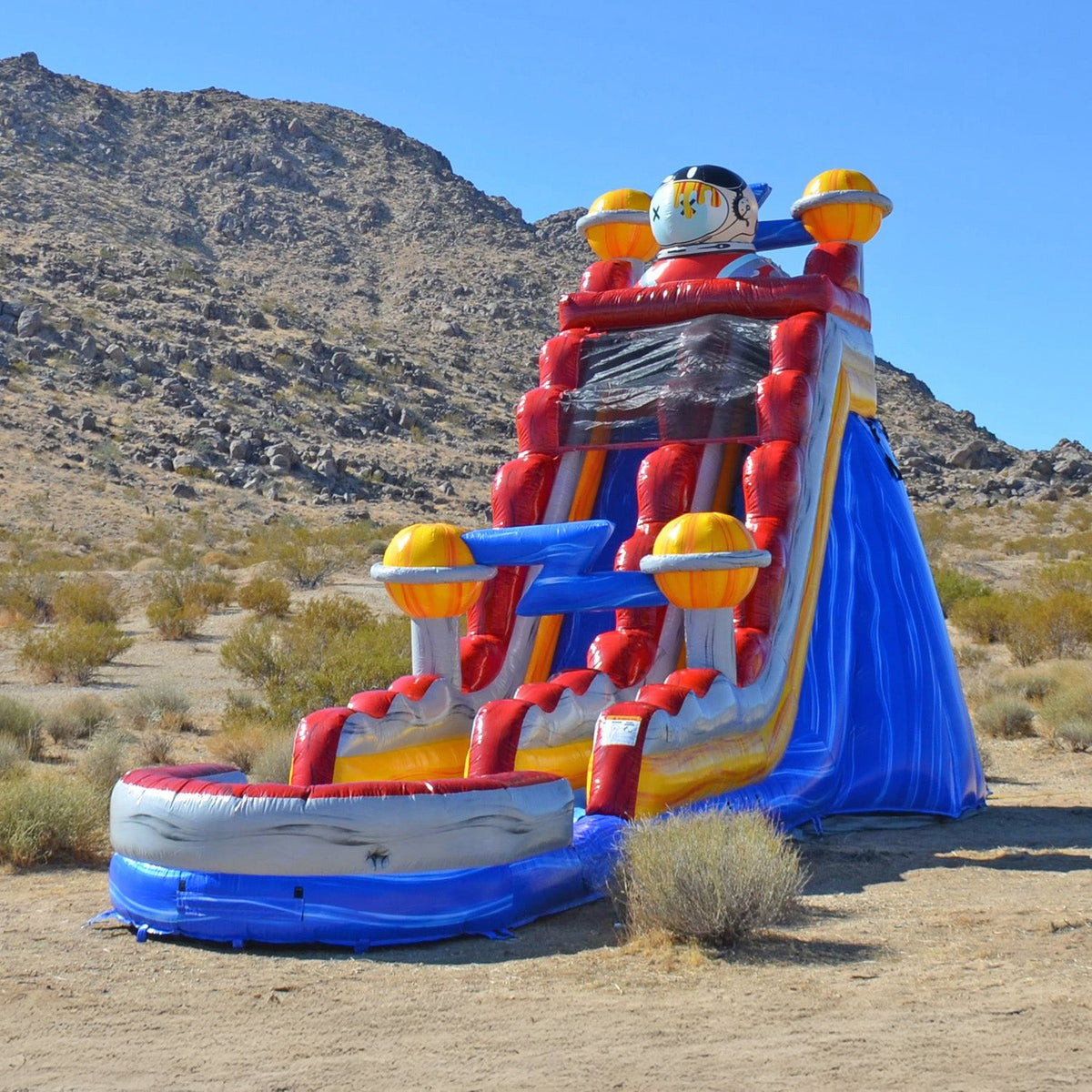
Modular water slide systems transform rental inventory into scalable revenue channels through sections that operate independently or combine. Each module functions as a distinct asset with separate pricing while connecting to form longer configurations. This approach shifts capital allocation from single large purchases to staged acquisition of rugged inflatable commercial water slides across multiple seasons.
The financial case rests on verifiable rate premiums at each expansion step and retained independent rentability. A single-piece obstacle course rents for $365 to $395 in Greater Austin markets. Adding a second module raises rates to $565 to $695, a 55% to 76% increase while maintaining separate booking capability.
Key Takeaways
- True modular systems sell individual sections as separate SKUs that rent independently or connect to form longer courses
- Rate uplift per added module ranges from 55% to 81% for modules two and three, dropping to 11% to 17% for the fourth module
- Each module requires one dedicated 15-amp GFCI circuit and one blower drawing approximately 1,300 watts running load
- New Jersey charges a $280 annual permit fee per inflatable ride, making regulatory costs scale linearly with module count
- Wet/dry convertible obstacle courses capture 32% of annual demand during October through February versus 11.6% for water-only slides
What Defines a Modular Water Slide System?
True modular designs consist of individual sections sold as distinct SKUs that connect physically and rent independently. Manufacturers assign separate product codes to each piece and publish specifications per module. This differs from multi-piece units that ship in segments purely for transport logistics.
Multi-piece construction addresses weight limits during delivery rather than operational flexibility. A 77-foot obstacle course splitting into two manageable sections serves transport needs but qualifies as modular only if each section carries its own SKU.
How Do True Modular Designs Differ from Multi-Piece Units?
JumpOrange's Shadow Obstacle set demonstrates genuine modularity through seven obstacles combining to form a 250-foot course. Each unit functions as an independent rental with separate pricing and availability tracking. The Happy Jump Extreme Rush IG5240 splits into a 565-pound slide section and a 430-pound game section that rent separately.
Tent and Table's Retro obstacles offer 30-foot single pieces at $4,999.99 or 60-foot two-piece configurations at $8,799.99. The system allows combining with rock climb slides and U-turns for L-shaped and custom layouts.
Which Manufacturers Offer Verified Modular Systems?
JumpOrange Shadow Obstacle Piece 1 measures 30 by 11 by 16 feet and weighs 420 pounds. The unit ships with one blower and supports four simultaneous occupants at a $5,125 list price. JEM member pricing reduces this to $4,356.25, representing a 15% discount across all modules.
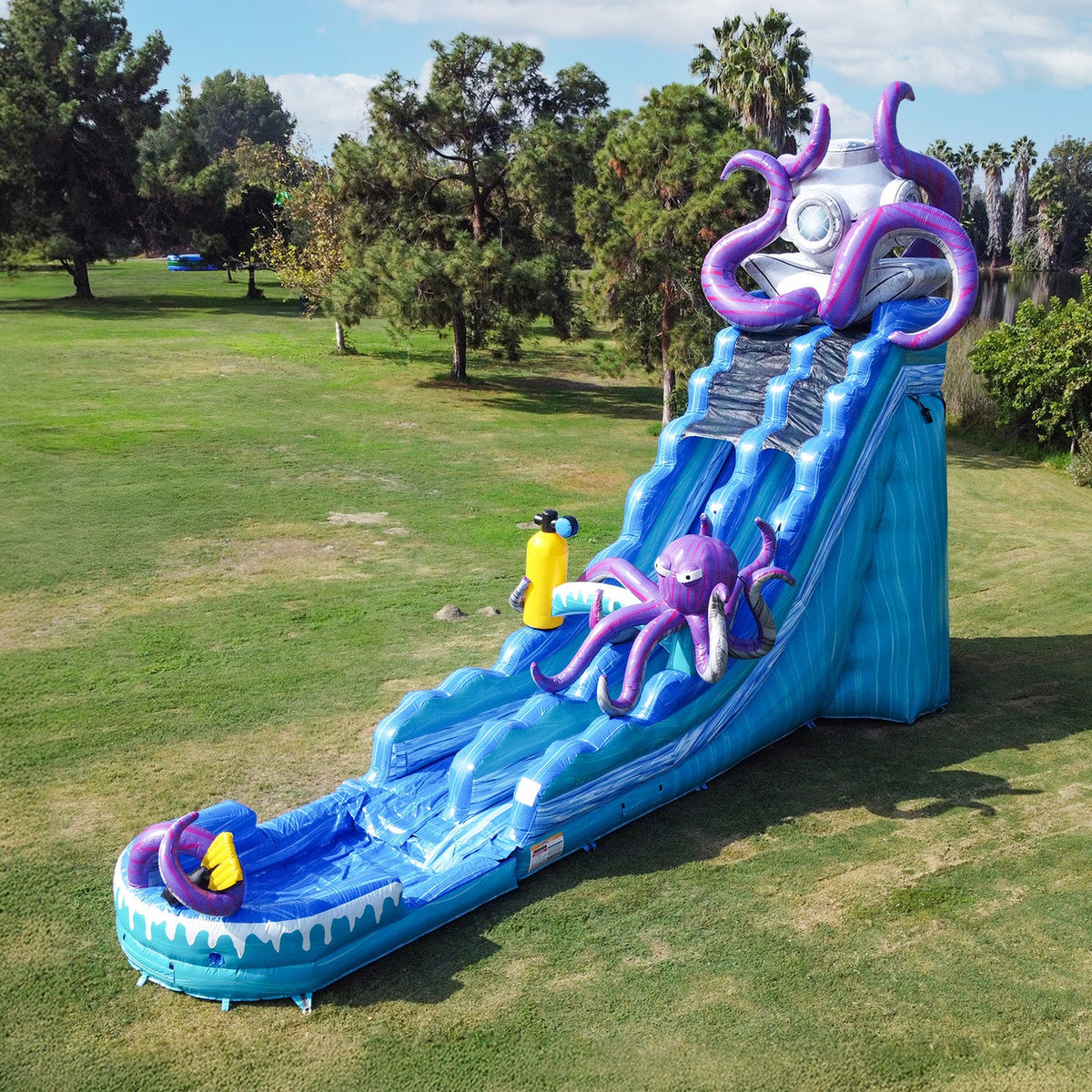
The Ocean Battle 25-foot slide attaches to the Ocean Battle Slip N Slide for extended ocean-themed configurations. Ocean Battle 19-foot Slide features a detachable deep pool, enabling operators to configure with or without the pool based on venue restrictions. Tent and Table Retro 30-foot units sell individually while the 60-foot version ships as coordinated pairs.
What Are the Physical and Power Specifications per Module?
JumpOrange Shadow modules occupy 30 by 11 by 16 feet of inflated space and require one dedicated blower per section. The Ocean Battle 19-foot Slide extends to 36 by 11 by 19 feet with a 12-foot platform height. Weight specifications are approximately 375 pounds, falling within the 375 to 565-pound range typical for obstacle course modules.
Happy Jump Extreme Rush IG5240 totals 77 feet across both sections, with the slide portion weighing 565 pounds and the game section contributing 430 pounds. Standard 1.5-horsepower blower amperage spans 8.8 to 11.0 amps depending on manufacturer, requiring confirmation of nameplate ratings before sizing electrical circuits.
How Does Modular Expansion Impact Setup and Operations?
Setup duration and crew requirements scale with module count but not linearly due to efficiency gains on single-site deployments. Two crew members handle one module in 25 to 40 minutes for water slide installation, including inflation and anchoring. Teardown requires 20 to 30 minutes for single units.
What Are Typical Setup Times and Crew Requirements by Module Count?
One module requires 25 to 40 minutes of setup and 20 to 30 minutes of teardown with two crew members. Two modules extend to 45 to 60 minutes of setup and 35 to 50 minutes of teardown. Three modules reach approximately 60 minutes of setup and 45 to 60 minutes of teardown with two to three crew.
Four modules demand 75 to 95 minutes of setup and 60 to 75 minutes of teardown, with three crew members mandatory. Five modules stretch to 90 to 115 minutes setup and 70 to 90 minutes teardown requiring three to four crew. The third crew member becomes economically justified at the fourth module when sequential setup exceeds a comfortable two-person morning window.
|
Modules |
Setup Time |
Teardown Time |
Crew Required |
|
1 |
25–40 min |
20–30 min |
2 |
|
2 |
45–60 min |
35–50 min |
2 |
|
3 |
~60 min |
45–60 min |
2–3 |
|
4 |
75–95 min |
60–75 min |
3 |
|
5 |
90–115 min |
70–90 min |
3–4 |
How Does Adding Modules Affect Power and Water Consumption Needs?
One blower draws 1,300 watts running load with a 1,950-watt startup surge requiring one dedicated 15-amp circuit. Two blowers consume 2,600 watts running and 3,900 watts at surge, demanding two separate circuits and a 5,000-watt generator minimum. Understanding commercial water slide regulations by state helps operators plan electrical infrastructure correctly.
Three blowers pull 3,900 watts running with a 5,850-watt surge requiring three circuits and a 7,500-watt generator. Four blowers reach 5,200 watts running and 7,800 watts surge with four circuits and a 10,000-watt generator capacity. Five blowers demand 6,500 watts running and 9,750 watts surge across five circuits powered by a 13,000-watt generator.
|
Blowers |
Running Load |
Surge Load |
Circuits Required |
Minimum Generator |
|
1 |
1,300 W |
1,950 W |
1 |
Standard outlet |
|
2 |
2,600 W |
3,900 W |
2 |
5,000 W |
|
3 |
3,900 W |
5,850 W |
3 |
7,500 W |
|
4 |
5,200 W |
7,800 W |
4 |
10,000 W |
|
5 |
6,500 W |
9,750 W |
5 |
13,000 W |
What Compatibility and Regulatory Considerations Affect Modular Use?
New Jersey charges a $280.00 annual permit fee per inflatable ride with individual approval requirements for each ride. Pennsylvania registration costs $100 annually, with inspection required every 28 to 30 days or at every setup, whichever comes first.
JumpOrange markets an NJ/PA APPROVED collection with dedicated sub-collections for slides, combos, bouncers, and obstacles. Type certification work completed at the manufacturer level reduces operator compliance burden. Modules bought in different years may not match current certification standards, creating potential approval gaps when combining pieces purchased across seasons.
What Are the Financial and Resale Implications of Modularity?
Purchase price per module remains constant across the set with no volume discounts on additional pieces. The economic case depends on rental rate premiums at combined configurations rather than acquisition cost reductions. Secondary market liquidity improves through partial fleet liquidation options unavailable to fixed single-unit operators.
How Does Modular Pricing Compare to Fixed Units?
JumpOrange Shadow Obstacle Piece 1 lists at $5,125 with JEM member pricing at $4,356.25 representing 15% off. The full seven-piece Shadow Obstacle set totals $35,875 at list or $30,494 for JEM members. No per-module discount applies beyond the membership tier.
Tent and Table Retro 30-foot units sell for $4,999.99 individually while 60-foot two-piece configurations cost $8,799.99 total, implying $3,800.00 for the second module, a 24% reduction below base price.
What Are the Resale Advantages of Modular Systems?
Inflatable Trading Post lists used commercial inflatables by manufacturer including piece-level obstacle course sales. One example listing describes a 35-foot slide in two sections weighing 1,200 pounds and 600 pounds, confirming pieces trade separately in secondary markets.
JumpOrange shows 11 of 17 slip n slides marked sold out at August 2026 access date, signaling genuine demand rather than inventory failure and supporting winter purchasing decisions for summer deployment.
How Does Staged Acquisition Enhance Business Growth?
Season one with one module generates $9,240 revenue from 24 bookings at $385 each. Season two adding a second module produces $14,140 from 12 bookings at $665 plus 16 single-module bookings. Season three with three modules reaches $21,520 from 10 bookings at $1,025, 10 at $665, and 12 at $385.
Season four operating four modules achieves $23,990 from 10 bookings at $1,195, 10 at $665, and 14 at $385. Cumulative contribution through season four totals $48,223 at 70% margin. The fourth module produces only $2,470 incremental revenue with a 2.52-season payback, making it economically defensible only with confirmed demand for 115-foot courses from large school districts and corporate events.
|
Season |
Modules Active |
Total Revenue |
Booking Mix |
|
1 |
1 |
$9,240 |
24 bookings at $385 |
|
2 |
2 |
$14,140 |
12 at $665 + 16 at $385 |
|
3 |
3 |
$21,520 |
10 at $1,025 + 10 at $665 + 12 at $385 |
|
4 |
4 |
$23,990 |
10 at $1,195 + 10 at $665 + 14 at $385 |
How Do Multi-Unit and Inflatable Water Park Setups Work for Large Events?
Multi-unit deployments transform rental businesses from drop-and-go services into staffed event operations with different cost structures. Unit counts scale from single backyard pads to zoned water park configurations with dedicated toddler areas. Power distribution and water access become primary site constraints above five units.
What Are Typical Unit Counts and Layouts by Event Type?
Backyard birthdays deploy one unit in single-pad layouts. Church VBS or family fun days use two to three units arranged linearly. School field days require three to five units with a 96-foot obstacle course as anchor and station rotation around field perimeters.
Corporate picnics book three to five units including 115-foot or 160-foot obstacle courses configured into competition and family zones. Community festivals demand five to eight units with 160-foot obstacle course anchors and multi-zone layouts including dedicated toddler areas. Determining the best commercial water slide to grow your rental business depends on matching inventory to dominant event types.
How Do Footprint, Power, and Staffing Scale with Unit Numbers?
One-unit sites occupy approximately 1,200 square feet including circulation space. Two units expand to 2,600 square feet while three units require 4,100 square feet. Five units consume 7,300 square feet and eight units demand 12,400 square feet.
Power requirements grow linearly, with each blower adding one dedicated 15-amp circuit. Three-unit bookings require dedicated generator support. Staffing follows CPSC guidance recommending a minimum of two operators on inflatables designed for younger children, scaling to three to five attendants for eight-unit configurations.
What Are the Transport and Supervision Requirements?
One to two small units fit in pickups or cargo vans with a minimum 500-pound payload capacity. Three or more mixed units require utility or enclosed trailers ranging from 4 by 6 feet up to 8 by 20 feet. Multi-unit event fleets demand box trucks or 8-by-20-foot enclosed trailers with appropriate GVWR ratings.
Eight-unit water park bookings model approximately 4,000 to 4,500 pounds payload, including units, blowers, stakes, tarps, and generators. Applying water slide safety guidelines protects rental businesses from liability exposure during multi-unit deployments.
What Market Demand Factors Influence Modular Water Slide Investments?
Search volume data reveals seasonal concentration and year-round potential across attraction categories. Water slide rentals experience 14.5 times peak-to-trough demand variation while obstacle courses maintain only 2.3 times variation. This fundamental difference shapes inventory allocation decisions.
Lead times for custom orders span 30 to 90 days from production through shipping. Customer booking patterns show three to four weeks advance notice for holiday weekends. The mismatch forces operators into seasonal purchasing windows during January through March for summer deployment.
How Do Search Volumes and Seasonality Affect Booking Patterns?
US Google search volume reaches 9,900 monthly for water slide rental and 800 monthly for inflatable obstacle course rental. Water slide rental shows a 14.5 times peak-to-trough demand ratio, concentrating bookings in May through August. Obstacle course rental maintains a 2.3 times ratio, distributing bookings more evenly.
October through February captures only 11.6% of annual water slide demand but 32.0% of obstacle course demand. This three-to-one advantage in shoulder-season revenue makes obstacle courses superior investments for year-round utilization. Reviewing water slide rental pricing strategy helps maximize returns during compressed booking windows.
What Lead Times Should Operators Expect for Orders and Bookings?
Holiday weekend bookings require three to four weeks' advance notice as popular slides sell out for Memorial Day, July 4, and Labor Day dates. Custom inflatable water park orders demand 30 to 90 days for production plus shipping. JumpOrange charges $595 flat shipping per order but provides free home delivery on orders of three or more units.
JumpOrange JEM Club costs $100 and includes a 15% discount on all purchases plus one year of free shipping. On a $5,125 module, $595 shipping represents 11.6% of unit cost. The JEM membership recovers its cost on shipping alone before accounting for the 15% price discount.
How Do Package Pricing and Revenue per Labor Hour Vary?
Single-unit packages price at $450, while two-unit packages reach $825, representing an 8% bundle discount. Three-unit packages cost $1,150 with a 15% discount, and five-unit packages sell for $1,975 at a 22% discount. Eight-unit water park packages command $3,900 with a 20% bundle discount.
Revenue per crew hour climbs from $150 for single units to $244 for eight-unit deployments. Revenue per total labor hour, including on-site supervision, peaks at $192 for three-unit packages, then declines to $126 for eight-unit configurations. The three-unit tier represents the operational sweet spot combining highest labor efficiency with minimal supervision requirements.
How Do Modular Water Slides Compare to Other Inflatable Attractions?
Attraction categories differ fundamentally in throughput capacity, seasonal demand distribution, and expansion scalability. Obstacle courses process 120 to 180 participants per hour in three-piece configurations compared to 30 to 40 per hour for single-lane water slides. This three-to-six times throughput advantage drives school field day bookings toward obstacle courses.
Durability standards specify 15-ounce PVC as the industry baseline, with commercial lifespans reaching five to eight years under proper maintenance. Post-event protocols, including drying, correct folding, and proper storage, extend average lifespan to nine years versus 2.5 years without discipline. The maintenance protocol gap represents $3,700 annual value on a $5,125 module through avoided replacement costs.
What Are Lengths, Configurations, and Rental Rates for Obstacle Courses and Slides?
One-piece obstacle courses rent for $365 to $395 in Greater Austin markets. Two-piece configurations command $565 to $695, while three-piece courses reach $1,025 to $1,075. Four-piece courses are priced at $1,195, and five-piece flagship courses rent for $1,595.
|
Configuration |
Rental Rate (Greater Austin) |
|
One-piece |
$365–$395 |
|
Two-piece |
$565–$695 |
|
Three-piece |
$1,025–$1,075 |
|
Four-piece |
$1,195 |
|
Five-piece flagship |
$1,595 |
Combined configurations achieve $1,025, a figure no single bounce house or standard water slide matches. The rate advantage compounds with piece count rather than remaining flat. Exploring what makes water slide-enabled inflatable bounce houses remarkable as commercial assets reveals hybrid unit performance across multiple revenue streams.
How Does Throughput and Year-Round Booking Potential Differ?
A 96-foot three-piece obstacle course handles 120 to 180 participants per hour in structured relay rotations. A 35-foot single-lane water slide processes 30 to 40 participants per hour due to longer climb times. Obstacle courses capture 32.0% of annual demand during October through February compared to 11.6% for water slides.
Water slides show 22.1% of annual demand concentrated in June alone, while obstacle courses distribute more evenly. Modeled annual rental days total 32 for obstacle courses versus 26 for water slides. The flatter demand curve translates to 2.8 times proportional off-season revenue for obstacle courses.
What Are Durability, Repair, and Safety Standards for Modular Units?
Commercial vinyl weight standards specify 15-ounce PVC as the industry baseline, with 18-ounce and 20-ounce offerings from select manufacturers. Commercial lifespan reaches five to eight years with proper maintenance versus one to two years for residential units. Full post-event protocols extend average lifespan to nine years.
ASTM F2374 establishes a minimum 75-pound anchoring force per tie-down point, with wind limits ranging from 15 to 25 mph depending on specific rides. Studying best water slides for rental business 2026 rankings by ROI clarifies which models deliver strongest returns across complete ownership cycles.
What Operational Best Practices Optimize Modular Water Slide Use?
Each course section requires its own blower connected to a dedicated GFCI-protected outlet on a separate circuit breaker. Three-piece 96-foot courses require three separate circuits while five-piece 160-foot courses demand five circuits. Daisy-chaining extension cords or sharing breakers between blowers creates fire hazards and trips protective devices.
Operators must start blowers sequentially rather than simultaneously to avoid stacking surge loads that exceed generator capacity. Never run generators above 80% of rated capacity for extended periods. Extension cords require 12-gauge wire minimum and should not exceed 50 feet to avoid voltage drop that damages blower motors.
How Should Power Distribution and Generator Use Be Managed?
Each blower needs a dedicated GFCI-protected outlet on a separate circuit breaker. Sequential starting prevents surge load stacking that trips overload protection. Generators must never exceed 80% continuous capacity rating during extended operation.
Extension cords require 12-gauge minimum wire and should not run beyond 50 feet from outlets. Generator placement must maintain a minimum 10-foot distance from devices per Westfield, New Jersey requirements. Following a commercial water slide buyers guide ensures electrical specifications match operational requirements before purchase commitments.
What Are Key Regulatory, Insurance, and Certification Requirements?
Annual general liability premiums range from $1,800 to $2,500 for one to five units and $5,000 to $9,000+ for comprehensive packages covering five to ten units. Insurance coverage minimums require $1,000,000 per occurrence as standard, with schools and municipal parks often demanding $2,000,000. SIOTO BISOC/AISOC certifications built around ASTM F2374 gain recognition from insurers and municipalities while supporting permit approvals.
Companies servicing water slides, obstacle courses, or mechanical bulls face substantially higher premiums than bounce house-only operators. SIOTO certification can reduce premiums while improving municipal permit approval rates.
How Can Operators Plan Setup, Teardown, and Storage Efficiently?
Confirm overhead clearance for low branches, power service drops, pergolas, and eaves before crew arrival. Modular courses deliver section-by-section with connection, anchoring, and testing completed before guest arrival. Multi-unit setup efficiency gains model 15% per additional unit on the same site through shared tool deployment.
Storage costs range from $0 for owned garage space to $200 monthly for climate-controlled units. Proper folding and storage discipline extends equipment life from 2.5 years to nine years on average, creating $3,700 annual value on a $5,125 module through avoided replacement costs.
Modular Water Slide Systems as Scalable Assets for Rental Businesses
Modular water slide systems and water park modular equipment deliver staged acquisition paths matching capital deployment to verified market demand. Rate premiums of 55% to 81% per added module through the third piece create compelling expansion economics. Independent rentability of each section preserves operational flexibility while combined configurations command premium pricing.
The fourth module represents a critical threshold where rate uplift drops to 11% to 17%, and payback extends to 2.52 seasons. Operators should purchase fourth and fifth modules only after confirming sustained demand for 115-foot and 160-foot courses from large institutional clients. Expandable water slide options succeed through disciplined expansion paced to actual booking patterns rather than speculative inventory builds.
JumpOrange provides modular slide systems with verified NJ/PA certification and up to three-year warranties backed by 24 years of continuous manufacturing. JEM Club membership delivers 15% discounts and free shipping on qualifying orders, recovering its $100 cost on the first module through shipping savings alone. This combination of staged investment flexibility and manufacturer support creates sustainable growth paths for rental operators.
Partner With JumpOrange for Your Next Modular Investment
Staged expansion works best with equipment built to hold up across seasons. JumpOrange manufactures its own commercial-grade modular systems, backed by verified NJ/PA certification and warranties running up to three years, so each module you add performs the way the numbers above assume it will.
Talk with a JumpOrange product specialist before you commit to a second, third, or fourth module. Book a free 1:1 product advice session to review specifications and pricing, including durable inflatable slip and slides, for your market, or call 877-388-5867 to speak with the team directly. JEM Club members save 15% on full-price commercial units and receive one year of free shipping, savings that typically cover the membership cost on the first module alone.
Frequently Asked Questions
What is the difference between a modular water slide system and a multi-piece unit for transport?
A true modular system sells each section as its own SKU with independent pricing, availability, and rental capability. A multi-piece unit, by contrast, splits into sections only to meet shipping weight limits, and those pieces are not designed to be rented or sold separately. JumpOrange's Shadow Obstacle set is a modular example, since each of its seven pieces can be booked on its own or combined into a 250-foot course.
How much does it cost to add a second module to an existing obstacle course?
Pricing varies by manufacturer and product line, but rate premiums for a second module have run from 55% to 81% above the single-module rental rate in verified market data. On the purchase side, per-module list prices generally stay flat, so the return comes from higher rental rates at combined configurations rather than a volume discount on the equipment itself.
How many crew members do I need to operate a five-module obstacle course?
Five-module courses typically require three to four crew members, with setup running 90 to 115 minutes and teardown 70 to 90 minutes. The third crew member becomes cost-effective at the fourth module, once sequential setup time exceeds what two people can comfortably complete in a single morning window.
Do modular water slide systems qualify for NJ/PA approval requirements?
Many JumpOrange modular products are sold under a dedicated NJ/PA APPROVED collection, with certification handled at the manufacturer level to reduce compliance work for operators. New Jersey charges a $280 annual permit fee per inflatable ride, while Pennsylvania requires $100 in annual registration plus inspection every 28 to 30 days or at every setup. Operators combining modules purchased in different years should confirm that all pieces still meet current certification standards.
What is the payback period for adding a fourth module to a rental fleet?
Modeled data shows the fourth module generating roughly $2,470 in incremental season revenue against its purchase cost, which works out to a payback period near 2.52 seasons. That is a longer return window than the second or third module, so operators should confirm demand for 115-foot or larger courses from schools, municipalities, or corporate clients before adding a fourth piece.


Leave a comment
This site is protected by hCaptcha and the hCaptcha Privacy Policy and Terms of Service apply.