Corporate inflatable rentals represent a lucrative segment within the USD 16.76 billion event rental industry. Companies increasingly invest in experiential events to boost employee engagement and strengthen workplace culture. The bounce house and inflatable submarket reached USD 4.0 billion in 2024 and is projected to grow to USD 5.62 billion by 2028.
Corporate clients differ significantly from individual consumers in purchasing behavior and priorities. These organizations seek vendors offering safety compliance, reliability, and full-service solutions for company picnics, team building activities, and employee appreciation events. Understanding corporate decision-making processes and budget structures is essential for rental businesses pursuing this high-value segment.
Key Takeaways
- Corporate events account for 29% of total rental spending, with inflatables valued at USD 4.0 billion in 2024
- Team building activities using inflatables can generate 7.5x ROI through 14% productivity gains and 45% reduced turnover
- Safety compliance (ASTM F2374) and reliability rank as top priorities for 95% and 85% of corporate clients
- The national average rental cost is $312 per day, with corporate budgets typically exceeding school and church segments
- Digital booking systems and full-service solutions are preferred by 54% of event planners and HR managers
What Are Corporate Event Inflatables and Their Uses?
Corporate event inflatables serve as interactive entertainment at company picnics, team building sessions, and employee engagement events. These commercial-grade units range from standard bounce houses to elaborate obstacle courses designed for competitive team challenges. Companies utilize inflatables to create memorable experiences that strengthen team cohesion and demonstrate investment in employee satisfaction.
Rental operators targeting corporate clients must offer diverse inventory meeting commercial safety standards. Sports inflatables for corporate rentals provide unique entertainment options beyond traditional bounce houses. Proper equipment selection directly impacts client satisfaction and repeat booking potential.
Types of Inflatables for Corporate Events
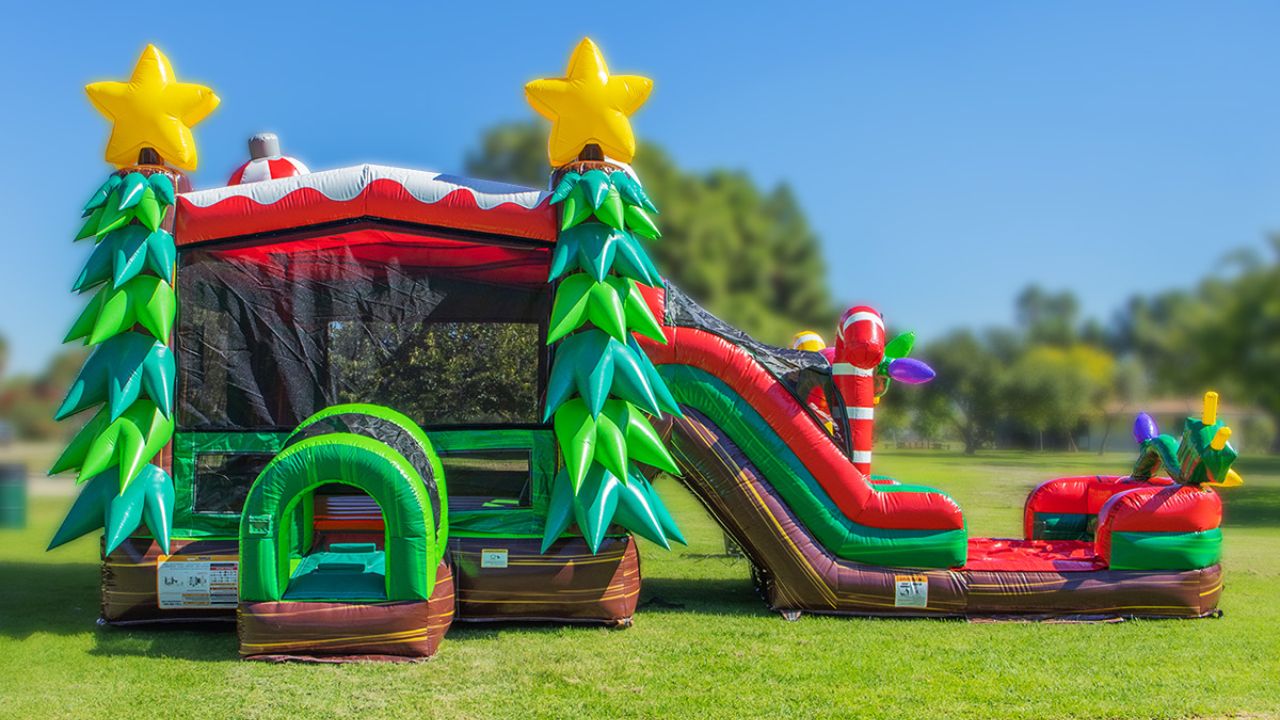
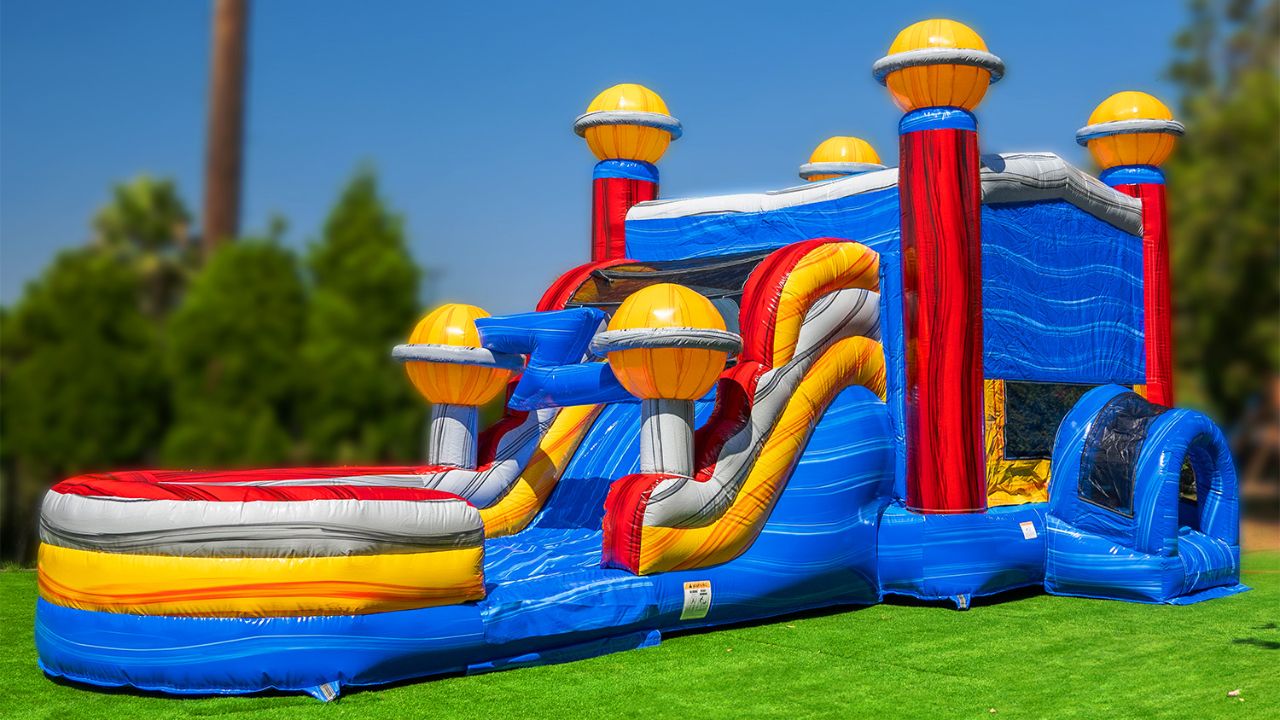
Standard bounce houses rent for $150-$250 per day and serve as entry-level options for smaller corporate gatherings. Large combo units with slides range from $255 to $495 and deliver enhanced guest engagement through multiple activity zones.
Corporate clients with substantial budgets often request premium obstacle courses that facilitate competitive team activities. Purchase costs for large obstacle courses reach up to $10,995, while commercial-grade bounce houses cost $1,395 to $2,995. Understanding these investment thresholds helps rental operators determine profitable inventory expansion strategies for corporate market penetration.
Key Features That Appeal to Corporate Clients
Safety compliance ranks as the top priority for 95% of corporate customers evaluating inflatable rental vendors. Reliability follows closely at 85%, reflecting corporate intolerance for equipment failures during scheduled events. These priorities stem from liability concerns and reputational risk associated with poorly executed company events.
Sustainability considerations influence 72% of corporate purchasing decisions as companies pursue environmental, social, and governance goals. Quality and aesthetics matter to 62% of clients, while 51% desire customization options for brand engagement. Corporate event planners increasingly view inflatables as brand marketing opportunities rather than generic entertainment.
How Inflatables Support Team Building Activities
Team-building events can yield 7.5x Return on Investment when properly designed and executed. Well-structured activities using inflatables drive measurable improvements in collaboration, communication, and interpersonal trust. Corporate decision-makers increasingly recognize experiential events as strategic investments rather than discretionary spending.
Well-designed team-building events drive 14% increase in team productivity across participating departments. Team-building events result in 45% decrease in employee turnover, delivering substantial cost savings. 40-ft inflatable obstacle courses in demand for corporate and school events create competitive scenarios that organically develop teamwork and problem-solving skills.
Who Decides and What Drives Corporate Inflatable Rentals?
Human Resources managers, corporate event planners, and department heads typically control budget allocation for company events. These decision-makers evaluate vendors based on reliability, safety compliance, and ability to deliver turnkey solutions. Understanding their priorities is essential for rental operators seeking long-term corporate contracts.
Budget authority often resides with HR departments for company-wide events or individual department heads for team-specific activities. Decision cycles for corporate bookings may span several months, particularly for annual events requiring advance planning. Rental businesses must align sales strategies with these extended timelines.
Corporate Decision-Makers and Their Roles
The average age of event planners is 37-38 years old, placing most decision-makers in the millennial generation. This demographic demonstrates a strong preference for digital tools and values vendor transparency throughout the planning process. Understanding generational communication preferences improves conversion rates when targeting corporate event planners.
76% of event planning professionals are over 30 years old, indicating a mature, experienced workforce. Ethnic diversity within US event planners shows 61.3% identify as White and 16.4% as Hispanic or Latino. These demographic insights inform marketing messaging and relationship-building approaches for rental operators pursuing corporate contracts.
Budget Considerations for Corporate Inflatable Rentals
Corporate events represent 29% of total rental spending, significantly outpacing individual consumer segments. The national average inflatable rental cost is $312 per day, though corporate bookings often exceed this baseline. Companies allocate larger budgets compared to schools or churches, creating opportunities for premium pricing on high-quality inventory.
Corporate budgets typically accommodate full-service solutions, including delivery, setup, teardown, and attendant staffing. These comprehensive packages reduce logistical burden on HR departments and event coordinators. Rental operators offering bundled services capture higher average order values while differentiating themselves from competitors focused solely on equipment provision.
Priorities and Preferences in Vendor Selection
Safety compliance remains paramount, with 95% of customers prioritizing this factor when evaluating rental vendors. Reliability follows at 85%, reflecting corporate clients' need for dependable execution on scheduled event dates. Sustainability considerations influence 72% of vendor selection decisions as corporate social responsibility initiatives expand.
Digital booking preference reaches 54% among corporate clients seeking streamlined procurement processes. Customization capability appeals to 51% of decision-makers looking to incorporate branding elements into event entertainment. The benefits of a bounce house for your company's portfolio extend beyond individual events to long-term client relationship development.
How Do Corporate Inflatables Compare with Other Institutional Markets?
Corporate clients demonstrate distinct characteristics compared to schools, churches, and individual consumers in purchasing behavior. Budget capacity, decision timelines, and quality expectations vary significantly across institutional market segments. Rental operators must adapt their service offerings and pricing strategies to match each segment's unique requirements.
Corporate events typically feature larger budgets and higher expectations for vendor professionalism and service quality. Schools and churches prioritize cost efficiency due to budget constraints and fundraising dependency.
Differences Between Corporate, School, and Church Inflatable Rentals
School budgets face significant constraints, relying heavily on fundraising efforts and PTA-allocated funds for event expenses. End-of-year field days and fall festivals represent primary school event types requiring inflatable entertainment. Churches organize vacation bible school kick-offs and community block parties as major annual events.
Corporate clients book inflatables for team building retreats, company picnics, and employee appreciation celebrations. Event scale for corporate bookings often exceeds school and church gatherings in both attendance and budget. These differences necessitate tailored pricing structures and service packages for each institutional segment.
Unique Safety and Compliance Requirements for Corporations
Corporate events face heightened liability scrutiny due to workers' compensation considerations and potential litigation exposure. Companies require vendors to provide comprehensive insurance certificates and ASTM F2374 compliance documentation. Failure to meet these standards typically disqualifies vendors from consideration, regardless of pricing competitiveness.
Risk management departments within larger corporations often review vendor contracts before event approval. Safe age ranges for inflatable obstacle course rentals must align with participant demographics at corporate events. Rental operators serving corporate markets must maintain impeccable safety records and proper documentation systems.
Event Types and Scale Differences Across Markets
Corporate events typically accommodate 100 to 500+ employees, requiring multiple inflatable units for adequate guest engagement. Schools usually host smaller gatherings of 50-200 students, depending on grade level and event scope. Churches may organize community festivals serving 200-1000 attendees, creating opportunities for large-scale rental packages.
Event duration varies significantly, with corporate team building sessions lasting 4-6 hours versus full-day school carnivals. Budget allocation per attendee is substantially higher for corporate events compared to volunteer-run school fundraisers.
What Safety Standards Must Corporate Inflatable Rentals Meet?
ASTM F2374 establishes the industry standard for commercial inflatable design, manufacture, operation, and maintenance requirements. This comprehensive specification applies exclusively to commercial-use inflatables, distinguishing professional rental equipment from residential consumer products. Corporate clients typically mandate ASTM F2374 compliance as a non-negotiable vendor requirement.
Compliance verification protects rental operators from liability claims and builds customer confidence in equipment safety. Bounce house insurance requirements, coverage limits, and costs directly correlate with safety standard adherence. Operators maintaining rigorous compliance protocols have access to premium corporate markets unavailable to competitors lacking proper certifications.
Overview of ASTM F2374 Compliance
ASTM F2374 defines the Standard Practice for Design, Manufacture, Operation, and Maintenance of Inflatable Amusement Devices. This specification applies only to commercial-use inflatables, excluding residential toy-grade products covered under separate standards. Compliance encompasses structural integrity, material strength, anchoring systems, and operational protocols.
Manufacturers must demonstrate adherence through design documentation, material testing, and quality control processes. Rental operators bear responsibility for proper maintenance, inspection schedules, and operator training aligned with standard requirements. Corporate clients increasingly request compliance certificates before finalizing rental agreements.
Insurance and Liability Requirements
Liability concerns require comprehensive insurance coverage for rental operators serving corporate markets. Corporate risk management departments typically specify minimum coverage limits before approving vendor contracts. Standard general liability policies may prove insufficient for large-scale corporate events requiring specialized coverage provisions.
Insurance carriers assess premium rates based on safety compliance, maintenance records, and operator training documentation. Rental businesses demonstrating ASTM F2374 adherence often qualify for favorable underwriting terms and lower premiums.
Best Practices for Operations and Maintenance
Operational training requirements for staff and attendants are mandatory under ASTM F2374 compliance protocols. Properly trained personnel recognize weather hazards, conduct pre-use inspections, and enforce capacity limits during operation. Training investments reduce accident frequency and demonstrate vendor professionalism to corporate clients.
Inflatables face limitations to 15-25 mph sustained wind speeds to prevent structural failure and participant injury. Maintenance costs consume approximately 30% of operational budgets, while equipment damage rates hover around 22%. Regular inspection schedules and preventive maintenance programs minimize downtime and extend equipment lifespan.
How Is Pricing Structured for Corporate Event Inflatables?
Pricing structures for corporate inflatable rentals reflect equipment quality, event scale, and service comprehensiveness. The national average inflatable rental cost is $312 per day, with corporate bookings frequently exceeding this baseline. Understanding cost components helps rental operators develop competitive yet profitable pricing strategies.
Corporate clients demonstrate willingness to pay premium rates for superior equipment quality and full-service solutions. Pricing strategy for renting a 40-ft obstacle course requires analyzing market positioning and competitor offerings.
Typical Rental Costs and Pricing Tiers
The national average inflatable rental cost is $312 per day across all market segments and equipment types. Inflatable rental ranges from $240 to $406, depending on the size and complexity of the unit. Standard bounce houses in Texas and North Carolina rent for $150-$250 per day for basic entertainment needs.
Large combo units with slides range from $255 to $495, delivering enhanced value through multiple activity zones. Premium obstacle courses command higher rates justified by superior guest engagement and team-building applications. Corporate clients typically select mid-range to premium equipment tiers rather than budget options.
Hidden Costs Including Delivery and Labor
Delivery fees range from $20-$150 based on distance from the warehouse to the event location. Setup and teardown labor costs $50-$200+ depending on equipment complexity and crew size requirements. These ancillary charges significantly impact total event cost and must be clearly communicated during the sales process.
Additional expenses may include damage waivers, overnight rentals, and attendant staffing for supervised operation. Corporate clients generally accept these costs when positioned as value-added services rather than unexpected fees.
Return on Investment Considerations for Corporations
Team-building events can yield 7.5x Return on Investment through productivity gains and turnover reduction. Corporate decision-makers increasingly evaluate event expenses against measurable business outcomes rather than viewing entertainment as discretionary spending. Rental operators articulating ROI potential differentiate their offerings from competitors focused solely on equipment features.
Quantifying benefits in terms of employee engagement scores, retention rates, and productivity metrics resonates with data-driven corporate buyers. Inflatables facilitating team building activities deliver measurable value exceeding their rental cost.
What Strategies Help Win Corporate Inflatable Contracts?
Securing corporate contracts requires understanding decision-maker priorities and delivering solutions addressing their specific pain points. Reliability, safety compliance, and service comprehensiveness rank higher than price for most corporate buyers. Rental operators must position themselves as strategic partners rather than transactional vendors.
Long-term relationship development with corporate clients creates recurring revenue streams and higher lifetime customer value. Seasonal booking strategy filling your calendar during slow months through corporate events, stabilizes cash flow.
Offering Full-Service Solutions for Ease of Use
Corporate event planners and HR managers prioritize full-service solutions, minimizing their logistical involvement. Vendors handling delivery, setup, operation, and teardown eliminate coordination burdens for busy corporate staff. This comprehensive approach justifies premium pricing while increasing customer satisfaction and referral likelihood.
Full-service packages should include trained attendants supervising equipment operation throughout the event duration. Corporate clients value vendor accountability for safety compliance and proper equipment function.
Leveraging Digital Tools and Online Booking Systems
54% of customers prefer digital booking platforms over traditional phone-based reservation systems. Corporate event planners accustomed to streamlined procurement processes expect intuitive online interfaces for browsing inventory and completing transactions. Digital tools reduce friction in the sales process and accommodate millennial buyer preferences.
54% of global rental activity now occurs digitally, reflecting industry-wide transformation in customer engagement. Online booking systems with real-time availability, transparent pricing, and instant confirmation improve conversion rates.
Building Long-Term Vendor Partnerships
Establishing long-term partnerships with multi-event contracts creates predictable revenue and reduces customer acquisition costs. Corporate clients hosting annual company picnics, quarterly team building sessions, and seasonal celebrations represent substantial lifetime value. Account management strategies should emphasize relationship development beyond individual transactions.
Multi-year agreements with preferred vendor status insulate rental operators from price-based competition. Corporate procurement departments value vendor consistency and relationship history over marginal cost savings.
How Do Corporate Event Inflatables Impact Employee Engagement?
Corporate event inflatables serve as catalysts for employee engagement, team cohesion, and workplace culture development. Companies investing in experiential events demonstrate commitment to employee well-being beyond compensation and benefits. These investments yield measurable returns through improved retention, productivity, and organizational loyalty.
Experiential team building activities create shared memories and strengthen interpersonal relationships among coworkers. Inflatables provide low-stakes competitive environments where employees interact outside formal workplace hierarchies.
Linking Team Building ROI to Inflatable Usage
Team-building events can yield 7.5x Return on Investment when designed to address specific organizational challenges. Inflatable obstacle courses and competitive activities naturally foster collaboration, communication, and mutual support among participants. Corporate decision-makers increasingly recognize these events as strategic interventions rather than discretionary entertainment expenses.
ROI calculation encompasses reduced turnover costs, productivity improvements, and enhanced employee satisfaction scores. Rental operators articulating these benefits position inflatables as business solutions rather than simple entertainment.
Enhancing Workplace Culture Through Events
Well-designed team-building events drive 14% increase in team productivity across participating departments. Improved workplace culture manifests through enhanced communication, increased trust, and stronger collaborative behaviors. Company picnic inflatables create informal environments where employees build relationships, transcending departmental boundaries.
Shared experiential activities generate positive associations with the employer brand and strengthen organizational commitment. Corporate event planners recognize culture-building as a strategic priority for talent retention and recruitment.
Measuring Success and Productivity Gains
Team-building events result in 45% decrease in employee turnover when integrated into comprehensive engagement strategies. Retention improvements deliver substantial cost savings through reduced recruitment, onboarding, and training expenses. Corporate HR departments increasingly track event impact through pre- and post-event engagement surveys.
Productivity gains from improved team cohesion compound over time as collaborative behaviors become embedded in organizational culture. Quantifying these benefits requires tracking metrics, including project completion rates, cross-functional collaboration frequency, and employee satisfaction scores.
Corporate Event Inflatables: Integrating Market Insights for Growth and Sustainability
The global party supply and event rental market reached USD 16.76 billion in 2024 and continues expanding rapidly. Market projections indicate growth to USD 32.03 billion by 2030, representing an 11.4% CAGR. The bounce house and inflatable rental submarket, valued at USD 4.0 billion in 2024, will grow to USD 5.62 billion by 2028.
Corporate inflatable rentals represent a strategic growth opportunity within this expanding market landscape. Rental operators positioning themselves for corporate market penetration must invest in commercial-grade equipment, safety compliance, and professional service delivery. Understanding corporate decision-maker priorities and demonstrating measurable ROI differentiates successful vendors in this competitive segment.
The corporate event market rewards rental operators delivering reliability, safety, and comprehensive service solutions. Companies seek vendors capable of executing flawless events that strengthen employee engagement and workplace culture. Inflatables facilitating team building activities generate measurable business outcomes, justifying premium pricing and long-term vendor relationships.
Rental businesses targeting corporate clients must align operational capabilities with corporate expectations for professionalism and accountability. Investment in digital booking systems, safety certifications, and full-service delivery models positions operators for sustainable growth. The expanding corporate event market offers substantial revenue potential for rental operators willing to meet elevated service standards.
Strategic rental operators like JumpOrange understand that corporate market success requires more than quality equipment. Building lasting partnerships with corporate clients demands consistent excellence, transparent communication, and measurable value delivery. Operators embracing these principles capture disproportionate market share within the high-value corporate segment.
Ready to Land Your First Corporate Client?
JumpOrange commercial-grade inflatables and durable bounce house combos meet ASTM F2374 standards, carry the documentation corporate risk managers require, and arrive fully set up -- so your client's HR team has nothing to worry about. Whether you're building a full-service corporate package or expanding your fleet to handle 500-person company picnics, the JEM Club gives you the pricing, support, and inventory access to compete for these high-value contracts. Shop corporate-ready inflatables at JumpOrange today!


Leave a comment
This site is protected by hCaptcha and the hCaptcha Privacy Policy and Terms of Service apply.